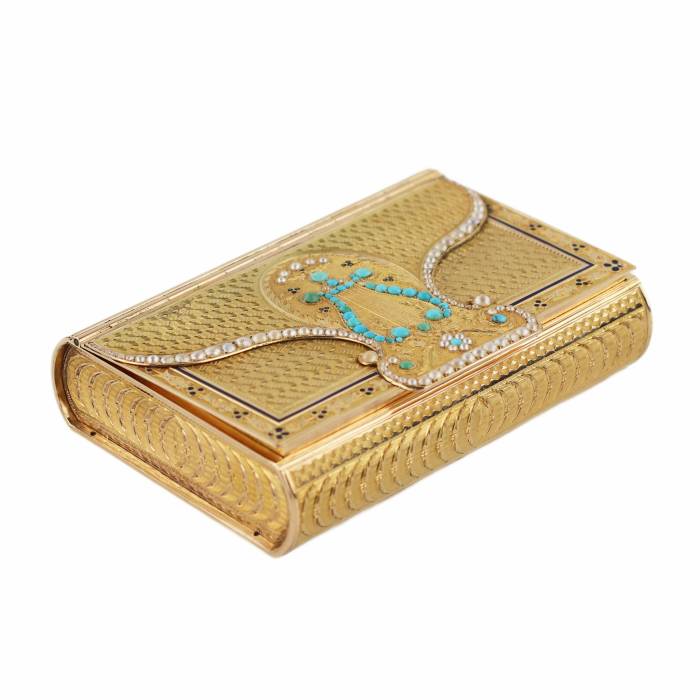
GOLD MUSICAL SNUFF BOX WITH LYRE, JEAN-GEORGE RÉMOND & CO GENEVA, SWITZERLAND, CIRCA 1804–1812
AntiqonART consultant will contact you within one business day after receiving your request.
Discover how the value of similar works has evolved over the past 10 years. Art is not only beauty — it's an investment.
Discover how the value of similar works has evolved over the past 10 years. Art is not only beauty — it's an investment.
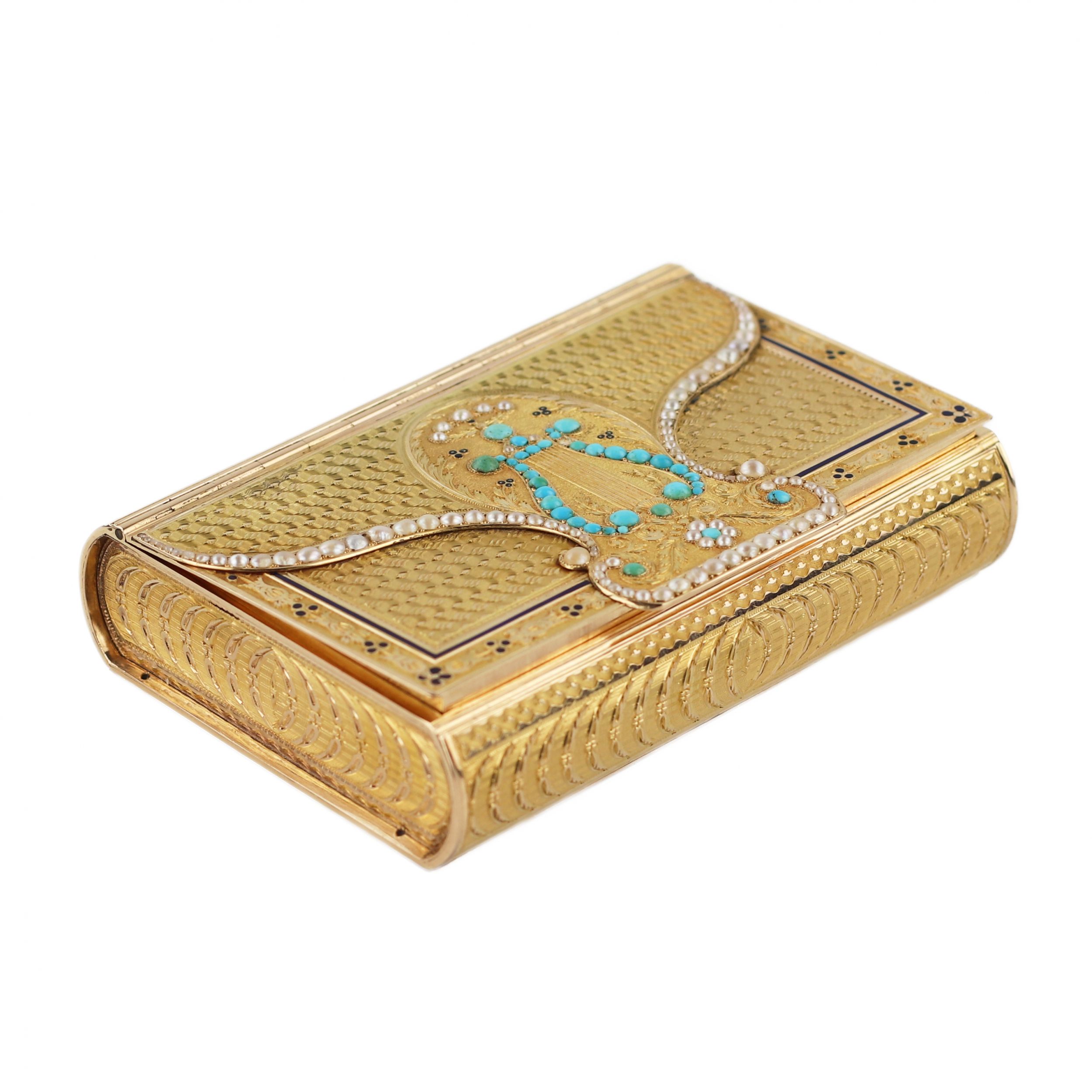
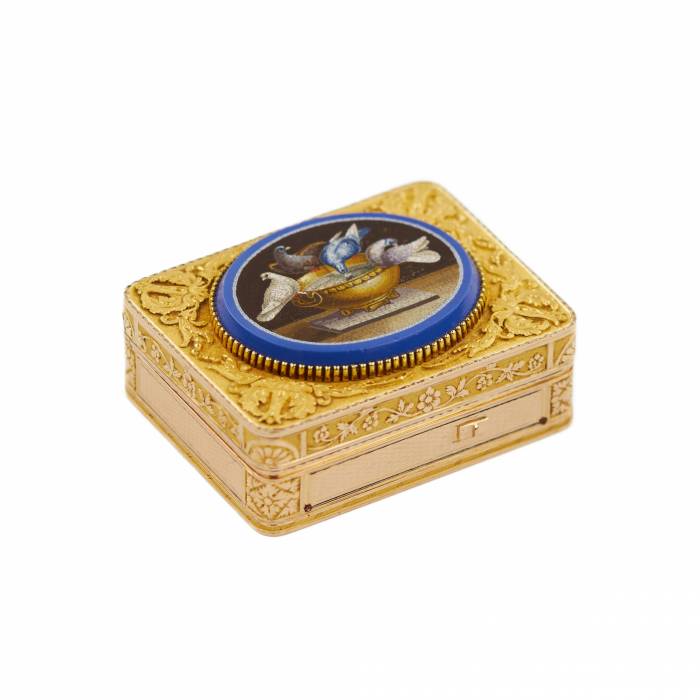
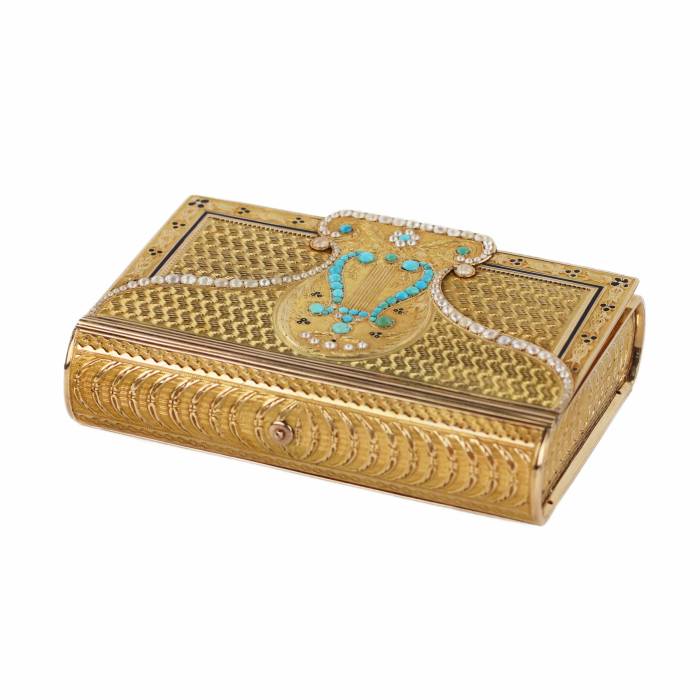
An exceptional rectangular gold musical snuff box created in Geneva by the renowned workshop Jean-George Rémond & Co during the golden age of Swiss jewellery and mechanical craftsmanship of the early nineteenth century. The case is made of gold and entirely covered with fine engine-turned guilloché, creating a lively, rhythmically vibrating surface characteristic of the finest Genevan luxury objects of the Late Neoclassical and Early Empire period.
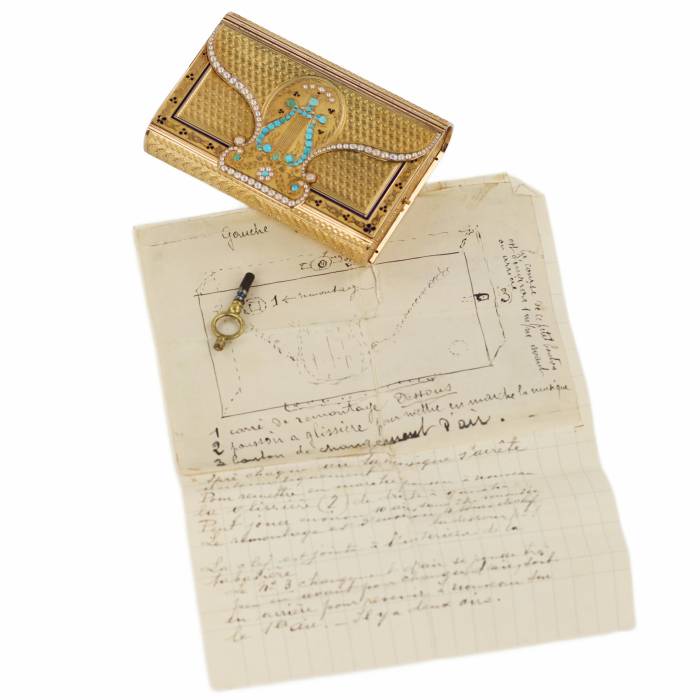
The borders are decorated with refined friezes of floral ornament filled with transparent deep blue enamel. The hinged lid is richly adorned with a central composition featuring a lyre, the classical symbol of harmony, art and poetry. The lyre is set with bright turquoise stones and framed by half-pearls forming elegant flowing lines that visually echo musical rhythm. The ornamental composition demonstrates remarkable balance and reflects the high artistic standards of Jean-George Rémond’s workshop.
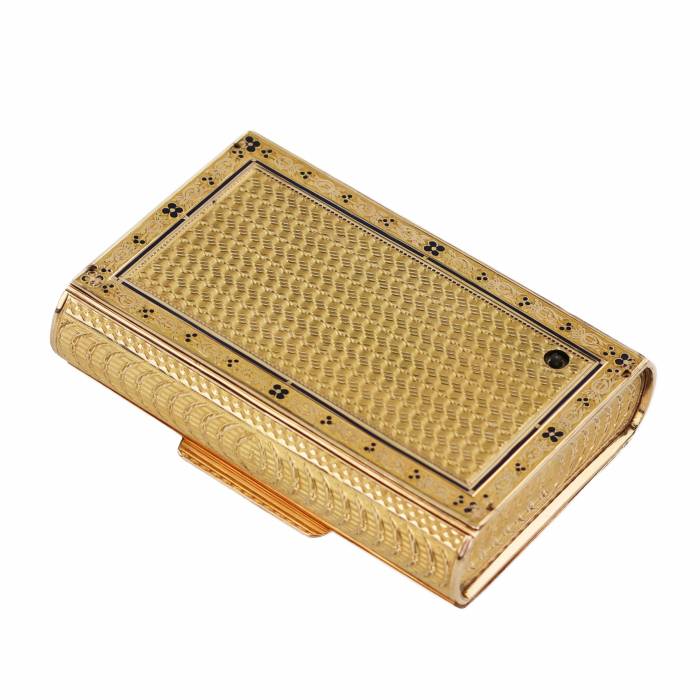
The reverse side is decorated with a guilloché field framed by a vegetal border enriched with blue enamel. The winding key aperture is discreetly positioned in the corner. The softly rounded sides are embellished with repeating ornamental motifs, reinforcing the coherence and completeness of the design.
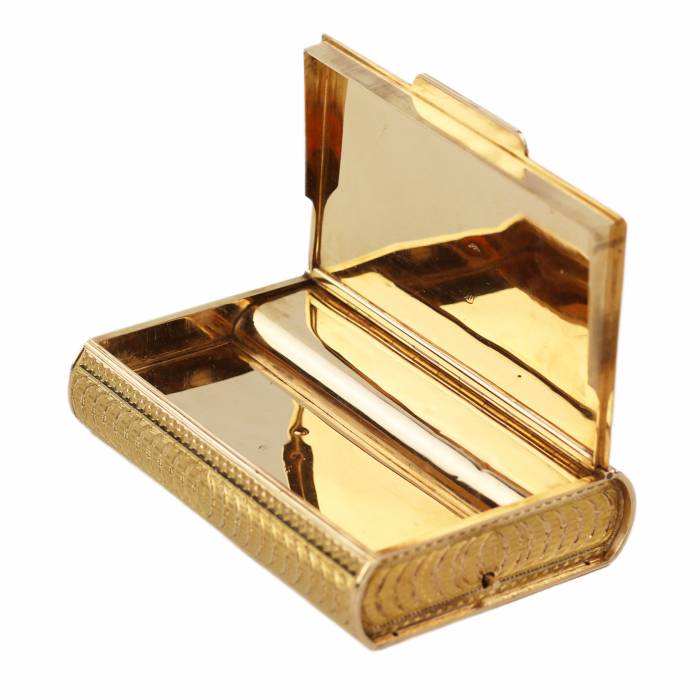
Inside is housed a high-quality musical mechanism, presumably produced by the masters Piguet & Meylan, capable of playing two musical airs selected via a side slide. The mechanism is finely executed and typical of the finest examples of Genevan micro-mechanics of the early nineteenth century. The original winding key is present. Of particular historical importance is the survival of the original design drawing of the box, a rare documentary testament to the collaboration between Genevan jewellers and mechanicians of the period.
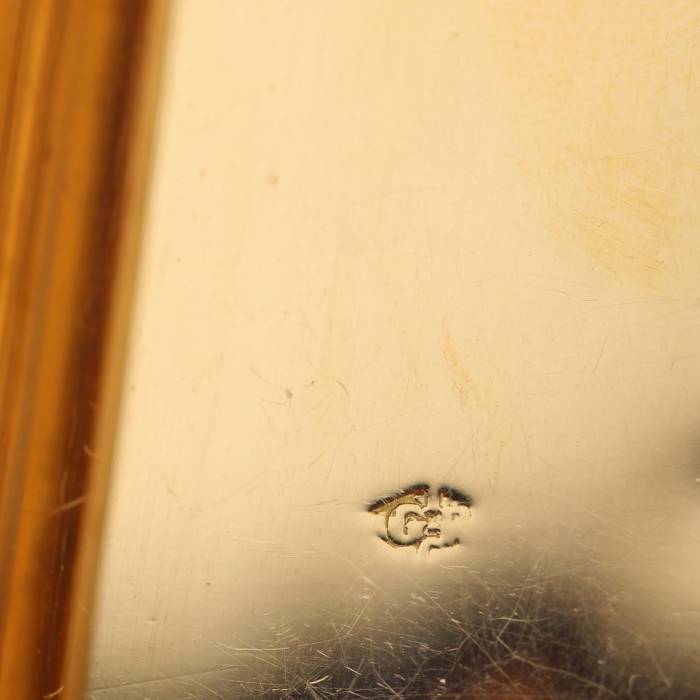
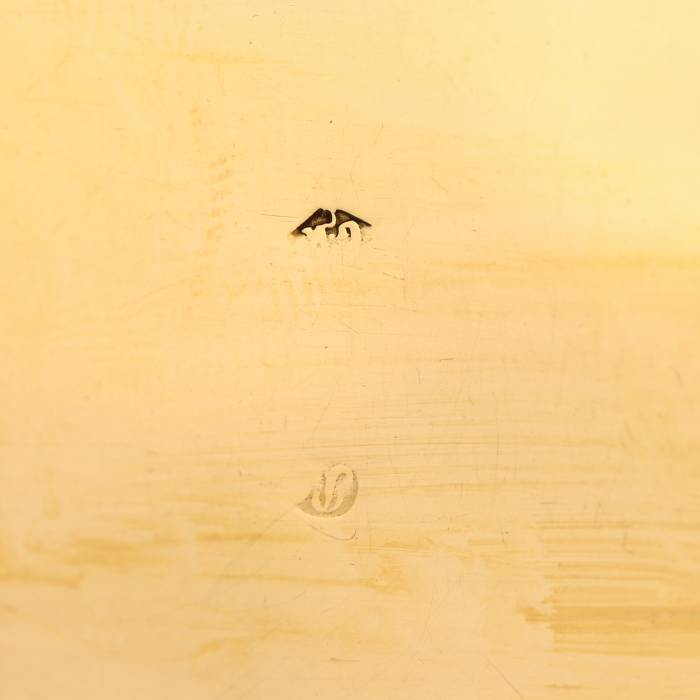
Marks: Maker’s mark of Jean-George Rémond & Co, Geneva, circa 1804–1812.
Dimensions: 8.5 × 5.0 × 1.8 cm.
Weight: 220 g.
Condition: Very good. The case shows no deformation; the guilloché is crisp and even; enamel, turquoise stones and half-pearls are intact. The musical mechanism has undergone professional servicing and is fully functional.
Provenance: Private European collection.
Musical snuff boxes of the late eighteenth and early nineteenth centuries occupy a distinctive position in the history of decorative arts and the development of micro-mechanics. During this period Geneva emerged as one of Europe’s leading centres for luxury objects combining jewellery, enamelling and sophisticated mechanical systems. Such pieces were commissioned for aristocratic and wealthy clientele and served not only as personal accessories but also as symbols of refinement, status and technological progress.
Jean-George Rémond (1752–1830) was a key figure of the Genevan jewellery tradition. His firm, Jean-George Rémond & Co, active from 1783 until around 1820, specialised in snuff boxes, musical boxes, singing bird automatons, form watches and complex jewelled objects. Operating between Geneva and Hanau, the company achieved an international reputation for exceptional quality and artistic excellence.
The musical mechanisms for such objects were often entrusted to leading specialists. Among the most prominent were Isaac-Daniel Piguet and Philippe-Samuel Meylan, whose workshops produced ultra-thin and highly precise mechanisms celebrated for their clarity of sound and reliability. Their work represents a crucial stage in the evolution of musical automata and contributed significantly to Geneva’s reputation as a centre of mechanical innovation.
The lyre motif reflects the era’s fascination with classical antiquity and allegorical symbolism associated with harmony and the arts. Such imagery was widely employed in Neoclassical and Early Empire jewellery and is well represented in museum and private collections. Taken together, the artistic refinement, excellent preservation, functional mechanism and surviving design drawing make this snuff box a rare and distinguished example of early nineteenth-century Swiss jewelled musical objects.
Overall condition is very good. The case and decorative elements are well preserved without losses or deformation. Guilloché remains sharp; enamel and settings are intact. The musical mechanism has been professionally serviced and functions reliably with clear sound.
The condition report is provided for informational purposes only.
It is not comprehensive and may not reflect all defects, restorations, alterations, or adaptations, as Antiqon does not perform professional conservation-level assessments. The information is based on a qualified, yet subjective, evaluation by our specialists.Before purchasing, we recommend consultation with an independent expert.Please also consult our Terms and conditions and Glossary A-Z, which contain important information on lot characteristics and sale conditions.