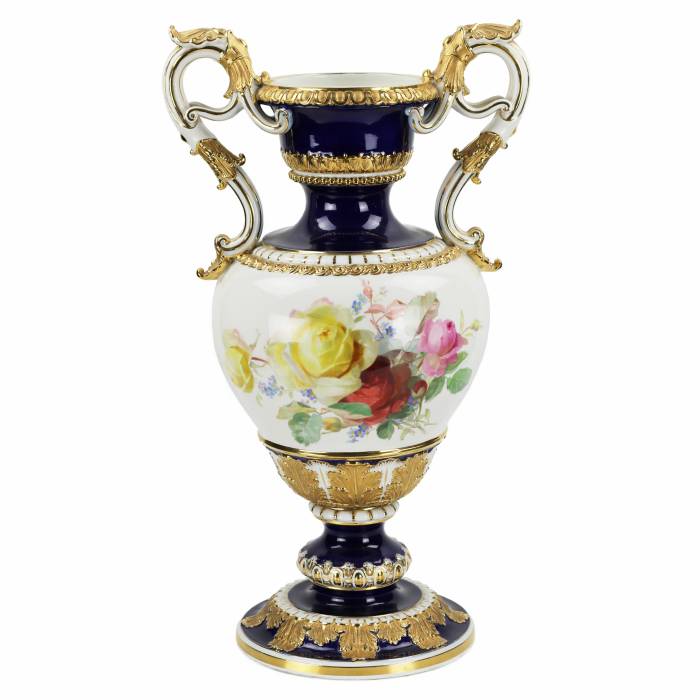

GRAND VASE DE SALON À BOUQUETS FLORAUX. ERNST AUGUST LEUTERITZ ALLEMAGNE, MEISSEN, SECONDE MOITIÉ DU XIXᵉ SIÈCLE

GRAND VASE DE SALON À BOUQUETS FLORAUX. ERNST AUGUST LEUTERITZ ALLEMAGNE, MEISSEN, SECONDE MOITIÉ DU XIXᵉ SIÈCLE

ID-ANTQ-11572
6500 EUR
Add to cart
Request more info
Guarantee of Authenticity

At Antiqon ART, we build trust and value your choice. Every purchase of art and antiques with us is an investment backed by our expertise, reputation, and a 100% authenticity guarantee.

Price History

Discover how the value of similar works has evolved over the past 10 years. Art is not only beauty — it's an investment.

Complimentary Shipping & Returns

Antiqon ART offers free packaging, insurance, and delivery for most items purchased through the company. Exceptions include large and oversized items that require specialized packing and shipping.

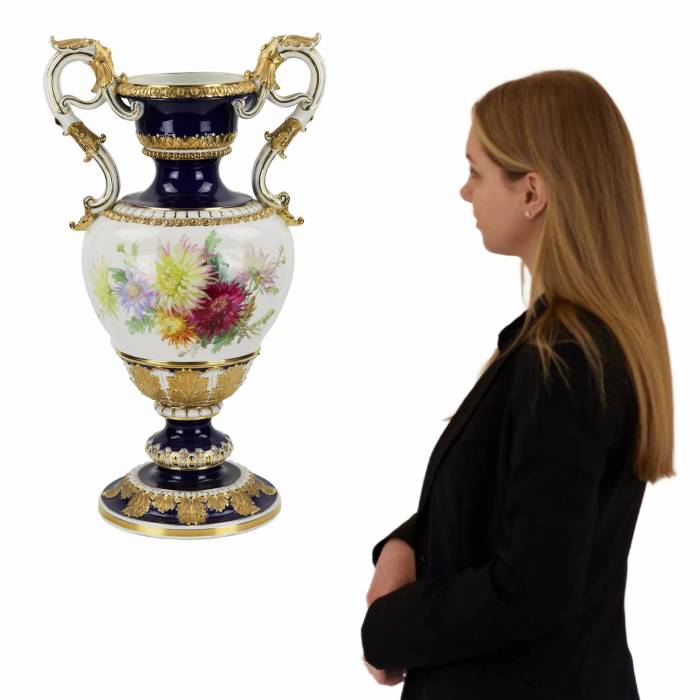
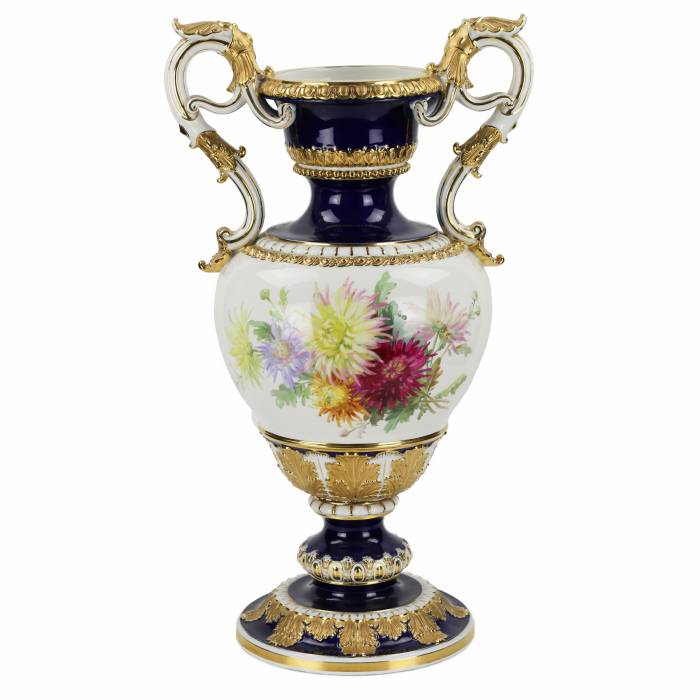
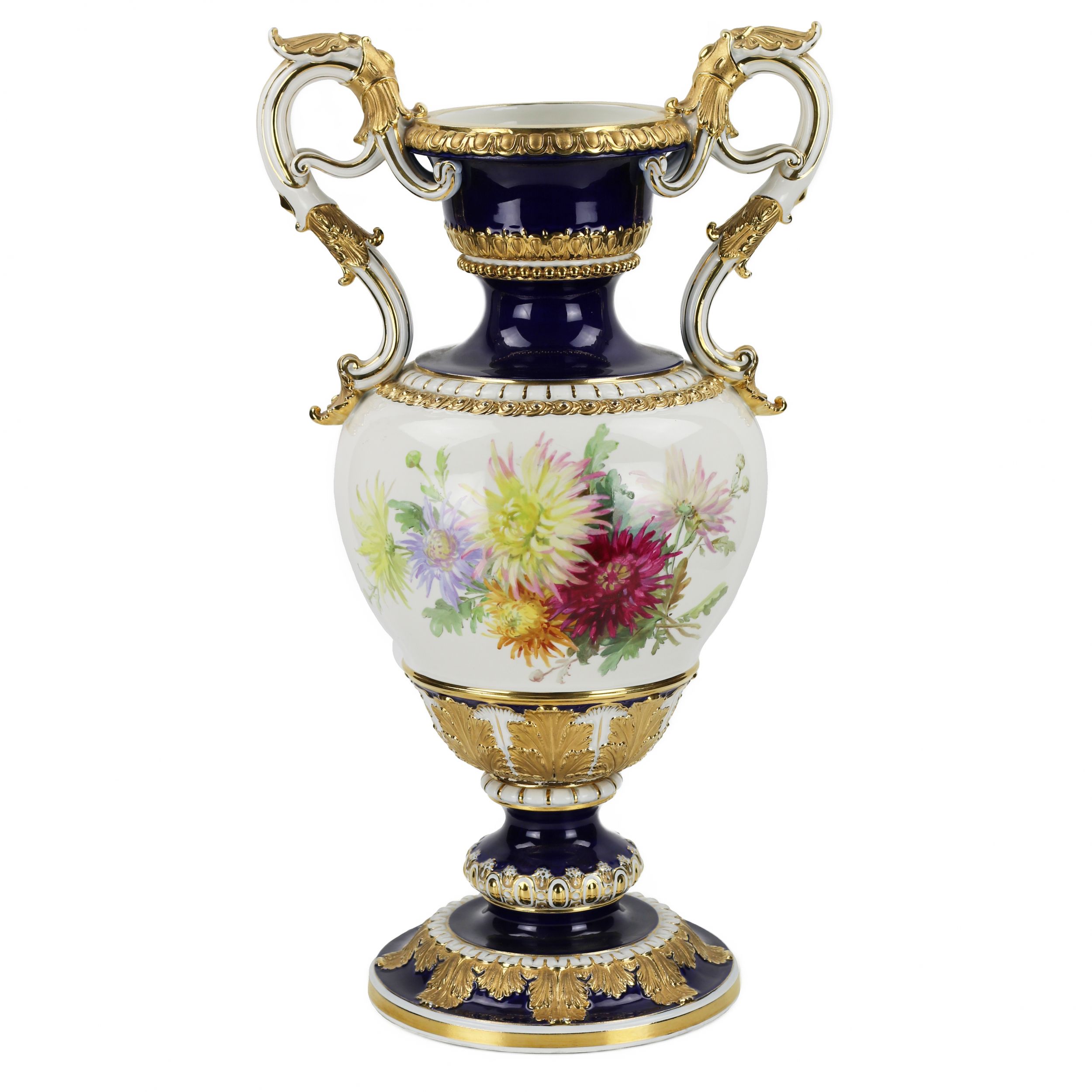
Grand vase de salon de niveau muséal, réalisé à la manufacture de porcelaine de Meissen d’après un modèle du sculpteur et modeleur de premier plan Ernst August Leuteritz. La forme monumentale, inspirée des traditions néo-Renaissance et néo-baroques, se présente comme une balustre élancée reposant sur un pied circulaire profilé à large base.

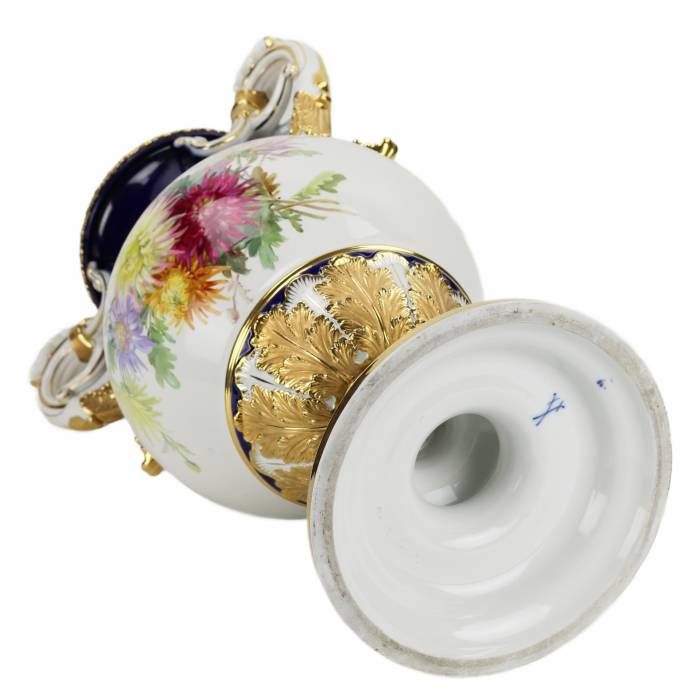
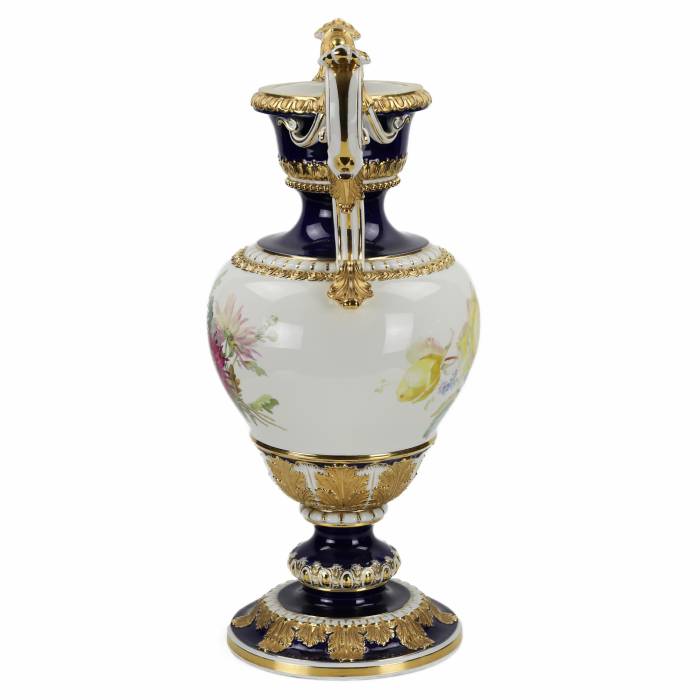
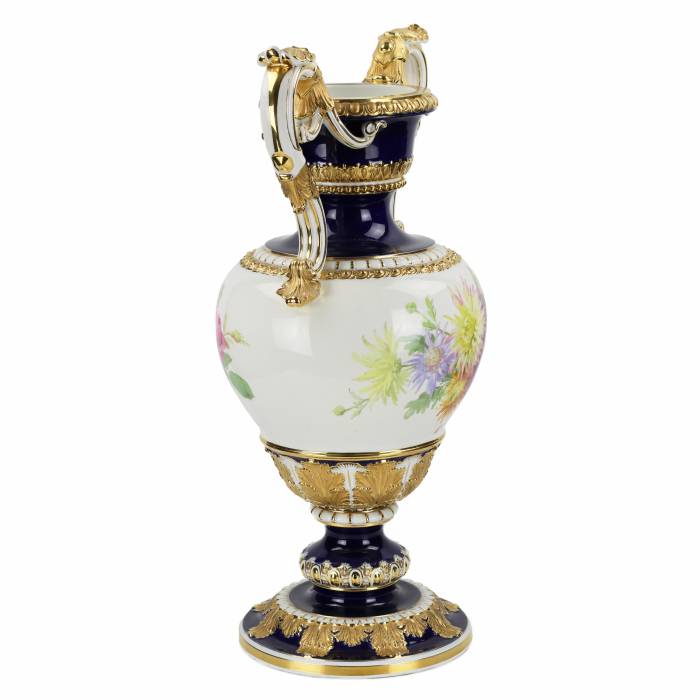
Le vase est composé de deux parties et se distingue par une silhouette architecturale affirmée. Le col élevé, doté d’un large bord, est orné d’un frise décorative et d’une moulure perlée sculptée. Deux anses puissantes en volutes, enrichies d’applications dorées, instaurent un rythme solennel et parfaitement symétrique. La partie inférieure du corps et le socle sont décorés de feuilles d’acanthe en relief, finement modelées et généreusement rehaussées d’or.

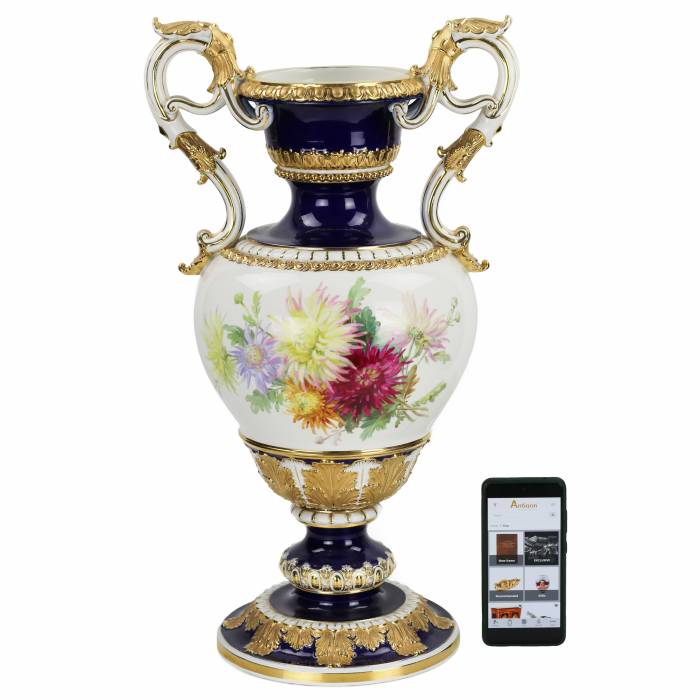
Le fond du vase est couvert d’une intense glaçure bleu cobalt, caractéristique des pièces de prestige de Meissen au XIXᵉ siècle. Les réserves centrales présentent une peinture polychrome sur émail figurant de luxuriants bouquets de roses et de chrysanthèmes, exécutés avec une grande maîtrise picturale. La composition se distingue par la subtilité des dégradés chromatiques, la finesse du modelé floral et l’harmonie générale des couleurs. Une riche dorure vient parachever l’ensemble et accentuer le caractère cérémoniel de l’œuvre.

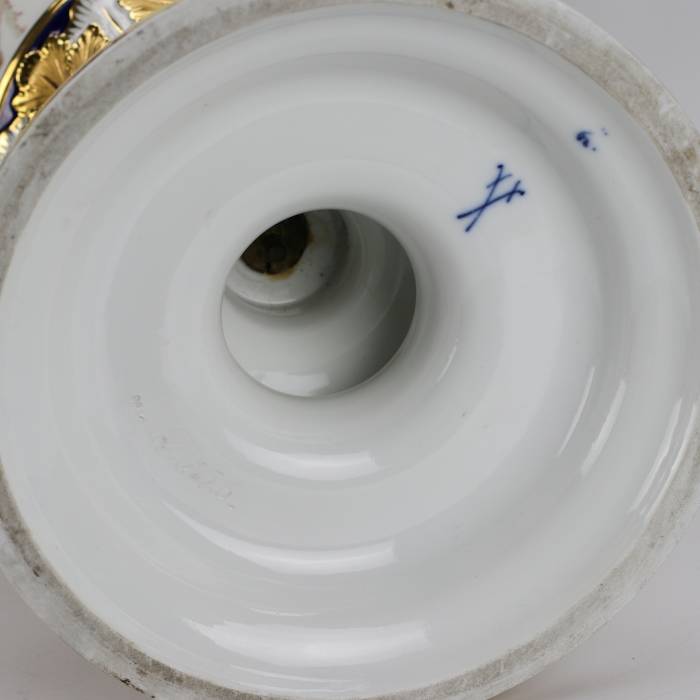
Marques: Marque aux épées croisées de Meissen en bleu sous glaçure; marque de première qualité.

Dimensions: Hauteur: 60 cm. Largeur: 35 cm. Profondeur: 35 cm.

Matériau: Porcelaine. Peinture sous glaçure et sur émail. Glaçure cobalt. Dorure.

État: Bon état. Légères traces du temps conformes à l’âge. Aucun éclat ni fissure. Dorure bien conservée.

Art:
europe
Hauteur:
60 cm
Largeur:
35 cm
Épaisseur:
35 cm
Période:
19Ème Siècle
Style:
Classicisme
Pays:
Allemagne
Matière:
Porcelaine, Peints À La Main, Dorure
État:
Revive
Fair
Good
Very good
Like new

Ernst August Leuteritz occupe une place essentielle dans l’histoire de la manufacture de Meissen en tant que l’un des principaux sculpteurs et créateurs de modèles de la seconde moitié du XIXᵉ siècle. Son œuvre s’inscrit dans une période de redécouverte et de réinterprétation des styles historiques, durant laquelle Meissen cherchait à affirmer son statut de centre artistique majeur au sein des arts décoratifs européens.

Les grandes vases de salon, destinés aux intérieurs représentatifs des résidences aristocratiques et des salons urbains, occupaient alors une place centrale dans la production de la manufacture. Le fond cobalt richement doré renvoie consciemment aux traditions du XVIIIᵉ siècle, tandis que l’interprétation du XIXᵉ siècle se caractérise par une monumentalité accrue et une somptuosité décorative renforcée. Les modèles de Leuteritz sont largement documentés dans la littérature spécialisée et figurent dans de nombreuses collections muséales européennes.

Le vase est en bon état général. Aucune altération structurelle observée. Légères marques d’usure de surface liées à l’âge. Décor peint vif et dorure bien préservée.

The condition report is provided for informational purposes only.

It is not comprehensive and may not reflect all defects, restorations, alterations, or adaptations, as Antiqon does not perform professional conservation-level assessments. The information is based on a qualified, yet subjective, evaluation by our specialists.Before purchasing, we recommend consultation with an independent expert.Please also consult our Terms and conditions and Glossary A-Z, which contain important information on lot characteristics and sale conditions.

Meissen
The first porcelain manufactory in Europe, Meissen, was founded in 1710, shortly after the discovery of the secret of making hard porcelain in Saxony by the alchemist Johann Friedrich Boettger (1682-1719) in collaboration with the scientist Ehrenfried Walter von Chirnhaus (1651-1708). factories, in 1704 it was entrusted to control the activities of Böttger - by decree of the ruler of Saxony August the Strong, he was kept as a prisoner in Meissen. Augustus the Strong instructed Boettger to get gold, but these experiments were not crowned with success. The ruler allowed Böttger to open a workshop for the production of hard porcelain. After two years of joint work with Chirnauz, in 1709, he discovered its composition. Hard porcelain is similar in its characteristics to Chinese porcelain, its main components are kaolin (porcelain clay) and Chinese stone (a type of feldspar), later feldspar was used. Around 1740, traditional Chinese and Japanese decorations were replaced by "German flowers". In addition, the so-called underglaze blue onion model has entered the market.Figurative sculpture had a large share in the production program of the manufactory. Already under August the Strong, in addition to the extensive production of ceremonial and decorative tableware for the needs of the Dresden court, miniatures and ceremonial figures were created for representative and decorative purposes. Even before 1731, fashion designer Johann Gottlieb Kirchner became famous for his large white animal figures. Subsequently, his colleague and successor Johann Joachim Kendler determined not only the development of figural sculpture in Meissen but also for porcelain in general.The Royal Porcelain Manufactory experienced a subsequent heyday from 1774 to 1814 under the direction of Count Camillo Marcolini. Small sculptures with colorful sculptures created by the French sculptor and master model of the Michel Victor Asier (1736–1799) and his colleague Johann Karl Schönheit (1730–1805) are well known. In addition, biscuit figurines were made. The period of classicism began to decline even before the end of the 18th century, culminating in the copying of the forms of the old eras. Bergrath Karl Wilhelm von Oppel succeeded Marcolini, who headed the factory until 1833. He made the necessary changes in the artistic, technical and commercial fields. The main contribution to these fundamental technical and technological improvements comes from Heinrich Gottlieb Kühn, who was assigned to the plant in 1814. The latter introduced the round oven and invented the "glittering gold". In 1848 Kuhn became director of the company. In the mid-19th century, numerous forms and decorations were influenced by renowned members of the Dresden Academy of Arts such as Gottfried Semper, Ernst Ritchell, Julius Schnorr von Karolsfeld. The Porcelain Academy was the epitome of the highest level of craftsmanship at the time. During the Art Nouveau era, the factory was developed by architects Richard Riemerschmid, Henri van de Velde. Artists: Otto Voigt, Joseph Olbrich, Arthur Julius Barth and Friedrich Ofelmann.After World War I and the November Revolution, Max Adolf Pfeiffer took over the overall management of the company from 1919. The artistic development of the lineup was his particular concern. Soon after he joined the management of the manufactory he hired the painter, illustrator and sculptor Paul Scheirich, who led Meissen′s sculpture to new achievements. Other artists working at Meißen were Max Esser, Ernst Barlach and Gerhard Marx. Emil Paul Berner designed simple and elegant tableware and decorations, which were the model for many porcelain factories.After the end of World War II, in the spring of 1946, the Meissen manufactory started working again. It became known as "VEB Staatliche Porzellan-Manufaktur Meißen". In 1950 Waldemar Wustenmann became the director of the manufacture. Since 1953, a separate department "Artistic wall design" has been created at the manufactory. Until now, there have been many frescoes made from Meissen porcelain. Made for interior decoration of buildings with different motives and manufacturing technologies. In the years that followed, the manufacture experienced a rapid rise and became the eighth strongest provider of foreign exchange in the GDR. In 1969 Karl Petermann was named director. He introduced an almost completely automatic production method that turned former luxury goods into mass commodities for everyone.The manufacture followed a traditional production program, but from the 1960s it tried to use new forms of expression. The department "Artistic development" was created. The most important new creation has been achieved by Ludwig Zepner with the Bolshoi Plot service ensemble. Among the artistic decorations were the subtle underglaze decorations by Heinz Werner "Orchid with a branch in blue" and the overglaze decorations "Almond Trees", "1001 Nights" and "Flower Flowers" by Heinz Werner and Rudy Stoll.
... Read More

Stay up to date with new arrivals
Save Porcelaine Européenne and we let you know when new listings appears in this category
Sauvegarder

Related items