Price:
1000 €
Add to cart
Porcelain is a high-quality ceramic material with a dense, fine-grained and partially translucent structure, first created in China and becoming one of the key materials of European decorative arts from the 18th century onward. It is used in tableware, sculpture, and interior vases.
We will only share latest what our month on the PORCELAIN.
ORIGIN AND DEVELOPMENT
Porcelain originated in China during the Tang dynasty and reached technological perfection in the Song and Ming periods, when standards of composition and firing were established, defining its classical formula. Its composition based on kaolin, quartz and feldspar ensured high strength, characteristic whiteness and slight translucency. The production center was Jingdezhen, where a system of imperial workshops with strict quality control and specialized labor was formed. From the 16th century porcelain reached Europe through trade, remaining an object of diplomatic exchange, collecting and a symbol of high social status. Numerous European courts attempted to uncover its technological secret. In 1708, the formula for hard-paste porcelain was discovered in Saxony, leading to the foundation of the first European manufactory in Meissen and marking the beginning of an independent European tradition. In the 18th century production spread to France, Austria, Russia and Italy, forming national schools, court styles and distinct technological variations.
TECHNICAL CHARACTERISTICS
Classical hard-paste porcelain consists of kaolin, quartz and feldspar, the proportions of which influence plasticity, translucency and shrinkage during firing. Firing at approximately 1350-1450°C ensures complete vitrification of the body and the formation of a dense, resonant structure with low porosity. Hard-paste, soft-paste and bone china are distinguished by differences in composition, firing temperature and visual qualities. The material is characterized by high mechanical strength, resistance to chemical influence and the ability to preserve delicate relief details after firing. It allows slip casting in plaster molds, hand modeling and wheel forming. The surface may be glazed or left as biscuit, with a matte texture emphasizing sculptural modeling.
AESTHETIC AND ARTISTIC FEATURES
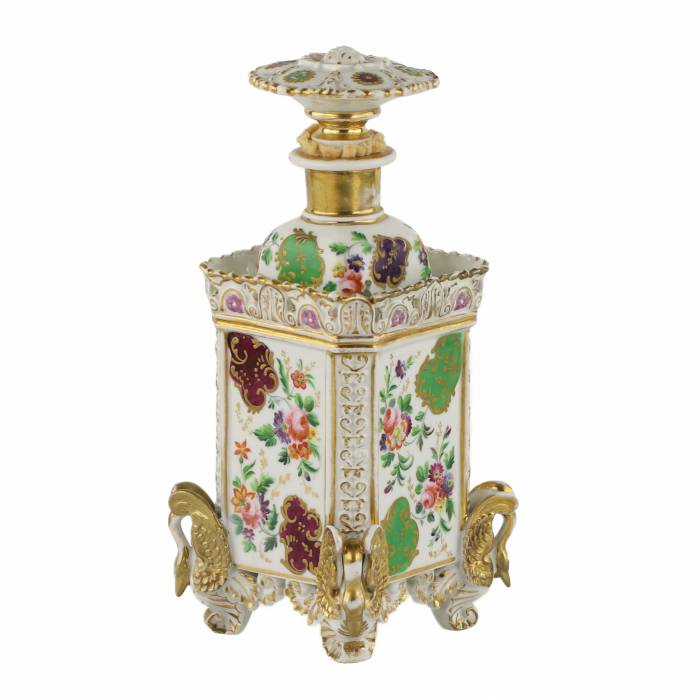
Porcelain is valued for the purity of its white tone, subtle translucency and its ability to softly reflect and diffuse light, creating an effect of inner luminosity. It supports both underglaze and overglaze painting, gilding, relief decoration and refined sculptural treatment. The white ground serves as a neutral base for complex pictorial compositions, ornamental schemes and heraldic imagery. Its visual effect combines material density with the illusion of fragility, enhancing decorative impact within an interior and emphasizing the status of the owner. In different periods porcelain adapted to the stylistic languages of Baroque, Rococo, Neoclassicism, Empire, Art Nouveau and Art Deco, reflecting changes in taste, artistic ideals and technological progress.
HISTORICAL EXAMPLES AND USAGE
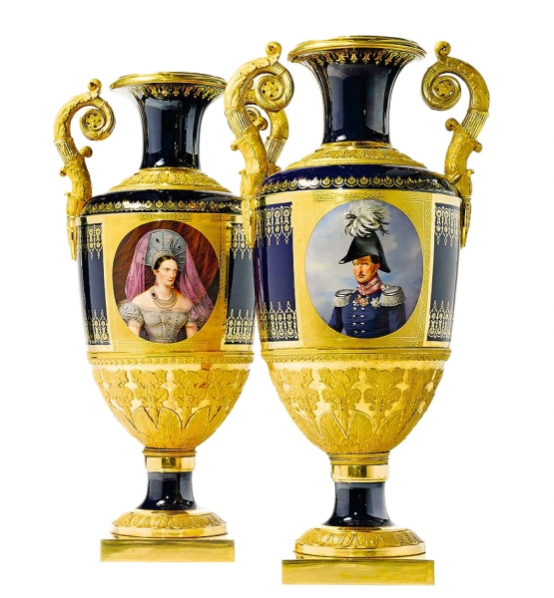
Among the principal centers are the Imperial kilns of Jingdezhen, the Meissen Manufactory, the Royal Manufactory of Sèvres and the Imperial Porcelain Factory in Saint Petersburg, each developing its own artistic language and repertoire of forms. Porcelain was used for ceremonial services, monumental vases, mantel garnitures, sculpture, small-scale figurative works and complete interior ensembles intended for courtly and aristocratic environments. It played an important role in diplomatic exchange, court etiquette and the representation of power. The museum collections of the Hermitage, the Louvre and the Victoria and Albert Museum illustrate the evolution of the material from Eastern prototypes to European interpretations, reflecting a dialogue of cultures and the progressive refinement of production.