Price:
35000 €
Add to cart
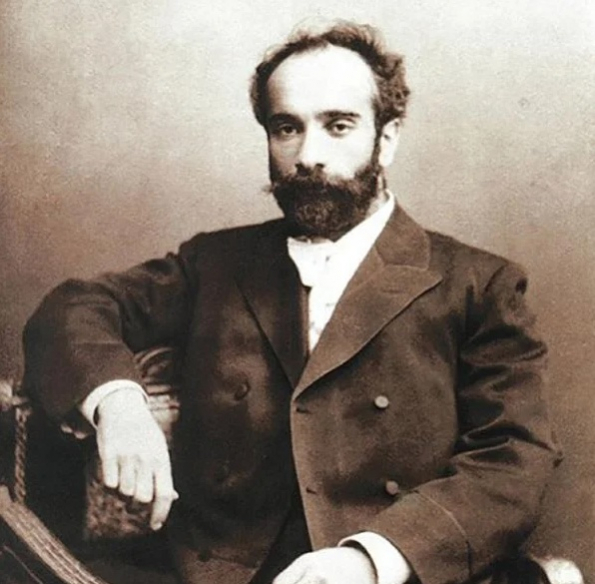
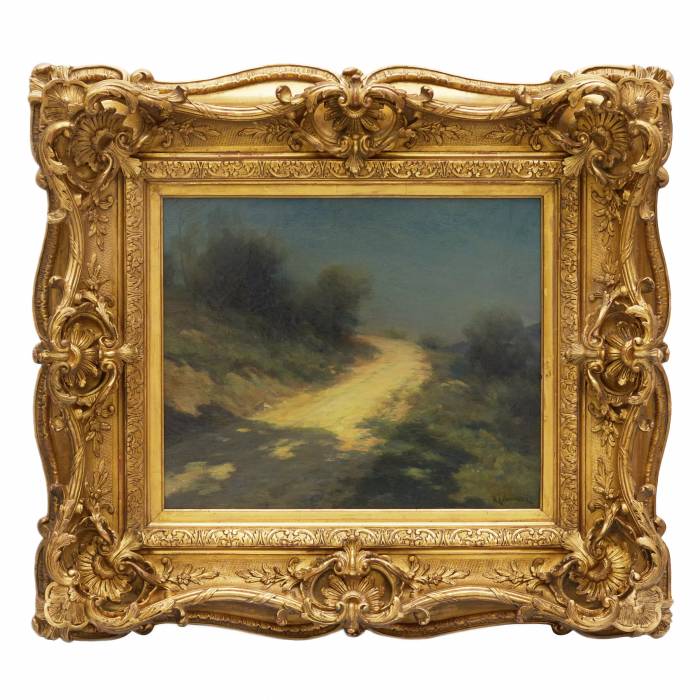
Isaac Levitan - Russian landscape painter and a key figure of the late 19th century Russian lyrical landscape school. A member of the Peredvizhniki movement. He established the concept of the “mood landscape”, profoundly influencing the development of national painting.
We will only share latest what our month on the ISAAC ILYICH LEVITAN .
BIOGRAPHY
Isaac Ilyich Levitan was born in 1860 in Kibarty, Lithuania, into a modest family. In 1873 he entered the Moscow School of Painting, Sculpture and Architecture, where he studied under Alexei Savrasov and Vasily Polenov. Despite early financial hardship, he was recognised as one of the most gifted students of his generation. He died in 1900 in Moscow.
CAREER STAGES
From the late 1870s Levitan participated in exhibitions of the Peredvizhniki. In the 1880s he developed his distinctive artistic language focused on the Russian central landscape. The 1890s marked his mature period, characterised by large-scale compositions with philosophical depth. Travels along the Volga, to Crimea and Europe broadened his artistic vision. In 1898 he was awarded the title of Academician of Painting.
STYLE, TECHNIQUE AND DIRECTION
Levitan worked within the Realist tradition, developing the Lyrical Landscape. His method was based on conveying emotional states through nature. His works are distinguished by subtle tonal gradation, delicate light and refined atmospheric effects. He painted in oil, employing glazing techniques and a свобод brushwork. The influence of Savrasov is evident in the poetic treatment of motifs, while Polenov shaped his spatial construction and handling of light.
LEGACY AND MASTERPIECES
Key works include:
“Evening Bells” (1892) - Tretyakov Gallery
“Above Eternal Peace” (1894) - Tretyakov Gallery
“Vladimirka” (1892) - a symbolic philosophical landscape
“Golden Autumn” (1895) - an iconic image of Russian nature
Levitan’s oeuvre became foundational for the Russian landscape school and influenced artists of the early 20th century.