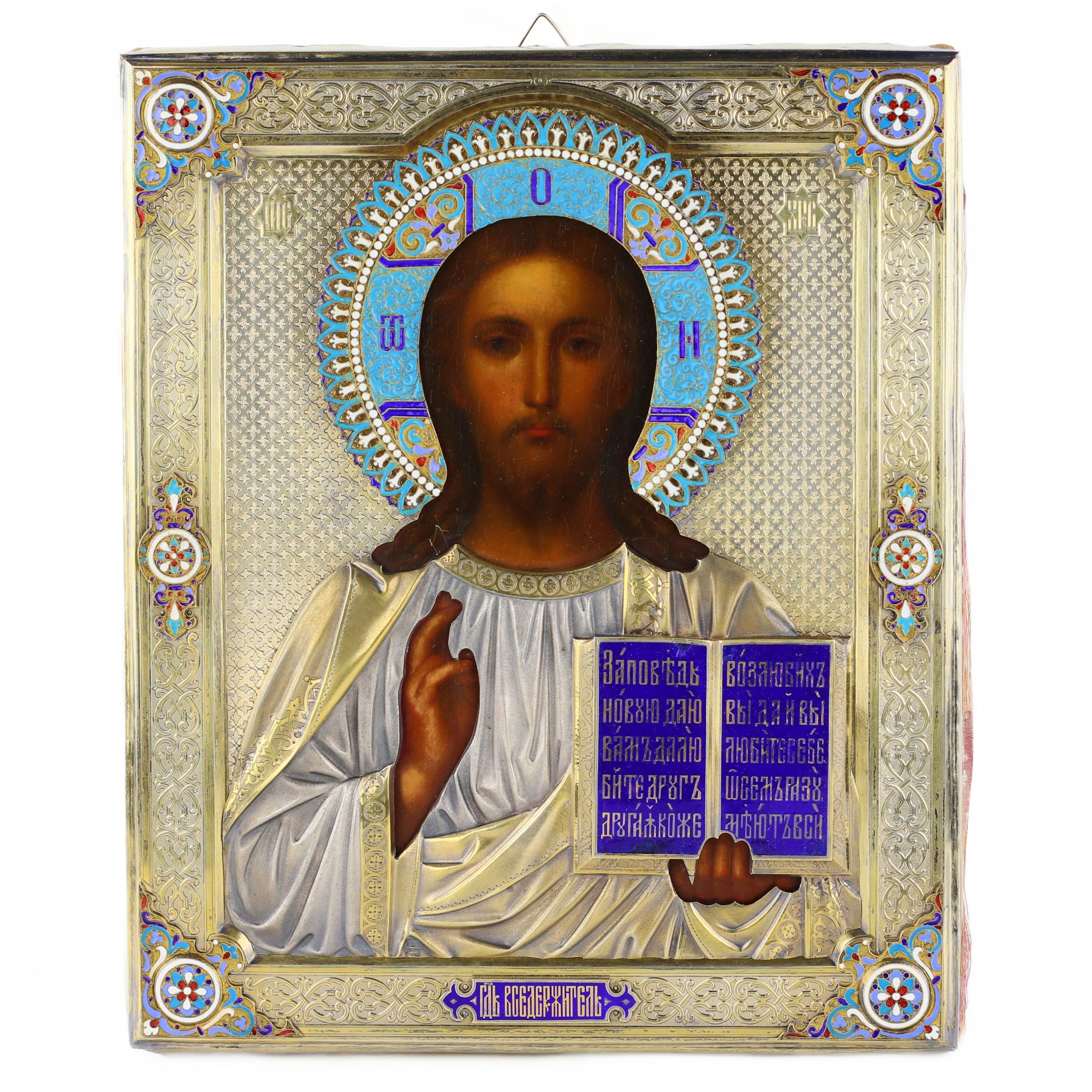



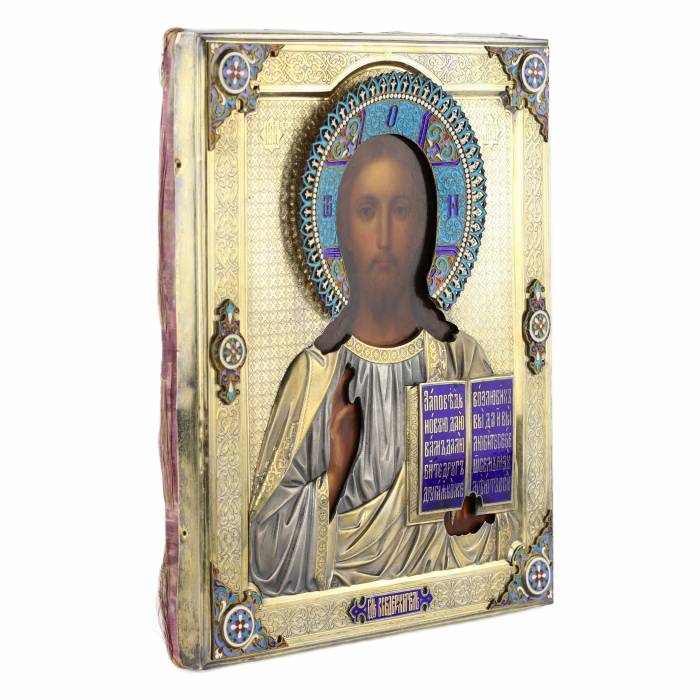
ICON OF CHRIST PANTOCRATOR IN A GILT SILVER OKLAD WITH ENAMELS RUSSIA, MOSCOW, 1891
AntiqonART consultant will contact you within one business day after receiving your request.
Discover how the value of similar works has evolved over the past 10 years. Art is not only beauty — it's an investment.
Discover how the value of similar works has evolved over the past 10 years. Art is not only beauty — it's an investment.
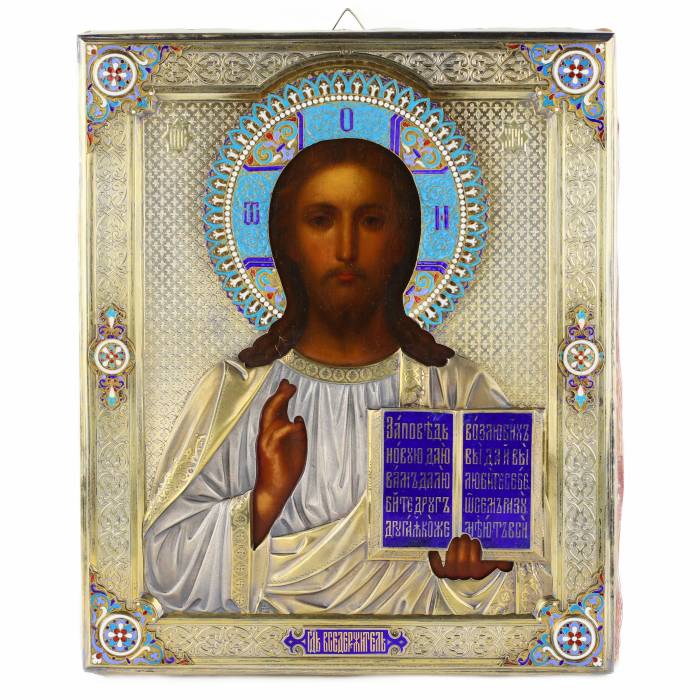
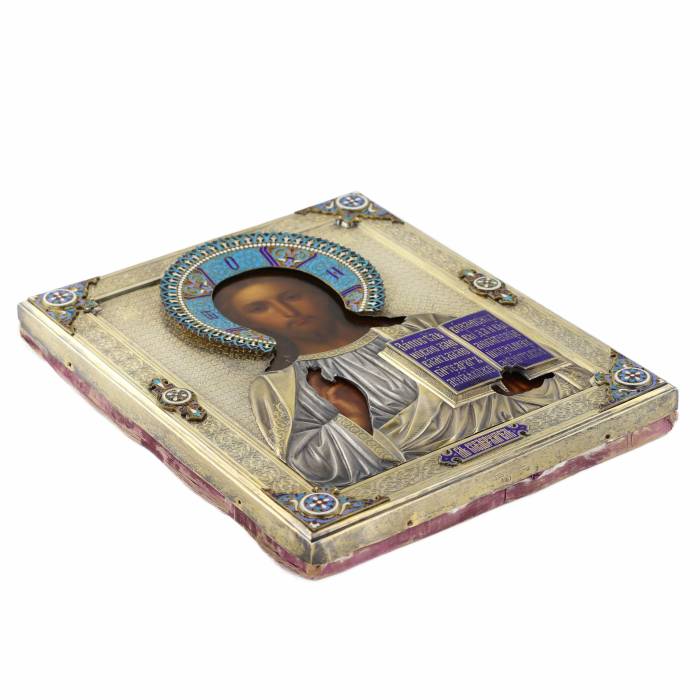
The icon Christ Pantocrator presents a half-length depiction of Christ, executed in an academic manner characteristic of Moscow icon-painting workshops of the late 19th century. Christ is shown according to traditional Pantocrator iconography, with the right hand raised in blessing and the open Gospel held in the left. The facial features are rendered with refined modelling, soft tonal transitions, and a restrained, noble palette, reflecting the influence of academic painting on ecclesiastical art of the period.
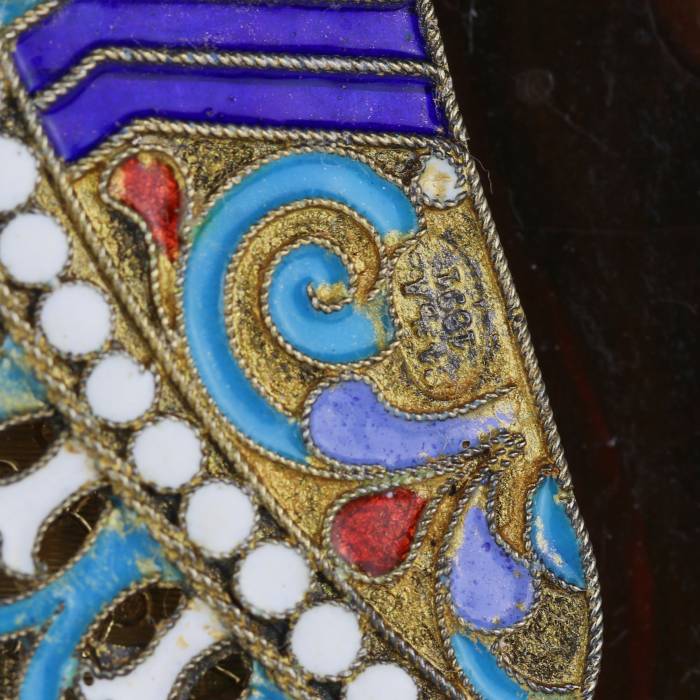
The icon is set in a finely crafted gilt silver oklad, richly decorated with polychrome enamels applied to the halo, borders, and corner elements. The ornamental programme combines vegetal and geometric motifs, executed with exceptional precision in repoussé and chasing techniques. The vivid blue, turquoise, white, and red enamels enhance the solemn character of the image and attest to the high artistic standards of prestigious Moscow commissions of the late 19th century. Stylistically, the oklad reflects the Neo-Russian movement, incorporating elements of Historicism alongside early Art Nouveau tendencies.
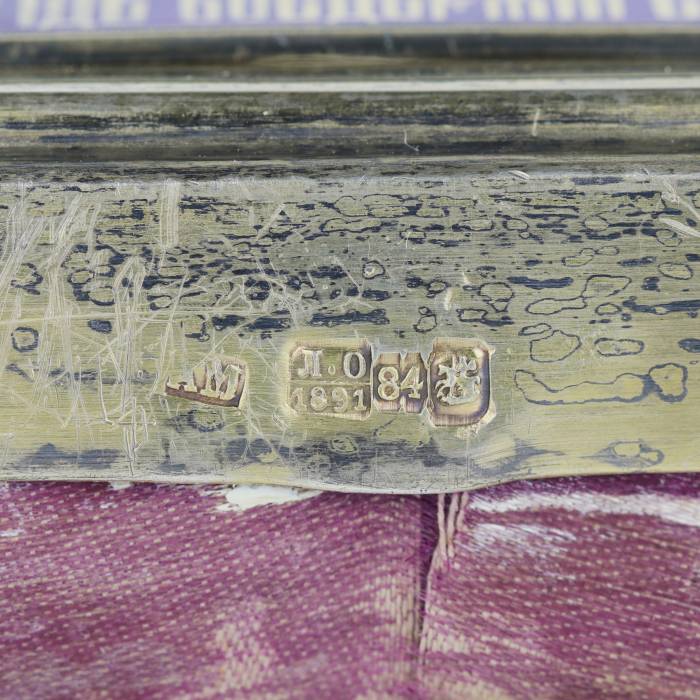
Marks: Maker’s mark “АМ” in Cyrillic, attributed to Alexander Alekseevich Mukhin; Moscow assay office mark with silver standard “84”; Assay master’s mark “Л.О.” – Lev Fyodorovich Oleks; Date “1891”.
Dimensions: 27 × 22.5 cm.
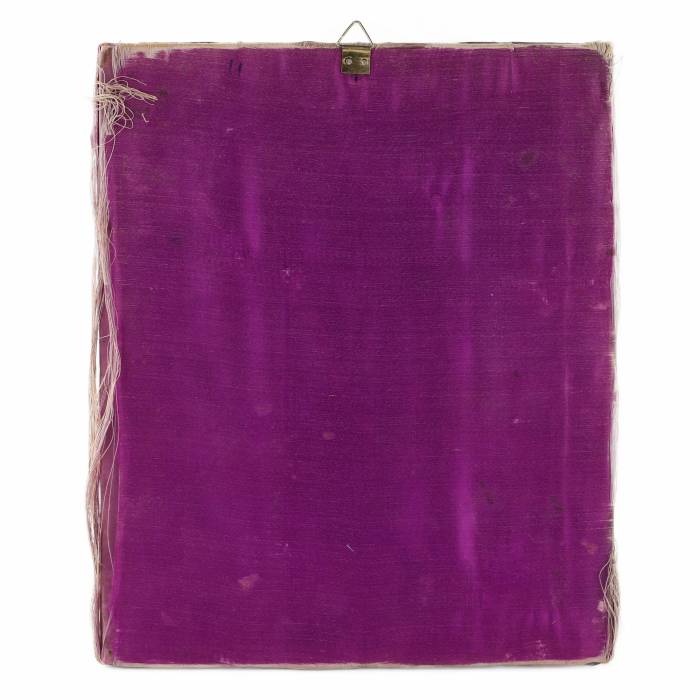
Condition: Good. The painted surface shows no significant losses. The gilt silver oklad displays an even age-related patina; enamels are well preserved. Structurally stable.
This icon belongs to the period of flourishing ecclesiastical art and silversmithing in Moscow at the end of the 19th century, when icon painting increasingly absorbed academic artistic principles and silver oklads became independent works of decorative art. Moscow remained one of the principal centres for the production of silver icon covers, developing a distinct artistic tradition marked by rich ornamentation and technical excellence.
Silver oklads of this period were commonly commissioned for churches, merchant households, and private chapels, serving both devotional purposes and as indicators of social status. The use of polychrome enamels, characteristic of Moscow workshops, reflects a revival of Old Russian decorative traditions while integrating contemporary stylistic innovations. The Neo-Russian style, widely promoted during the 1880s and 1890s, sought to reinterpret pre-Petrine artistic heritage through modern craftsmanship.
The workshop of Alexander Alekseevich Mukhin, to whom the maker’s mark is attributed, was among the established Moscow silversmithing enterprises of the period. Archival records indicate that in the second half of the 19th century, the workshop produced a wide range of ecclesiastical silver, including icon oklads, Gospel covers, and liturgical objects, distinguished by consistent quality and sustained demand.
Overall condition is good. The painted surface is stable with no active flaking. The gilt silver oklad shows uniform age patina; enamels are intact, with minor wear consistent with age.
The condition report is provided for informational purposes only.
It is not comprehensive and may not reflect all defects, restorations, alterations, or adaptations, as Antiqon does not perform professional conservation-level assessments. The information is based on a qualified, yet subjective, evaluation by our specialists.Before purchasing, we recommend consultation with an independent expert.Please also consult our Terms and conditions and Glossary A-Z, which contain important information on lot characteristics and sale conditions.