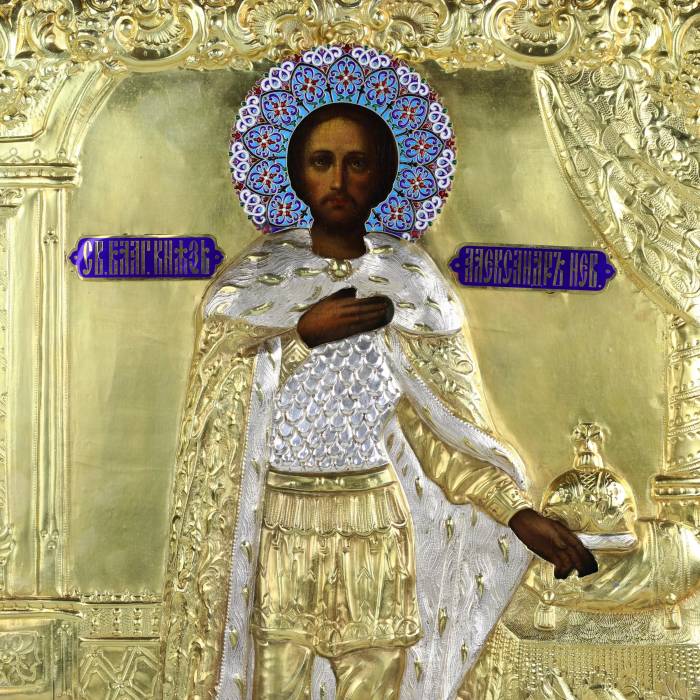

ICON OF SAINT BLESSED PRINCE ALEXANDER NEVSKY IN A SILVER OKLAD WITH ENAMELS. RUSSIA, 1895

ICON OF SAINT BLESSED PRINCE ALEXANDER NEVSKY IN A SILVER OKLAD WITH ENAMELS. RUSSIA, 1895

ID-ANTQ-13313
November 29, 2025 12:00 PM GMT+02:00
Live auction is finished
Estimate
2500 - 3500 EUR
Bidding is closed
Use our cost calculator

Discover how the value of similar works has evolved over the past 10 years. Art is not only beauty — it's an investment.

Price History

Discover how the value of similar works has evolved over the past 10 years. Art is not only beauty — it's an investment.

Request a Shipping Quote

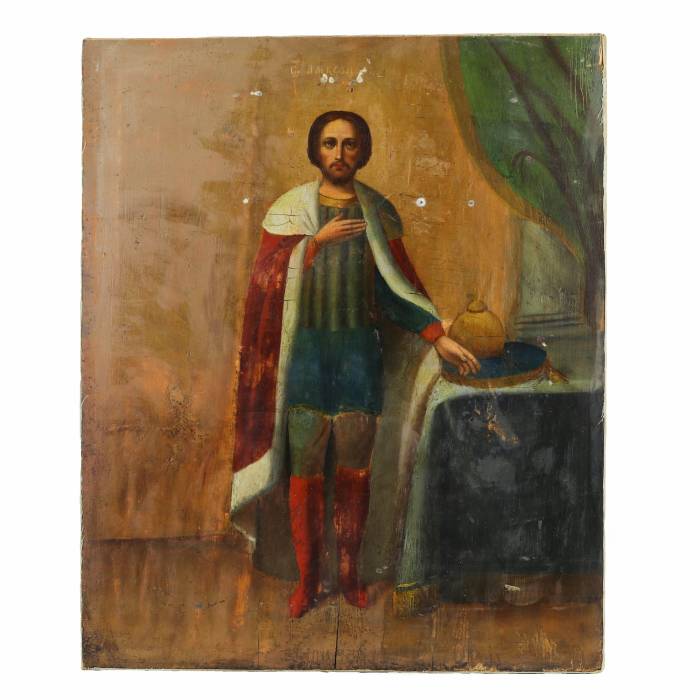
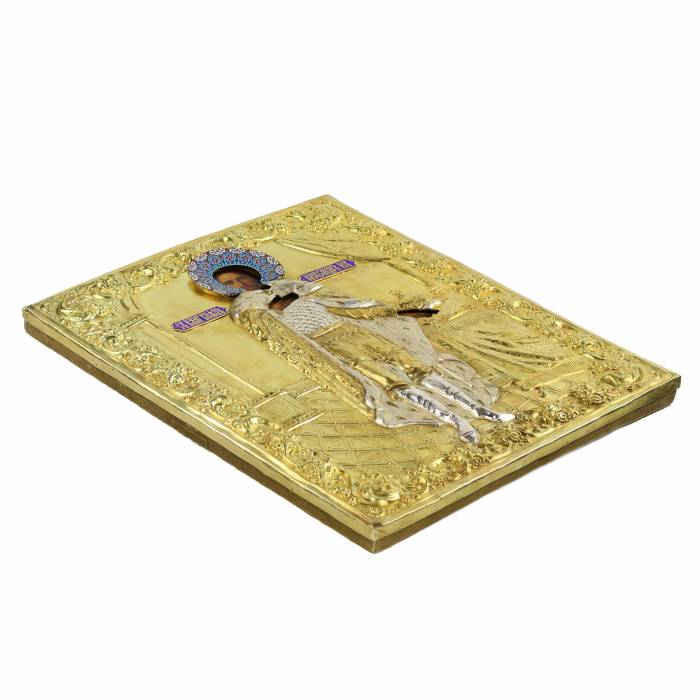
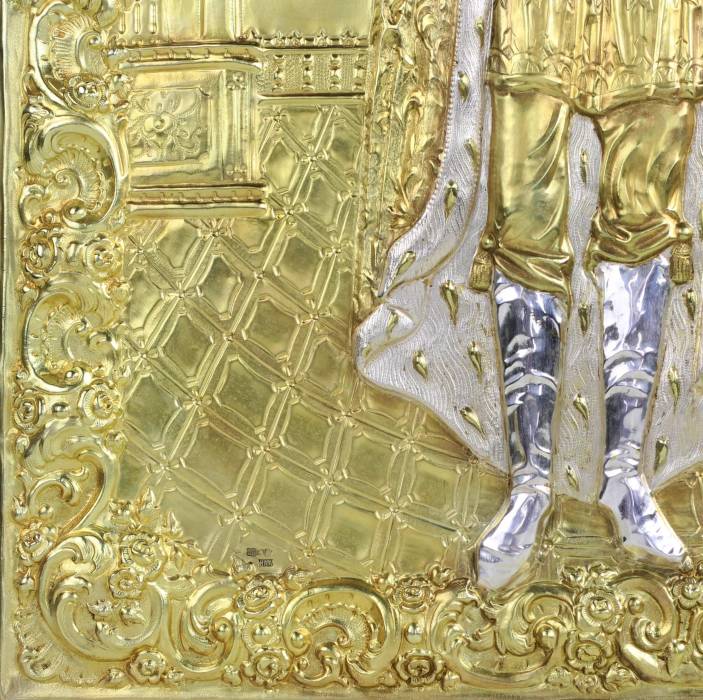
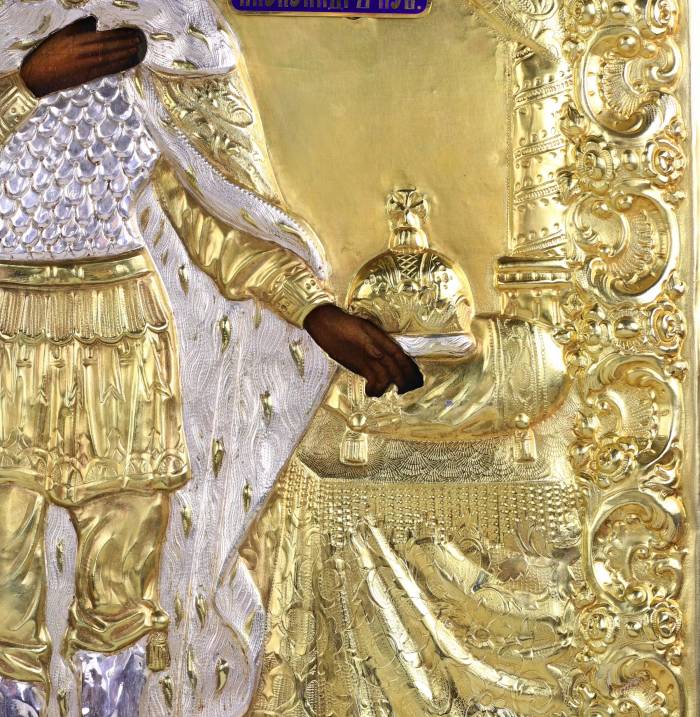
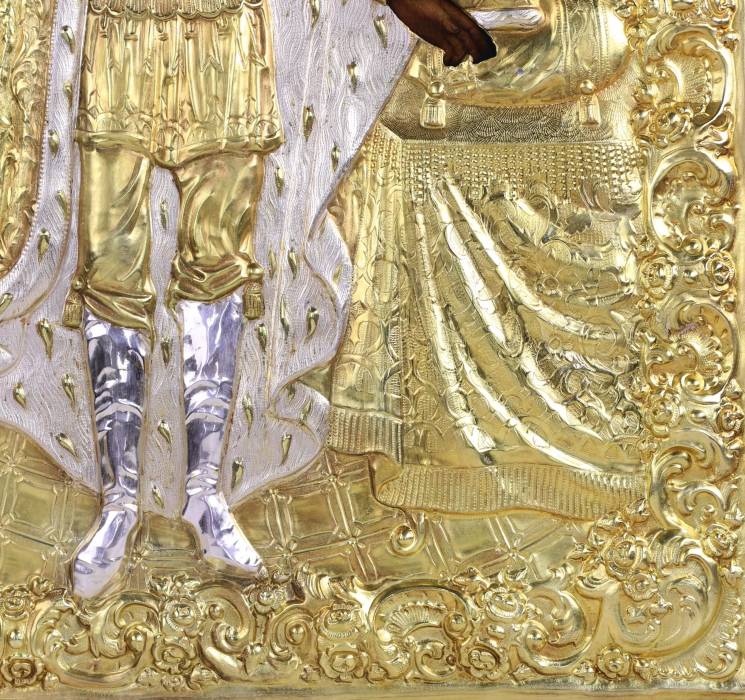
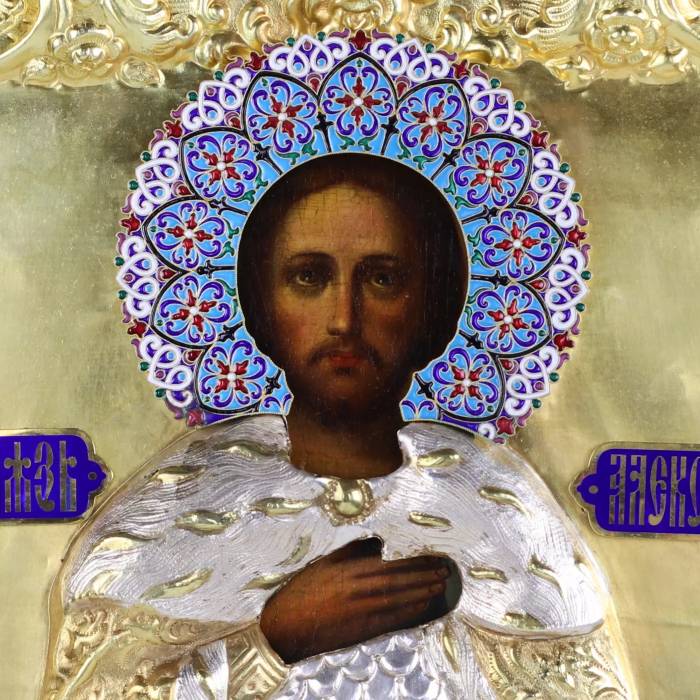
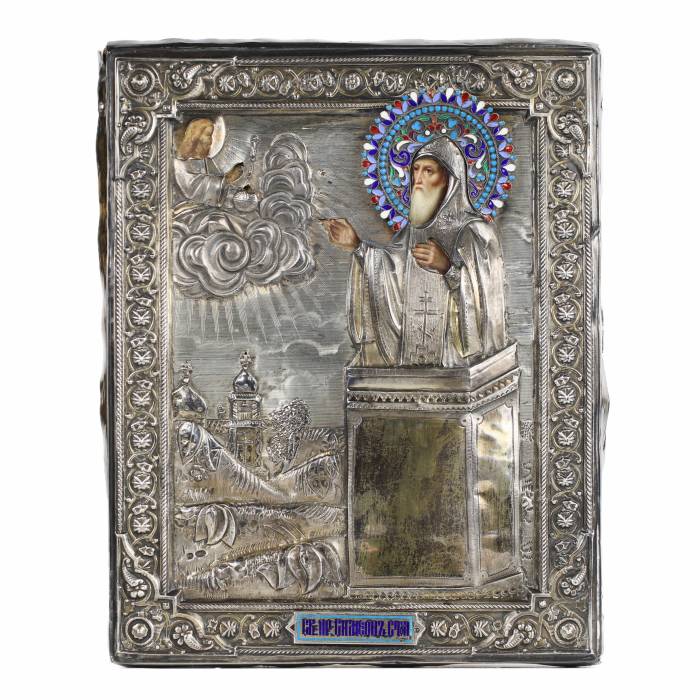
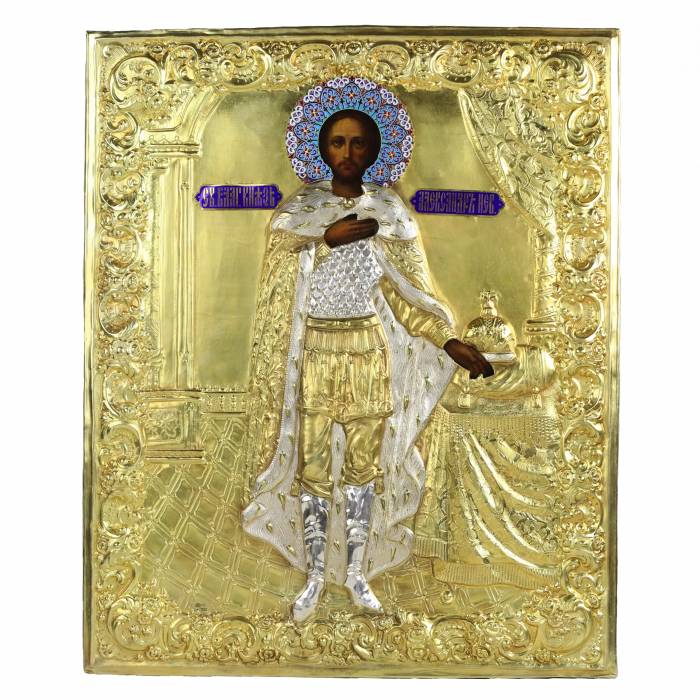
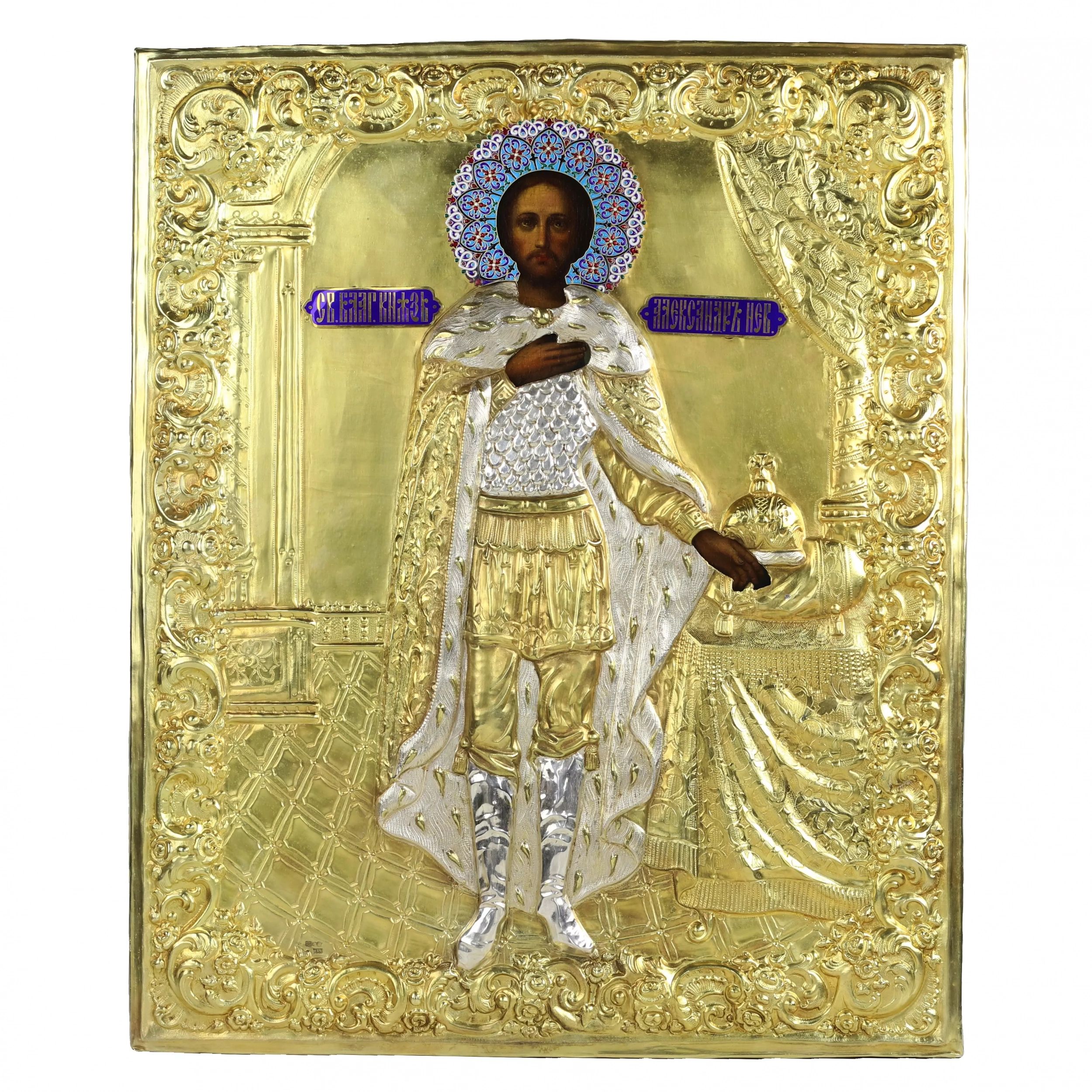
A rare example of Russian iconography from the late 19th century — a full-length icon of Saint Blessed Prince Alexander Nevsky, produced in Moscow in 1895 at the workshop of Ivan Alekseev. The image is painted in oil on wood and set within a rich silver oklad, adorned with delicate chasing, polychrome cloisonné enamel, engraving, and gilding. The saint is depicted in princely attire, holding an orb and sword — symbols of sovereignty and spiritual power. The composition is crowned with an enamel halo and enamel inscriptions. The background is enriched with architectural elements and carpet-like ornamentation.

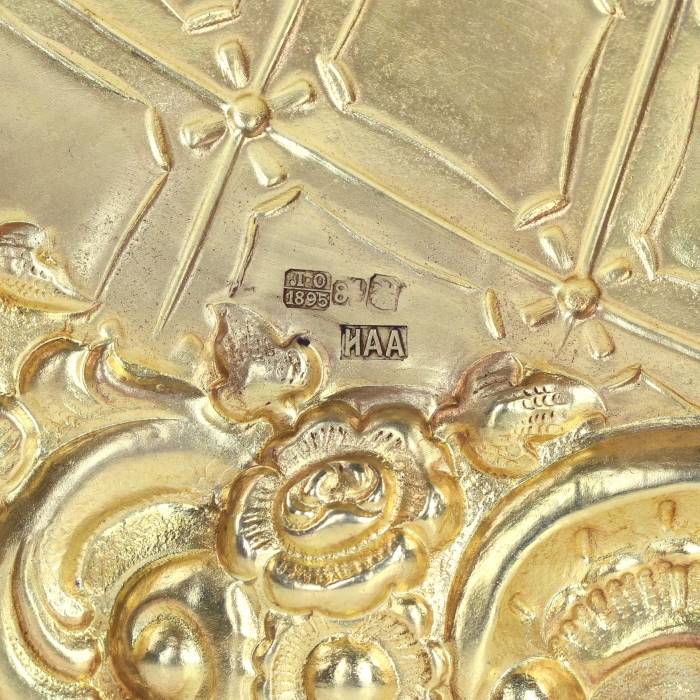
Hallmarks: Silver hallmark 84 in a rectangular cartouche, Moscow city mark featuring Saint George slaying the dragon, turned right in a shield with beveled corners, Moscow assay office mark with initials of assayer “L.O.” (Lev Oleks; Moscow, 1890–1896) above the date “1895”, and Ivan Alekseevs workshop mark in Cyrillic “ИАА”

Dimensions: Icon: 53 × 43.9 cm, Oklad: 53.4 × 44 cm, Kiot: 62.3 × 53.2 × 7 cm
Weight: Approx. 1706 g (silver oklad)
Condition: The icon is in good condition. Traces of early restoration.

Art:
russia
Height:
53 cm
Width:
44 cm
Depth:
3 cm
Period:
At the turn of 19th -20th century
Country:
Russia, Moscow
Material:
Silver 84, Cloisonné enamel, Gilding
Condition:
Revive
Fair
Good
Very good
Like new

Saint Alexander Nevsky, Grand Prince of Novgorod and Kiev, occupies a unique position in Russian spiritual and political tradition. Canonized by the Russian Orthodox Church as a defender of the Russian land and faith during foreign invasions, his victories over the Swedes at the Neva (1240) and the Teutonic Knights at Lake Peipus (1242) earned him the status of a national hero. Yet it was not only military prowess but also diplomatic foresight in dealings with the Golden Horde that made him a symbol of unity and survival for Rus in a time of turmoil.

In the second half of the 19th century, national symbols and historical figures were reinterpreted during the reigns of Alexander II and Alexander III, with the image of Saint Alexander Nevsky acquiring renewed significance, emphasizing imperial continuity and Orthodox identity. This was the golden age of icon-painting workshops and silver ateliers, producing commissioned works for churches and private devotion, marked by exceptional technical quality in chasing, filigree, and enameling.

The workshop of Ivan Alekseev, active in Moscow during this period, was known for its refined oklads with high-quality enamel decoration. The use of architectural and textile motifs in this icon is characteristic of the style of high historicism and Russian eclecticism, combining elements of Baroque, Neo-Byzantine, and national romantic aesthetics. An icon like this, created in 1895, likely belonged to a private chapel or noble household, serving as both a devotional object and a marker of status.

The icon is in good condition. Signs of wear, minor losses to the paint layer. Evidence of restoration.

The condition report is provided for informational purposes only.

It is not comprehensive and may not reflect all defects, restorations, alterations, or adaptations, as Antiqon does not perform professional conservation-level assessments. The information is based on a qualified, yet subjective, evaluation by our specialists.Before purchasing, we recommend consultation with an independent expert.Please also consult our Terms and conditions and Glossary A-Z, which contain important information on lot characteristics and sale conditions.
IVAN ALEKSEEVS WORKSHOP (1876–1912)
Founded in Moscow in 1876, Ivan Alekseev’s workshop became one of the leading manufacturers of ecclesiastical silverware and liturgical objects in Russia at the turn of the 20th century. The firm earned a strong reputation for its high-quality silver icon covers (oklads), devotional items, and religious household goods that combined traditional Orthodox aesthetics with richly decorated elements in the Neo-Russian revival style.FOUNDATION AND DEVELOPMENTIvan Alekseev (I.A. Alekseev) began his career as an independent silversmith in the final quarter of the 19th century. He quickly developed his modest atelier into a fully registered factory in Moscow. According to the Directory of Factories and Plants of the Russian Empire (1903), the enterprise was located at Yakovoapostolsky Lane and employed up to 40 workers. The workshop’s core specialization included the production of icon covers, tabernacles, kiots (icon frames), and pectoral crosses crafted from 84 zolotnik silver.Alekseev’s silverwork was in consistent demand among both private clients and religious institutions. His creations were regularly presented at All-Russian exhibitions, receiving praise for their refinement, precise ornamentation, and reliable craftsmanship.ARTISTIC FEATURES AND TECHNIQUESThe Alekseev workshop embraced the principles of artistic synthesis typical of the Neo-Russian style. Its decorative vocabulary incorporated a rich array of traditional techniques:Chasing and engraving with pronounced relief and ornamental complexity;Polychrome filigree enamel following the Moscow enamel tradition of the 19th century;Gilding and niello to heighten symbolic expressiveness and visual contrast;Multicolored enamel in tones of blue, green, crimson, and white, embellishing haloes, crowns, inscriptions, and icon borders.Thematically, the factory focused on canonical depictions of Christ Pantocrator, the Mother of God (including the Kazan, Tikhvin, and Iveron icons), Saint Nicholas, and large-format feast icons for church interiors. Alekseev’s products stood out for their iconographic accuracy, adherence to ecclesiastical canons, and meticulous detailing.ECCLESIASTICAL AND SOCIAL RECOGNITIONThanks to its consistently high quality and strong liturgical focus, the Alekseev factory received numerous commissions from churches, monasteries, and diocesan authorities, especially in the final decades of the Russian Empire. Its works spread beyond Moscow to regions such as Vladimir, Tambov, Yaroslavl, and Nizhny Novgorod.The stylistic and iconographic features of the workshop reflect the influence of the Moscow school and Stroganov traditions, particularly in the miniature-like precision of ornament and use of architectural frames. Alekseev’s icon covers were often commissioned for family shrines and memorial icons, which further enhances their cultural and historical significance.DECLINE OF THE WORKSHOPThe workshop ceased operations shortly after the death of Ivan Alekseev in 1912. The absence of direct successors and the growing political unrest that culminated in the 1917 Revolution prevented the continuation of the business. Nevertheless, many objects produced by the Alekseev factory have survived in private and museum collections and remain benchmarks of the Moscow school of silver icon frames.MUSEUM COLLECTIONS AND ANTIQUE VALUEObjects made by Ivan Alekseev’s factory are preserved in the collections of the State Historical Museum, the Moscow Kremlin Museums, the Tsaritsyno Museum-Reserve, and various ecclesiastical museums and private collections in Russia and abroad. Particularly rare and sought-after are icon covers with filigree enamel commissioned for prominent churches and noble families.
... Read More

Stay up to date with new arrivals
Save Icons and we let you know when new listings appears in this category
Save

Related items