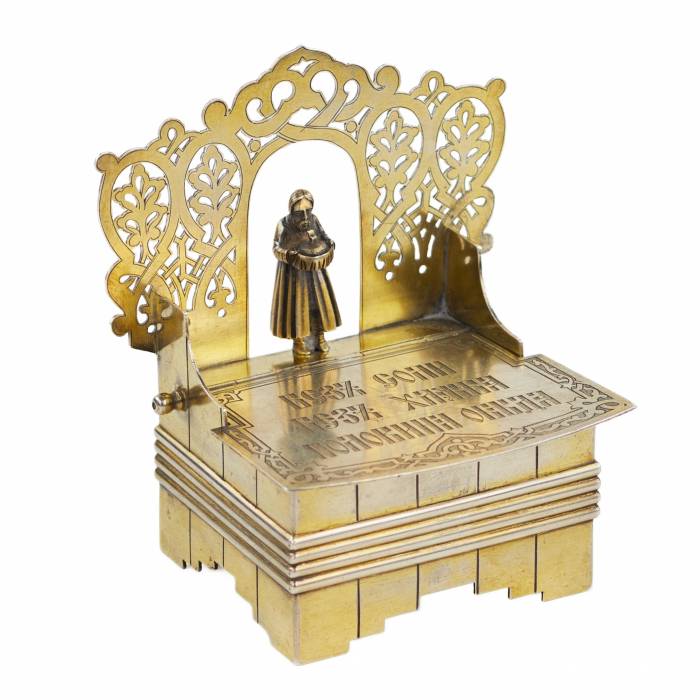

SALT CELLAR IN THE FORM OF A THRONE BY THE SAZIKOV FIRM RUSSIA, SAINT PETERSBURG, SECOND HALF OF THE 19TH CENTURY
AntiqonART consultant will contact you within one business day after receiving your request.
Discover how the value of similar works has evolved over the past 10 years. Art is not only beauty — it's an investment.
Discover how the value of similar works has evolved over the past 10 years. Art is not only beauty — it's an investment.
An elegant silver salt cellar executed by the renowned Saint Petersburg firm Sazikov represents a characteristic example of Russian artistic silver of the Historicism period. The object is conceived in the form of a miniature throne with a high shaped back, a stepped base, and a hinged front panel opening to reveal the inner compartment for salt. Such interpretation of a utilitarian object as a throne-like architectural form imparts a ceremonial, almost reliquary character and reflects the стремление of Russian silversmiths of the second half of the 19th century to create works imbued with a pronounced national-historical imagery.
The surface is decorated with fine engraving and chased geometric and cross-shaped ornaments associated with the decorative system of the Russian style. The upper section of the back features vertical openwork apertures framed by строгие ornamental motifs.
The combination of architectural composition, archaizing ornament and expressive plasticity makes this salt cellar a vivid example of the Russian national-romantic line in decorative arts. Such objects were created not only as tableware but also as камерные artistic images intended for a cultivated collector and for an environment receptive to ideas of historical memory and the aesthetics of Old Russia.
Marks: Under the double-headed eagle - “Sazikov”; assay mark “84”; Saint Petersburg city mark - anchor.
Dimensions: Height: 5 cm.
Weight: 81.6 g.
Condition: Good. Gilding even. Minor surface wear and light traces of use consistent with age. Structure preserved.
Provenance: Private collection.
In the second half of the 19th century, the firm of Ignaty Sazikov occupied a special place in the history of Russian jewelry art. The Moscow Kremlin Museums describe it as one of the most distinguished Russian silver firms of the century, noting that Ignaty Pavlovich Sazikov was among the first Russian silversmiths to gain wide European recognition. Scholarly and museum studies emphasize that the firm’s masters actively drew upon the artistic heritage of Old Russia and Byzantine traditions, shaping a distinctive language of the Russian style.
Collaboration with the artist-archaeologist Fyodor Solntsev played a key role in the development of this direction. His publication “Antiquities of the Russian State” became an essential source of forms and ornaments that were creatively reinterpreted in decorative art. As a result, a unique artistic system emerged in which objects of tableware acquired features of historical and architectural imagery.
Within the Russian style, utilitarian objects were transformed into carriers of cultural memory. Small-scale forms - such as salt cellars, kovsh vessels and cups - became a field for experimentation with national motifs, combining decorative richness, symbolism and refined craftsmanship. The present throne-shaped salt cellar belongs precisely to this category: its architectural structure refers to images of the throne and Old Russian architecture, enhancing its artistic significance.
The Sazikov firm, holding the title of Supplier to the Imperial Court, set a high standard of quality and artistic excellence. Today its works are represented in major museum collections and are regarded as key examples of 19th-century Russian decorative art. This salt cellar forms part of that tradition and is of interest both to collectors and scholars of the Russian style.
Overall good condition. Structure and marks clearly preserved. Minor surface wear and light traces of use consistent with age.
The condition report is provided for informational purposes only.
It is not comprehensive and may not reflect all defects, restorations, alterations, or adaptations, as Antiqon does not perform professional conservation-level assessments. The information is based on a qualified, yet subjective, evaluation by our specialists.Before purchasing, we recommend consultation with an independent expert.Please also consult our Terms and conditions and Glossary A-Z, which contain important information on lot characteristics and sale conditions.