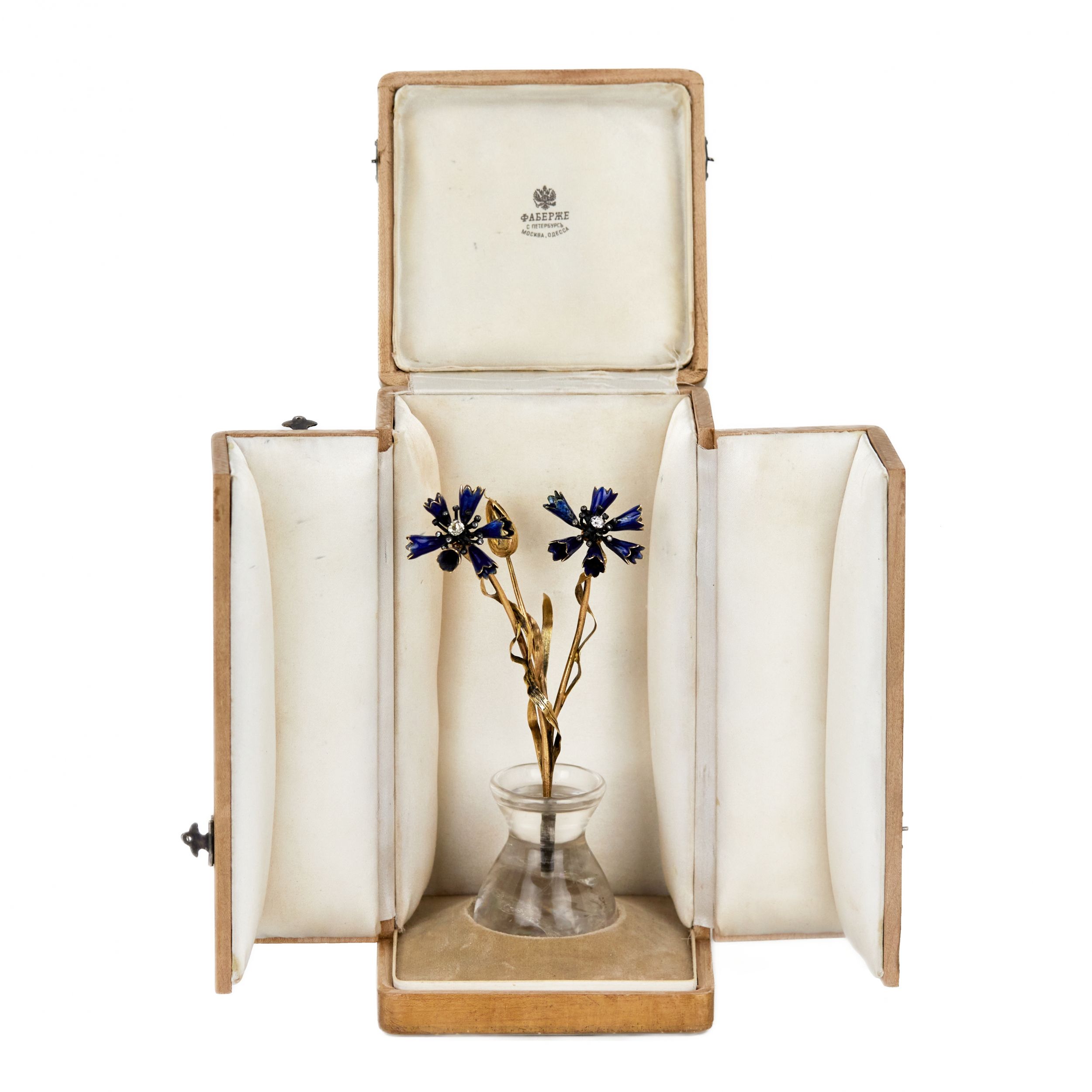
CORNFLOWER IN A VASE. JEWELLERY COMPOSITION BY THE FIRM OF C. FABERGÉ RUSSIA, SAINT PETERSBURG, EARLY 20TH CENTURY
AntiqonART consultant will contact you within one business day after receiving your request.
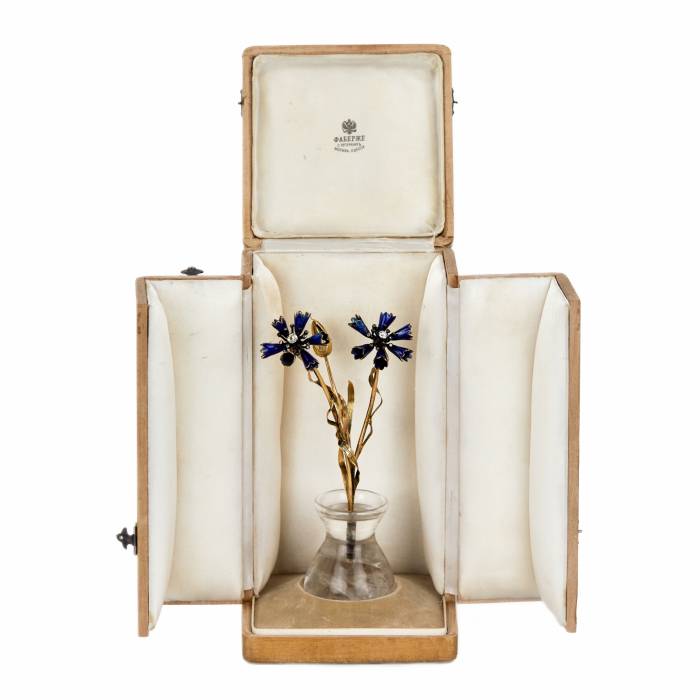
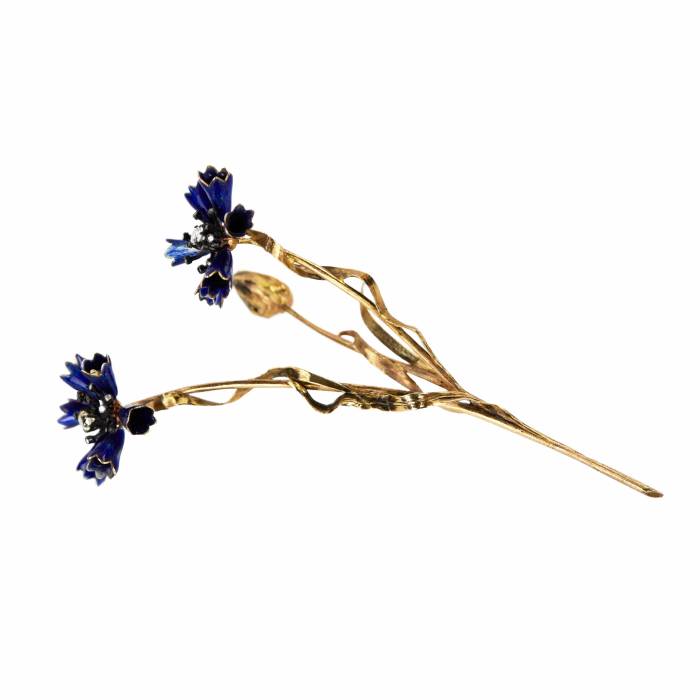
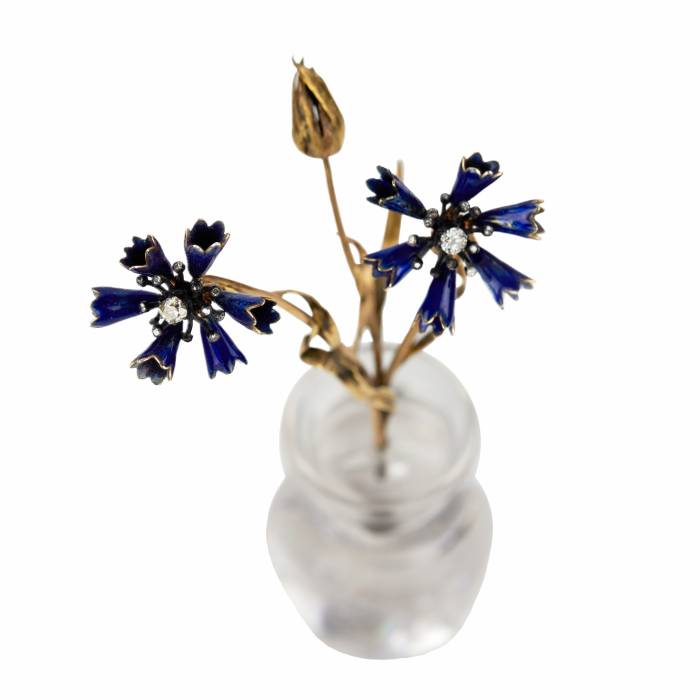
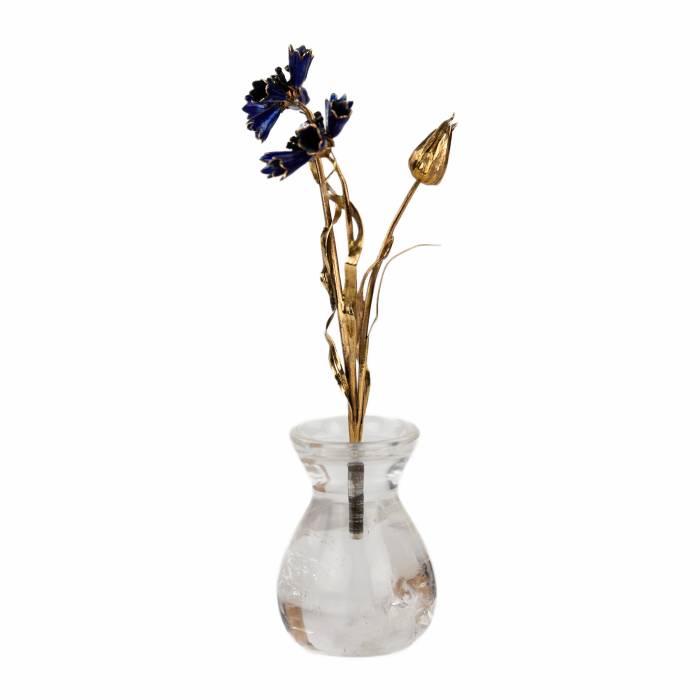
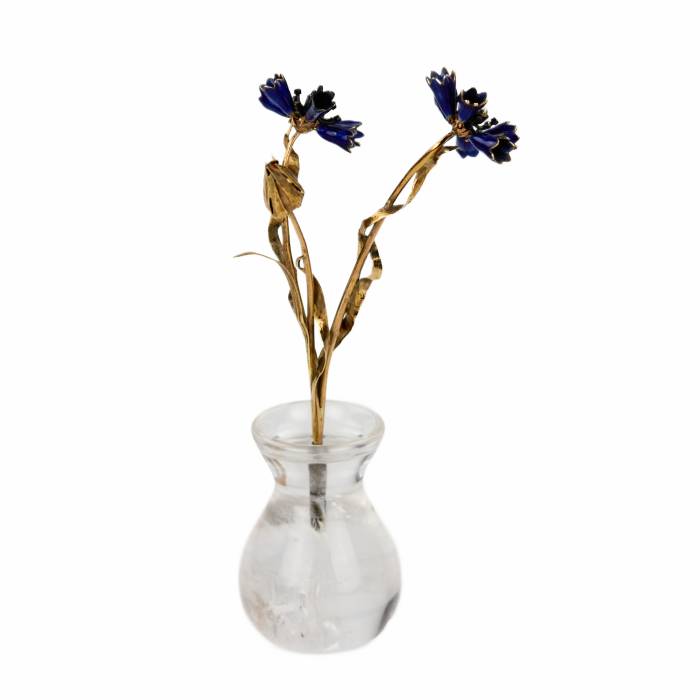
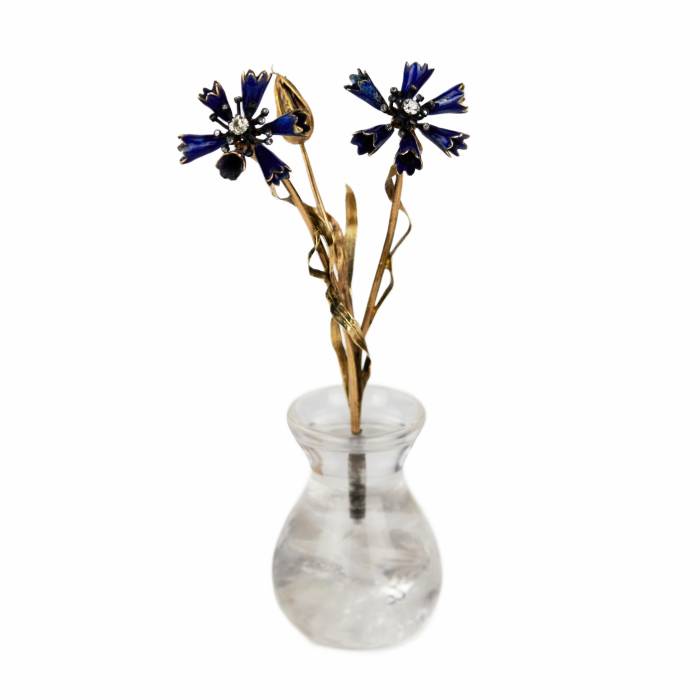
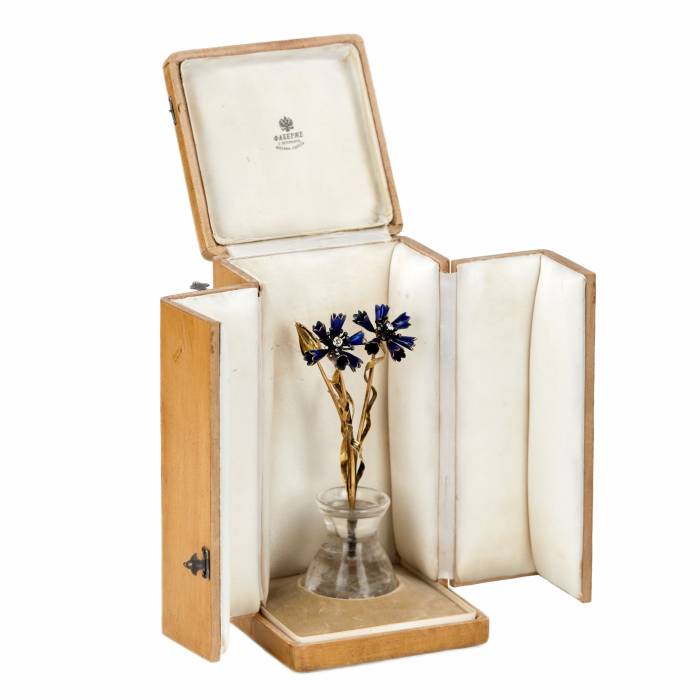
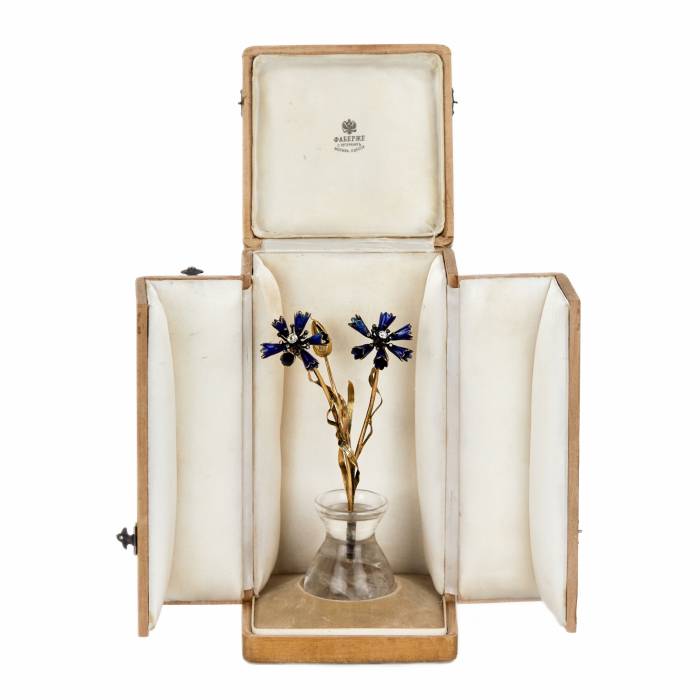
A jewelled masterpiece by the firm of Fabergé, presenting an exquisite decorative composition in the form of a wild cornflower arranged in a miniature vase. The flower is crafted in 56 standard gold and enriched with deep royal blue guilloché enamel, characteristic of the highest achievements of Saint Petersburg jewellery art of the early 20th century. The flower centres are set with rose-cut diamonds, lending refined brilliance and a lively play of light. The enamelled petals are articulated and movable, creating a striking sense of naturalism and botanical authenticity. The stems and leaves are rendered in a supple, gently twisted manner, emphasising the organic character of the composition.
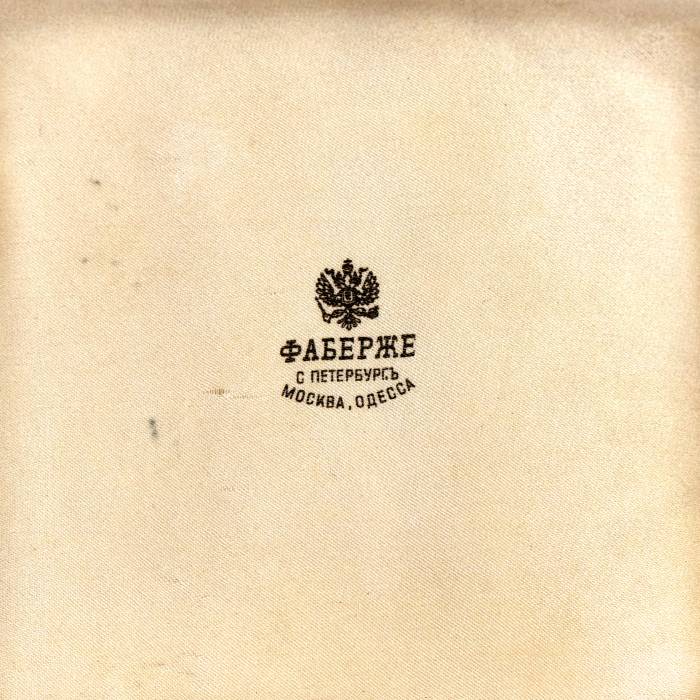
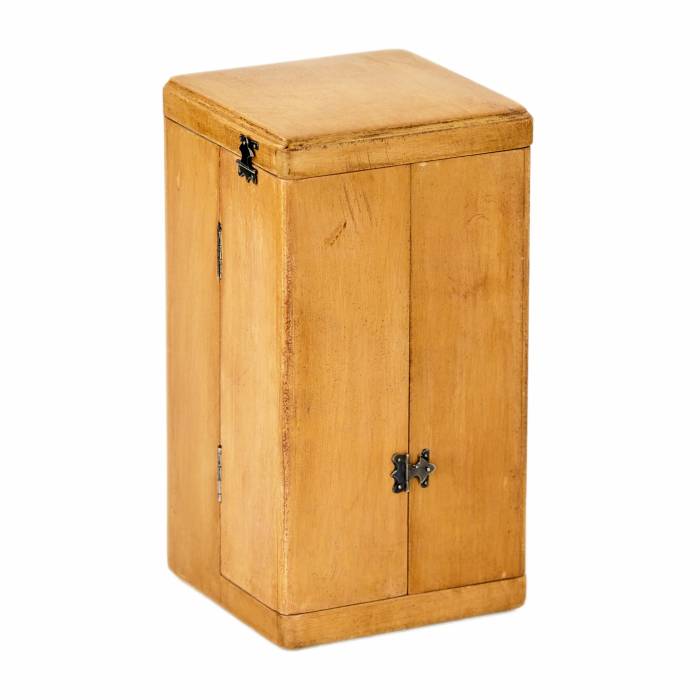
The vase, carved from quartz crystal at the Imperial Lapidary Factory in Peterhof, serves both as a functional base and as a refined artistic counterpoint to the gold flower. The composition is preserved in its original fitted Fabergé presentation case, lined with fabric and bearing the trade mark of the firm.
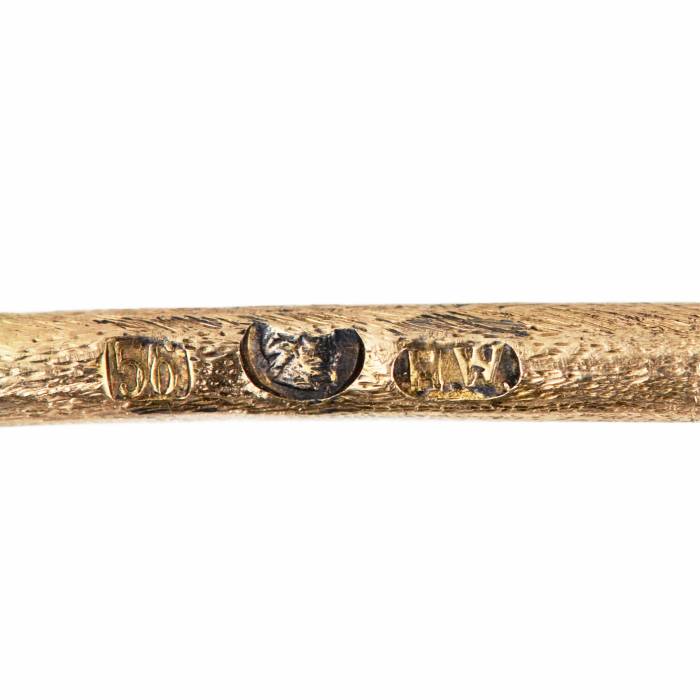
Marks: Russian gold standard mark “56”; maker’s mark of the firm of C. Fabergé; workmaster’s mark “HW” – Henrik Wigström.
Dimensions: Overall height 16 cm; stem height 12.5 cm; vase height 5.8 cm.
Condition: Good. Enamels of rich colour, without losses. Minor traces of age consistent with the period and nature of the object.
Provenance: Private European collection. The vase produced at the Imperial Lapidary Factory, Peterhof.
Jewelled floral compositions occupy a special place within the legacy of the firm of C. Fabergé and represent the pinnacle of Russian decorative and applied arts in the early 20th century. During this period, Fabergé’s Saint Petersburg workshops actively developed the genre of small-scale sculptural works that combined jewellery craftsmanship, hardstone carving and innovative enamel techniques. Floral compositions intended for interiors and intimate collections became refined “jewelled still lifes”, in which botanical accuracy was harmoniously balanced with artistic stylisation.
The cornflower, a recurring motif in Russian visual culture, was traditionally associated with natural purity, modest beauty and poetic national imagery. In Fabergé’s interpretation, this humble field flower acquires an aristocratic character through the use of precious materials and sophisticated techniques. The application of deep blue guilloché enamel required exceptional precision: beneath the translucent enamel layer, a finely engraved geometric pattern remains visible, creating a sense of depth and inner luminosity. The articulated petals demonstrate remarkable technical ingenuity and virtuoso metalwork, hallmarks of Fabergé’s finest creations.
Henrik Wigström, Fabergé’s chief workmaster between 1903 and 1917, played a pivotal role in the creation of such works. Under his supervision, many of the firm’s most complex and technically accomplished pieces were produced. His style is distinguished by a pursuit of lively sculptural form, meticulous detailing and a refined balance between realism and decorative elegance. The inclusion of a quartz crystal vase produced at the Imperial Lapidary Factory in Peterhof further underscores the collaboration between the leading artistic and industrial centres of the Russian Empire and elevates the composition to a court-level object.
Such compositions were highly prized within aristocratic circles and were frequently presented as gifts symbolising refined taste, artistic innovation and the prestige of owning a Fabergé work. Today, these objects form part of major museum holdings and distinguished private collections worldwide, regarded as quintessential examples of Russian Art Nouveau jewellery and as exceptional testimonies to the artistic culture of pre-revolutionary Russia.
Overall good condition. Gold with an even patina. Guilloché enamel intact, without cracks or losses. Diamonds securely set. Quartz vase without chips. Presentation case with expected signs of age.
The condition report is provided for informational purposes only.
It is not comprehensive and may not reflect all defects, restorations, alterations, or adaptations, as Antiqon does not perform professional conservation-level assessments. The information is based on a qualified, yet subjective, evaluation by our specialists.Before purchasing, we recommend consultation with an independent expert.Please also consult our Terms and conditions and Glossary A-Z, which contain important information on lot characteristics and sale conditions.