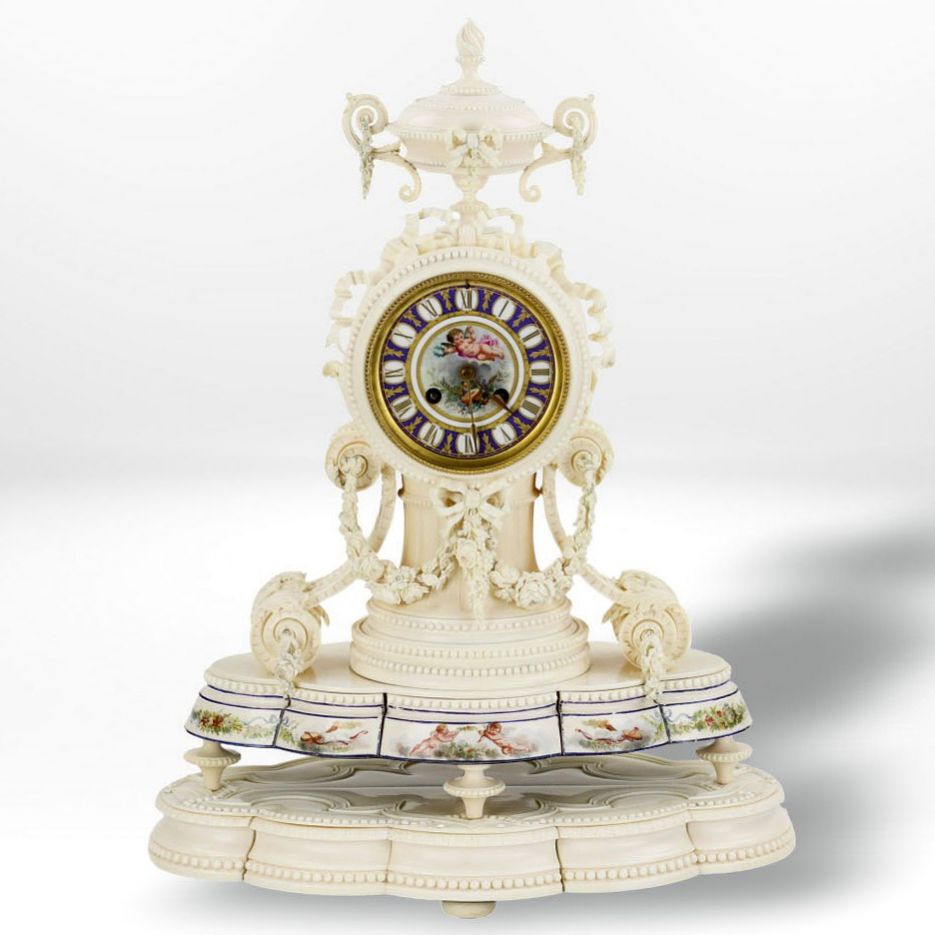



IVORY MANTEL CLOCK OF THE NAPOLEON III PERIOD FRANCE, PARIS, SECOND HALF OF THE 19TH CENTURY
AntiqonART consultant will contact you within one business day after receiving your request.
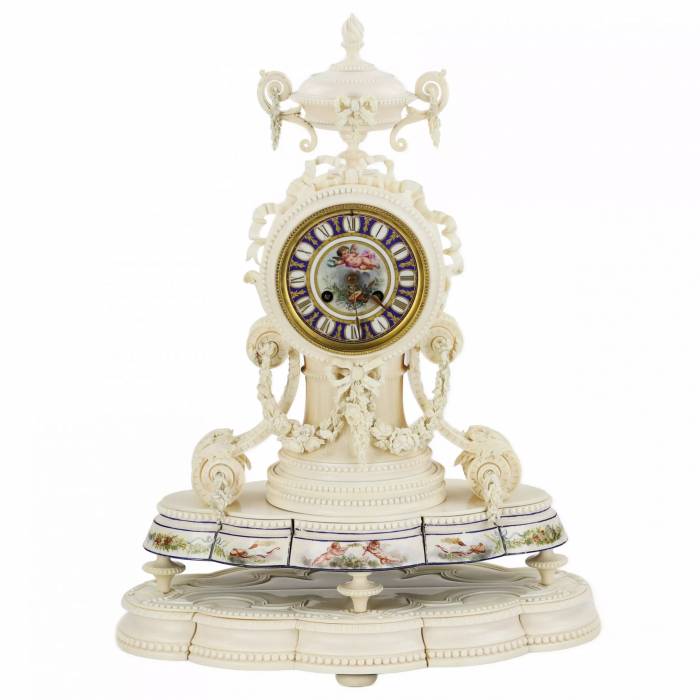
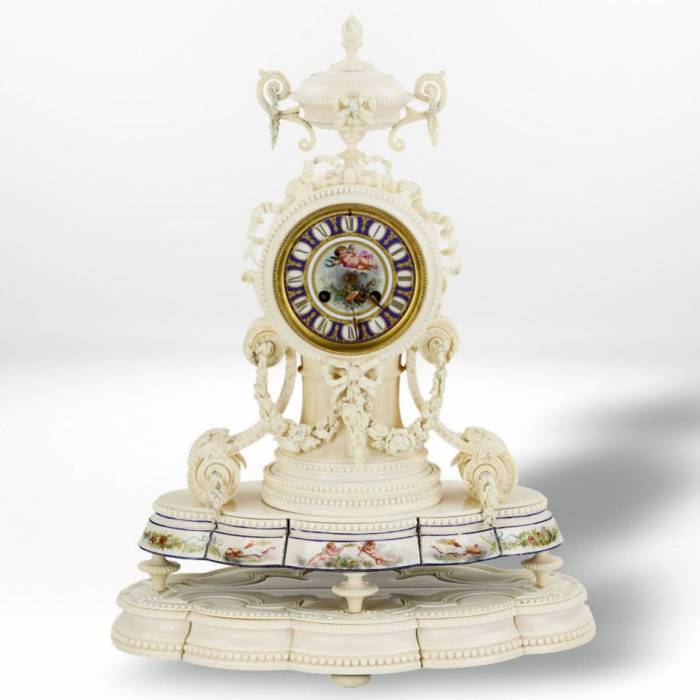
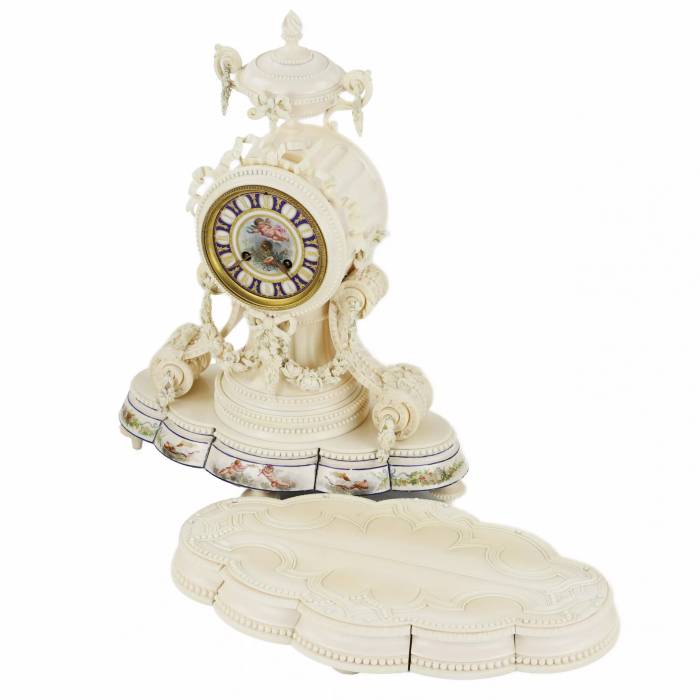
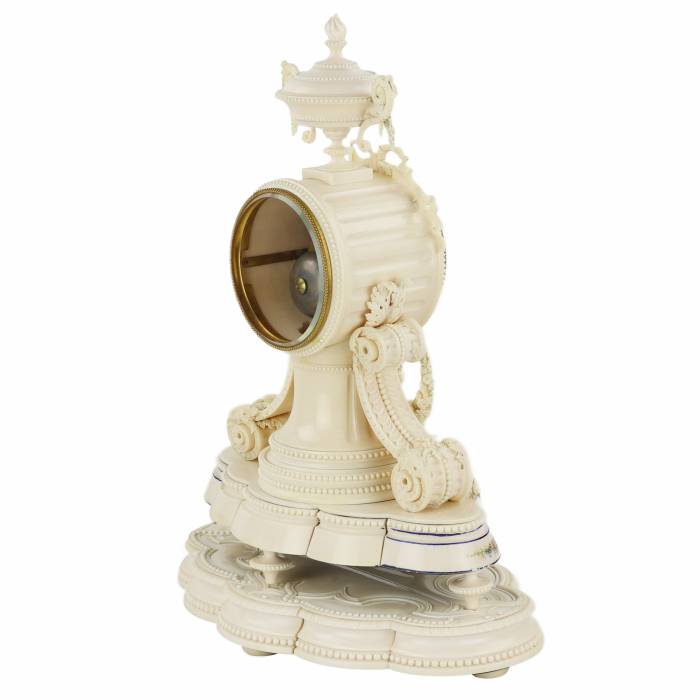
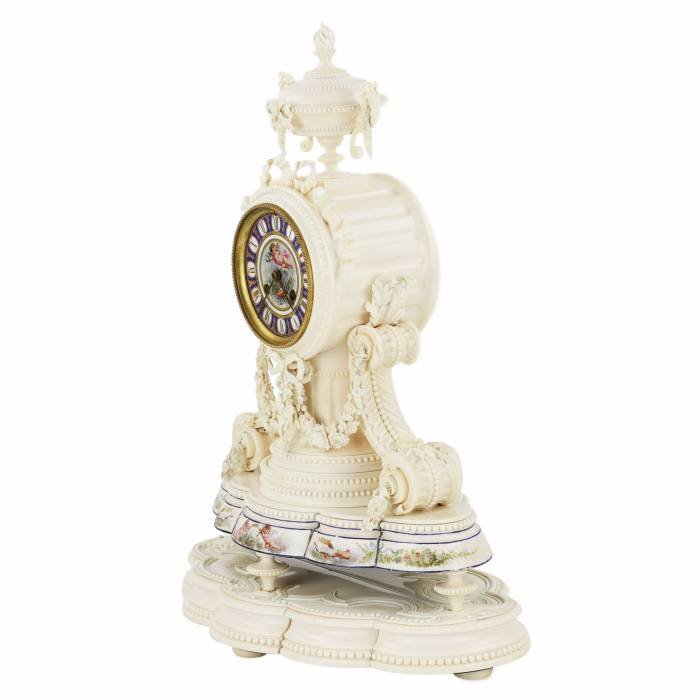
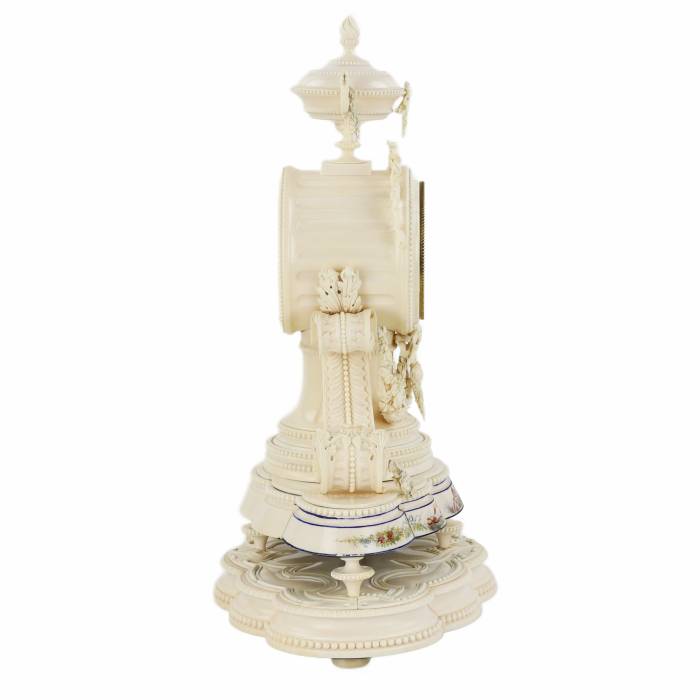
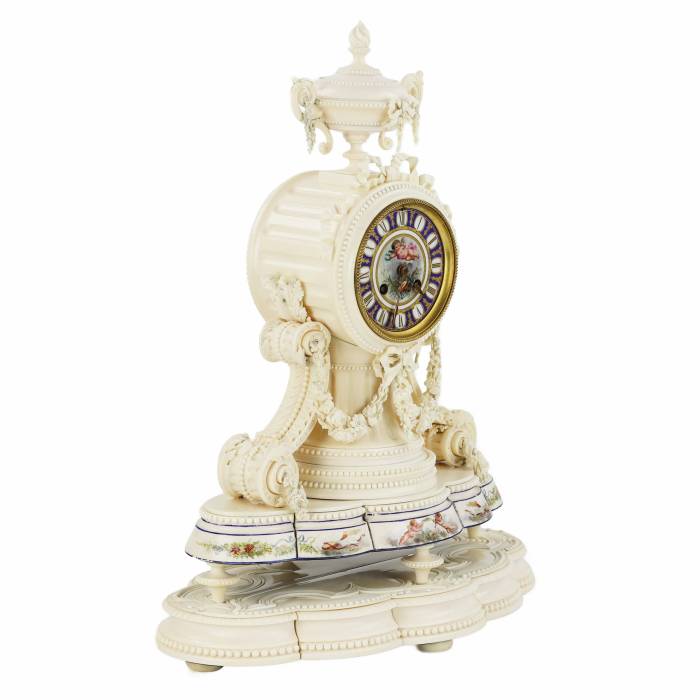
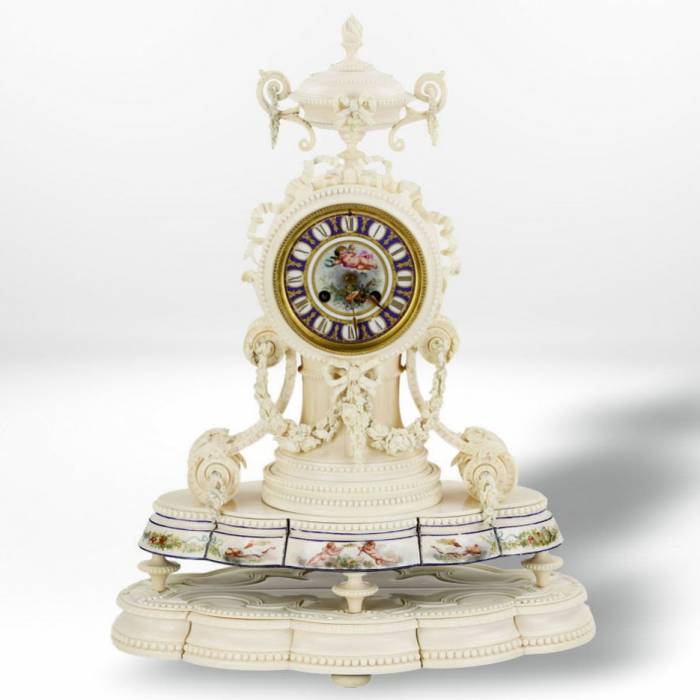
An exceptional mantel clock from the Napoleon III period, executed in the Neoclassical style and distinguished by a rare degree of artistic and technical refinement. The case is entirely carved from ivory, featuring a finely articulated architectural silhouette with columnar supports, volutes, garlands, rosettes, and a krater-shaped vase crowning the composition. The overall design demonstrates symmetry and ceremonial grandeur characteristic of Parisian decorative arts of the 1860–1880s.
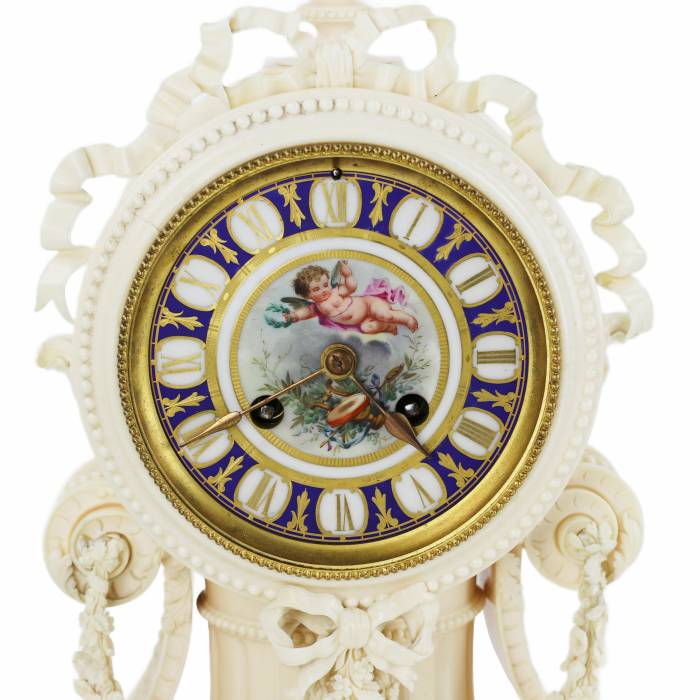
The porcelain dial, presumably produced by the Royal Sèvres Manufactory, is decorated with a painted composition depicting a flying Cupid holding a wreath, accompanied by musical instruments and floral motifs. The Roman numeral chapter ring is set against a deep cobalt-blue ground with gilded ornamentation and enclosed within a gilt brass bezel. The original pierced gilt hands enhance the refined appearance of the dial.
The lower frieze of the case is painted in oils with scenes of playing putti, musical attributes, and floral garlands, emphasizing the allegorical themes of love, harmony, and the arts. The clock rests on a complex, multi-tiered ivory base with profiled relief and decorative feet.
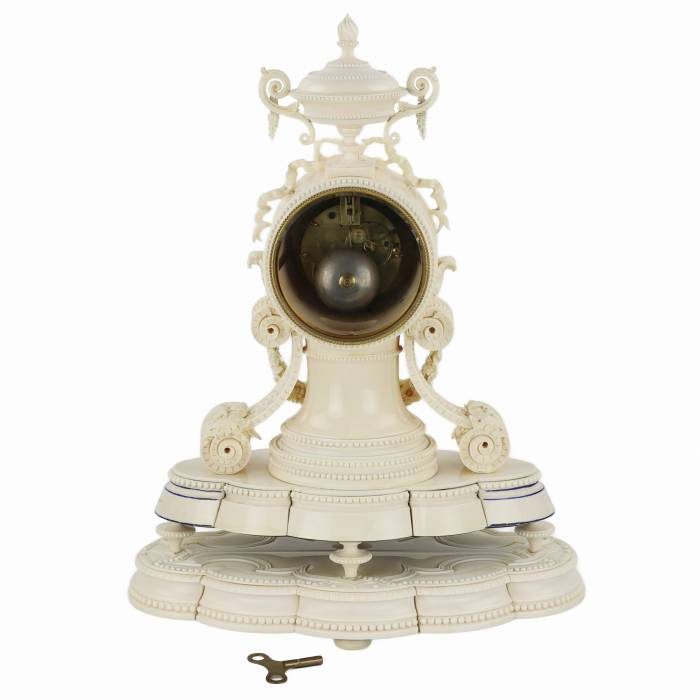
The French movement features an anchor escapement and striking mechanism, signed “S. Marti & Cie – Médaille de Bronze” and additionally numbered “Chameroy – 178”. The movement has undergone professional servicing and is in working order. During inspection, a historical presentation inscription was discovered on the interior of the base beneath a brass cover: “Wedding gift to Marie Dessarps …”, adding notable memorial and provenance value.
Marks: Movement signed “S. Marti & Cie – Médaille de Bronze”; numbered “Chameroy – 178”.
Dimensions: 50 × 37.5 × 23.5 cm.
Weight: Approx. 6,900 g.
Condition: Good, with natural traces of age and use.
Provenance: France, Paris; private European collection. Accompanied by a CITES certificate permitting circulation within the EU.
The reign of Napoleon III (1852–1870) marked a flourishing period in French decorative arts, with Paris firmly established as a global artistic center. The Second Empire style combined Neoclassicism with elements of Baroque and Renaissance, characterized by opulence and representational splendor. Mantel clocks occupied a central position in aristocratic and bourgeois interiors, serving both as functional objects and symbols of social prestige.
The use of ivory for clock cases was reserved for exceptional commissions. Valued for its noble tonality, fine carving properties, and associations with Antiquity, ivory perfectly aligned with Neoclassical aesthetics. Such clocks were produced in limited numbers or as unique pieces for affluent patrons and frequently incorporated porcelain dials and painted friezes executed in collaboration with leading French manufactories.
S. Marti & Cie was among the most prominent French clock movement manufacturers of the 19th century. Founded by Samuel Marti, the firm regularly participated in international exhibitions and received numerous distinctions, including an Honorary Diploma in 1839, a Bronze Medal in 1860, a Silver Medal in 1889, and several Gold Medals in 1841, 1851, 1852, and 1900. Following the 1860 Paris Exhibition, the Bronze Medal designation was consistently stamped on Marti movements as a mark of quality.
In the 1860s, S. Marti & Cie collaborated with renowned manufacturers such as Roux and Japy Frères, ensuring technical excellence and widespread use of its movements in high-quality Parisian cases. The name Chameroy appears in 19th-century Parisian horological archives, associated with the trade and commissioning of fine clock movements.
The presence of a personal presentation inscription confirms the private nature of the commission and highlights the social role of such clocks as commemorative gifts linked to significant family events. Today, Napoleon III ivory mantel clocks with S. Marti movements are regarded as rare museum-level objects, embodying a synthesis of sculpture, painting, and horology, and are highly prized in both private and institutional collections.
Overall good condition. The ivory case displays a natural age patina with no significant losses. The painted dial and frieze are well preserved. The movement has been serviced and is in working order. Minor signs of age consistent with the period.
The condition report is provided for informational purposes only.
It is not comprehensive and may not reflect all defects, restorations, alterations, or adaptations, as Antiqon does not perform professional conservation-level assessments. The information is based on a qualified, yet subjective, evaluation by our specialists.Before purchasing, we recommend consultation with an independent expert.Please also consult our Terms and conditions and Glossary A-Z, which contain important information on lot characteristics and sale conditions.