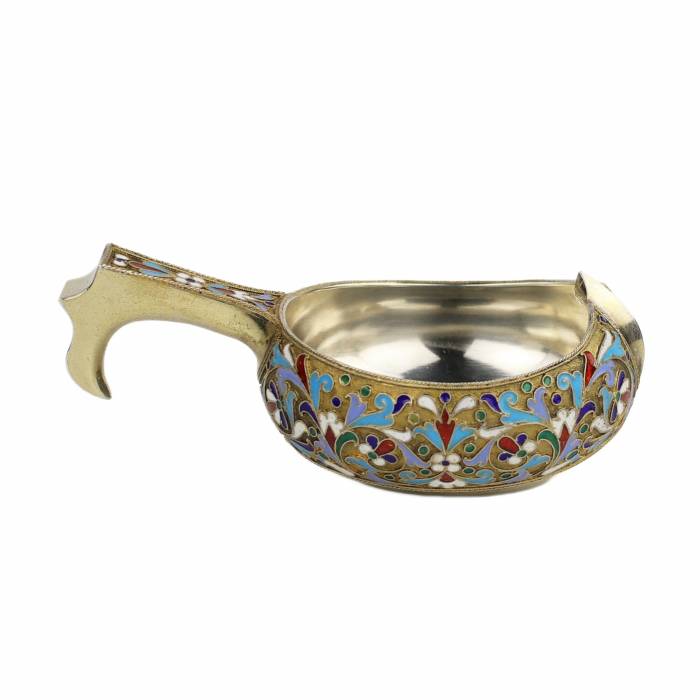
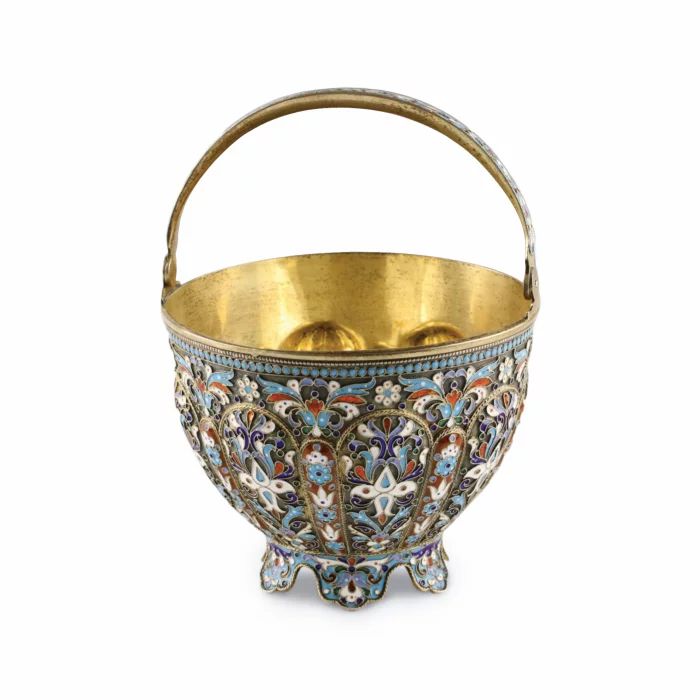
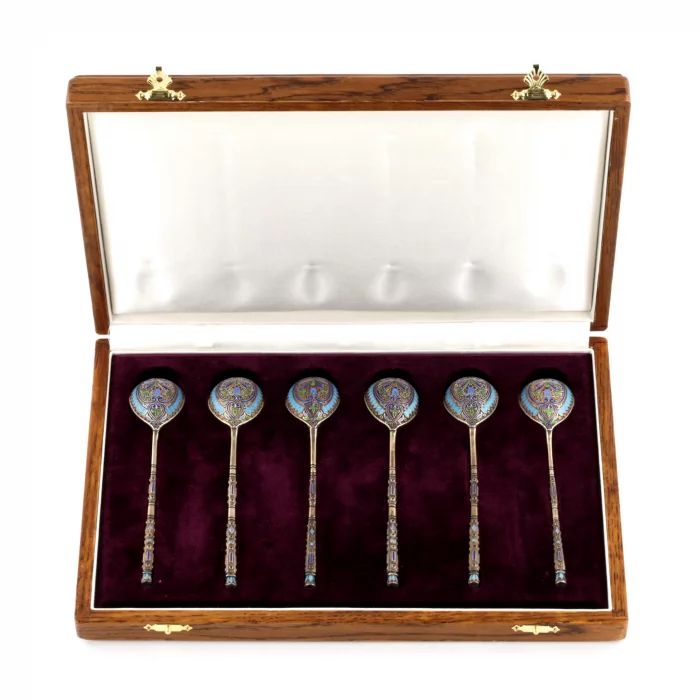
A highly refined silver shot cup of slightly flared cylindrical form, produced in the workshop of Pavel Akimovich Ovchinnikov, Purveyor to the Russian Imperial Court. The body is entirely covered with complex polychrome plique-à-jour enamel featuring an elaborate decorative composition depicting a swallow, a heron and a swan on a pond against the backdrop of a rising sun. The ornamental scheme is based on a harmonious combination of deep blue, green, amber and red tones, using translucent and semi-translucent enamels to create an effect of luminous depth and painterly vibration.
The decoration is distinguished by a dense ornamental structure, finely executed partitions and masterful command of enamelling techniques, characteristic of the finest works of the Moscow artistic jewellery school of the late Imperial period.
Hallmarks: Maker’s mark of the firm P.A. Ovchinnikov beneath the Imperial double-headed eagle, indicating Purveyor to the Russian Imperial Court; Moscow assay mark with a female head in kokoshnik facing left, in an oval cartouche, corresponding to the period 1899–1903; silver standard “84” zolotnik; maker’s mark “A.B.” – Alexander Bushkov, goldsmith working in the workshops of P.A. Ovchinnikov.
Dimensions: Height 7.5 cm; diameter 5.5 cm.
Weight: 75.6 g.
Condition: Good. Minor traces of wear and small enamel losses consistent with age.
Provenance: Private European collection.
The firm of Pavel Akimovich Ovchinnikov occupies a key position in the history of Russian silver and jewellery art of the second half of the 19th and early 20th centuries. Founded in Moscow, the enterprise became one of the leading centres of artistic metalwork in the Russian Empire and was granted the honorary title of Purveyor to the Russian Imperial Court, an official recognition of the highest artistic and technical standards. The firm’s production was distinguished by exceptional silver quality, refined chasing and, above all, virtuoso mastery of enamelling techniques, which became a hallmark of the Moscow school.
Of particular significance in the present work is the use of plique-à-jour enamel, one of the most complex and rare techniques in Russian jewellery of the late 19th century. Unlike traditional cloisonné enamel, plique-à-jour enamel lacks a metal backing beneath the glassy coloured layer. As a result, light passes freely through the enamel, creating effects of transparency, depth and luminous vibration that bring the object close to the aesthetic of stained glass. This technique required extreme precision in the construction of partitions, multiple firings and strict temperature control, as even minor deviations could result in cracking or loss of enamel.
In the workshops of P.A. Ovchinnikov, plique-à-jour enamel was used primarily for ceremonial and representative objects of small form, intended for Imperial and aristocratic commissions. The choice of this technique underscores the high status of the object and places it among the most prestigious productions of the firm. Motifs of birds, water landscapes and the rising sun harmonised naturally with the transparent qualities of plique-à-jour enamel, enhancing a sense of airiness, movement and poetic symbolism characteristic of the Art Nouveau aesthetic.
At the turn of the 19th and 20th centuries, Russian decorative art underwent a significant renewal of artistic language. The стремление to synthesise painting, ornament and form, together with an increased interest in natural motifs, found expression in works such as this, where utilitarian function gave way to artistic expressiveness. Shot cups with plique-à-jour enamel thus served not only practical purposes but also functioned as status objects for the ceremonial table, commemorative gifts and collectible works of art.
Today, works by the firm of P.A. Ovchinnikov from this period are preserved in major museum and private collections and are highly valued on the international art market as vivid testimonies to the flourishing of Russian jewellery art in the late Imperial era.
Overall good condition. Minor localized losses and wear to the plique-à-jour enamel. Silver with natural patina, without deformation or restoration.
The condition report is provided for informational purposes only.
It is not comprehensive and may not reflect all defects, restorations, alterations, or adaptations, as Antiqon does not perform professional conservation-level assessments. The information is based on a qualified, yet subjective, evaluation by our specialists.Before purchasing, we recommend consultation with an independent expert.Please also consult our Terms and conditions and Glossary A-Z, which contain important information on lot characteristics and sale conditions.