





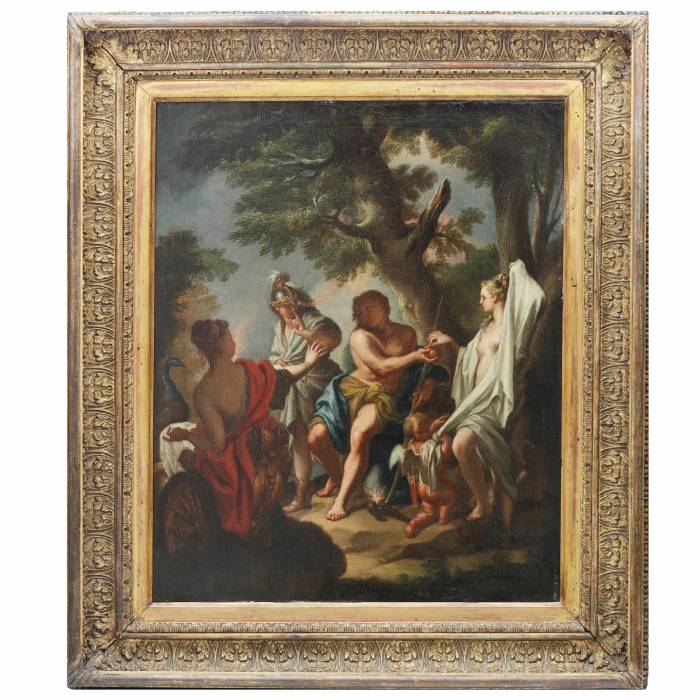
THE JUDGEMENT OF PARIS WESTERN EUROPE, FLEMISH SCHOOL, EARLY 18TH CENTURY
AntiqonART consultant will contact you within one business day after receiving your request.

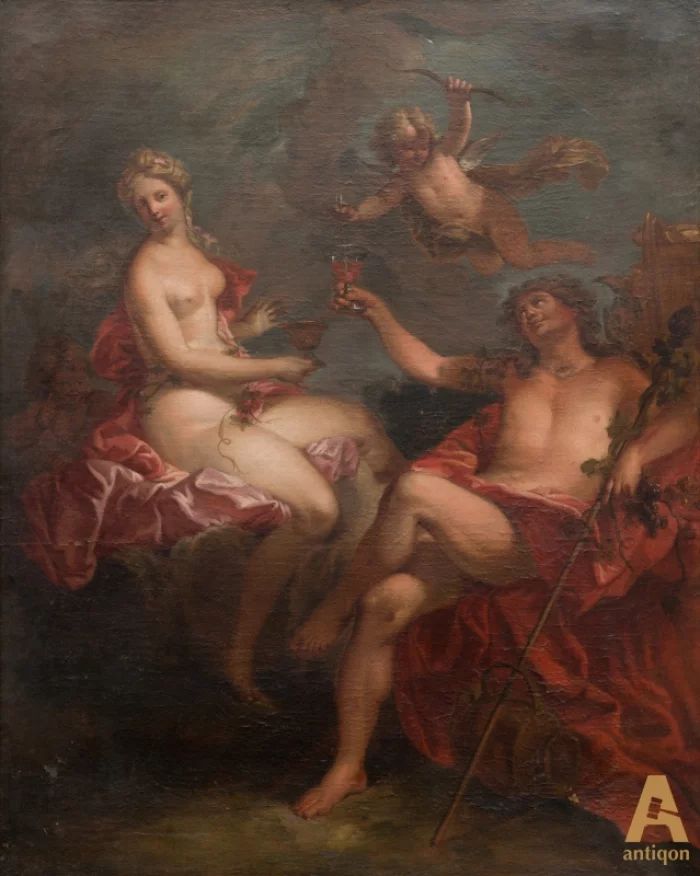
The painting The Judgement of Paris represents a refined work of Western European art of the early 18th century, executed in the tradition of the Flemish school. The canvas illustrates the classical myth in which Paris, son of Priam, king of Troy, is called to decide who among the three goddesses — Hera, Athena, or Aphrodite — deserves the title of “the fairest.” At the centre of the scene, Paris is seated under a tree, handing the golden apple to Aphrodite. Draped in a light garment, she receives the prize with elegance, while Cupid, with his quiver, stands beside her. To the left, Athena in helmet and armour gestures towards herself, while majestic Hera, accompanied by her peacock, observes the decision.
The work is marked by vibrant contrasts of light and shade and by the rich palette characteristic of the Flemish school, directly inspired by Peter Paul Rubens (1577–1640) and his circle. The baroque sensuality of the figures merges with a more orderly composition, in line with the aesthetics of the early 18th century.
Dimensions: Canvas 65 × 77 cm. Frame: height 97 cm, width 85 cm, depth 13 cm.
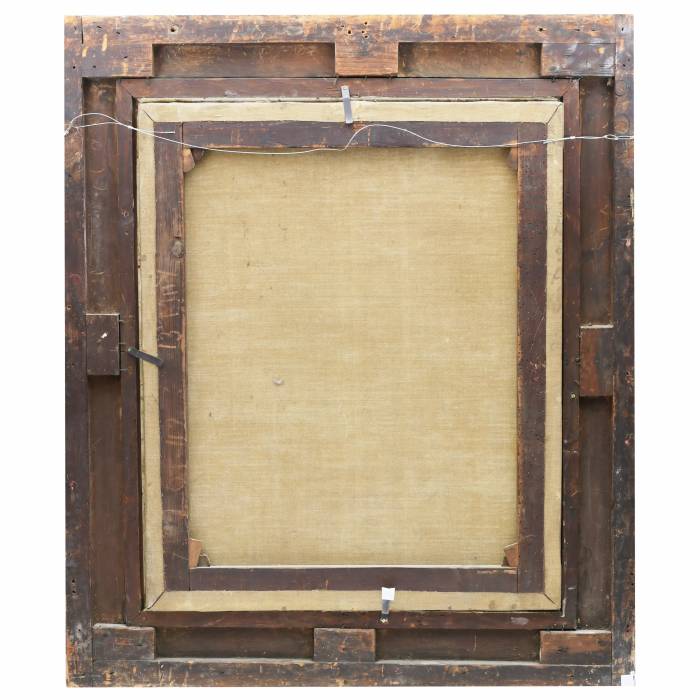
Material: Oil on canvas, relined.
Condition: Good preservation: canvas relined, paint layer stable, uniform craquelure and patina of age. Original gilt frame with natural wear, small losses and darkening, retaining decorative impact.
Provenance: European private collection.
The theme of The Judgement of Paris was one of the most beloved in European art and found particular resonance in the Flemish school of the 17th century, which set the standard for later interpretations. Based in Antwerp, the Flemish painters were renowned for their dramatic energy and sensual rendering of form. Peter Paul Rubens (1577–1640) established the archetype of this myth, presenting Paris’ choice not merely as a tale, but as an allegory of human destiny — a choice between power (Hera), military glory (Athena), and love (Aphrodite). His compositions, full of movement, colour, and corporeality, became models for generations of artists.
His pupils and followers, such as Jacob Jordaens (1593–1678) and Anthony van Dyck (1599–1641), carried these ideas forward, spreading them across Europe. By the early 18th century, the Flemish legacy deeply influenced French, German, Austrian, and Italian painters, who sought to balance baroque exuberance with the clarity of classicism. Thus, each new version of The Judgement of Paris became a dialogue between the sensuality of Flemish baroque and the harmony of the new century.
The present painting embodies this synthesis: baroque vitality and rich palette are combined with compositional clarity of the early 18th century, making it not only an artwork of decorative elegance but also a testimony to the enduring influence of the Flemish school on European art.
The painting is in good overall condition: relined canvas, stable paint surface, uniform craquelure with patina. The original gilt frame retains its decorative quality, despite minor losses and darkening.
The condition report is provided for informational purposes only.
It is not comprehensive and may not reflect all defects, restorations, alterations, or adaptations, as Antiqon does not perform professional conservation-level assessments. The information is based on a qualified, yet subjective, evaluation by our specialists.Before purchasing, we recommend consultation with an independent expert.Please also consult our Terms and conditions and Glossary A-Z, which contain important information on lot characteristics and sale conditions.