Price:
3000 €
Add to cart
We will only share latest what our month on the TRADING HOUSE S.G. GALKIN & CO.
HISTORY AND DEVELOPMENT
The origins of the enterprise date to 1890, when Semyon Grigorievich Galkin established a jewellery workshop in Moscow. In 1892, the firm was officially registered under the name “S.G. Galkin & Co”, marking its transformation into a fully developed trading house with integrated production and commercial operations.
Between 1895 and 1897, a retail jewellery shop was opened on Pokrovka Street, in the Shishelov House, located in the Yauza district of Moscow. The main manufacturing facilities were situated in Maryina Roshcha, at 41 Novoye Shosse. According to records from 1898, the factory employed 48 workers and 12 apprentices, with an annual output valued at approximately 50,000 roubles.
By 1904, the workforce had grown to 116 employees. In 1909, the enterprise employed 79 workers and reported an annual turnover of around 175,000 roubles, reflecting a period of stabilisation and sustained commercial activity. From 1913 to 1917, the trading house operated from Sheremetevskaya Street, house 11, in Maryina Roshcha, continuing its activity until the revolutionary events and subsequent nationalisation.
TITLES, AWARDS AND COMMISSIONS
The Trading House S.G. Galkin & Co actively participated in major artistic and industrial exhibitions of its time. In 1896, the firm took part in the All-Russian Art and Industrial Exhibition in Nizhny Novgorod, where it was awarded a medal for the high quality of its workmanship.
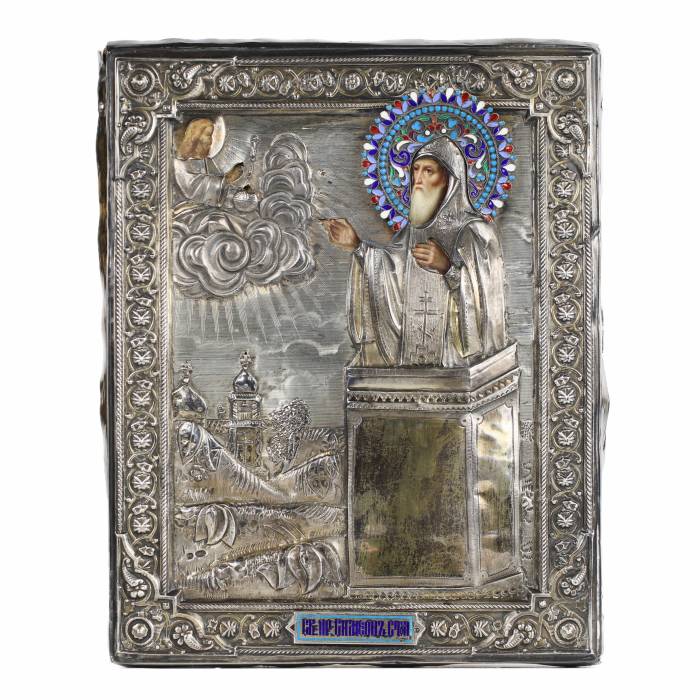
The firm maintained commercial relationships with Moscow and Saint Petersburg trading houses as well as ecclesiastical institutions. Documented commissions include supplies for the firm of O.F. Kurlyukov. For the firm of I.E. Morozov in Saint Petersburg, S.G. Galkin & Co produced engraved and chased icon covers, crosses, and other ecclesiastical and ceremonial objects, confirming its established specialisation in church metalwork.
ARTISTIC SPECIFICITY AND TECHNIQUES
The production of the trading house encompassed a wide range of gold and silver objects of utilitarian, decorative and devotional character. A significant part of the output consisted of icon covers, executed using repoussé and engraving techniques, often combined with gilding and mixed surface treatments.
Additional techniques included casting, soldering and refined hand-finishing. The artistic language of the works reflects Late Historicism and Eclecticism, characteristic of Moscow jewellery production at the turn of the 20th century, with an emphasis on clarity of ornament and structural durability.
LEGACY AND MASTERPIECES
The works of S.G. Galkin & Co, including icon covers and ecclesiastical metalwork, represent characteristic examples of Moscow factory-based jewellery production of the pre-revolutionary period. The firm’s legacy holds documentary significance for the study of Russian church and applied jewellery of the late 19th and early 20th centuries and remains of interest to museum collections and specialised private collectors.
MARKET ANALYSIS
Exceptional Works: Large-scale commissioned or unique ecclesiastical and ceremonial objects, including icon covers with documented provenance, are rare and belong to the upper market segment. The estimated price range is €80,000–150,000 when museum-level pieces appear on the market.
Rare Works: Icon covers, crosses and high-quality silver and gold objects from the late 19th and early 20th centuries demonstrate stable collector demand. The estimated price range is €15,000–60,000, depending on condition, technical complexity and attribution.
Serial Works: Standard factory production, including utilitarian silver objects and serial items, occupies the lower market segment. The estimated price range is €2,000–15,000, with demand confirmed by results from leading international auctions.