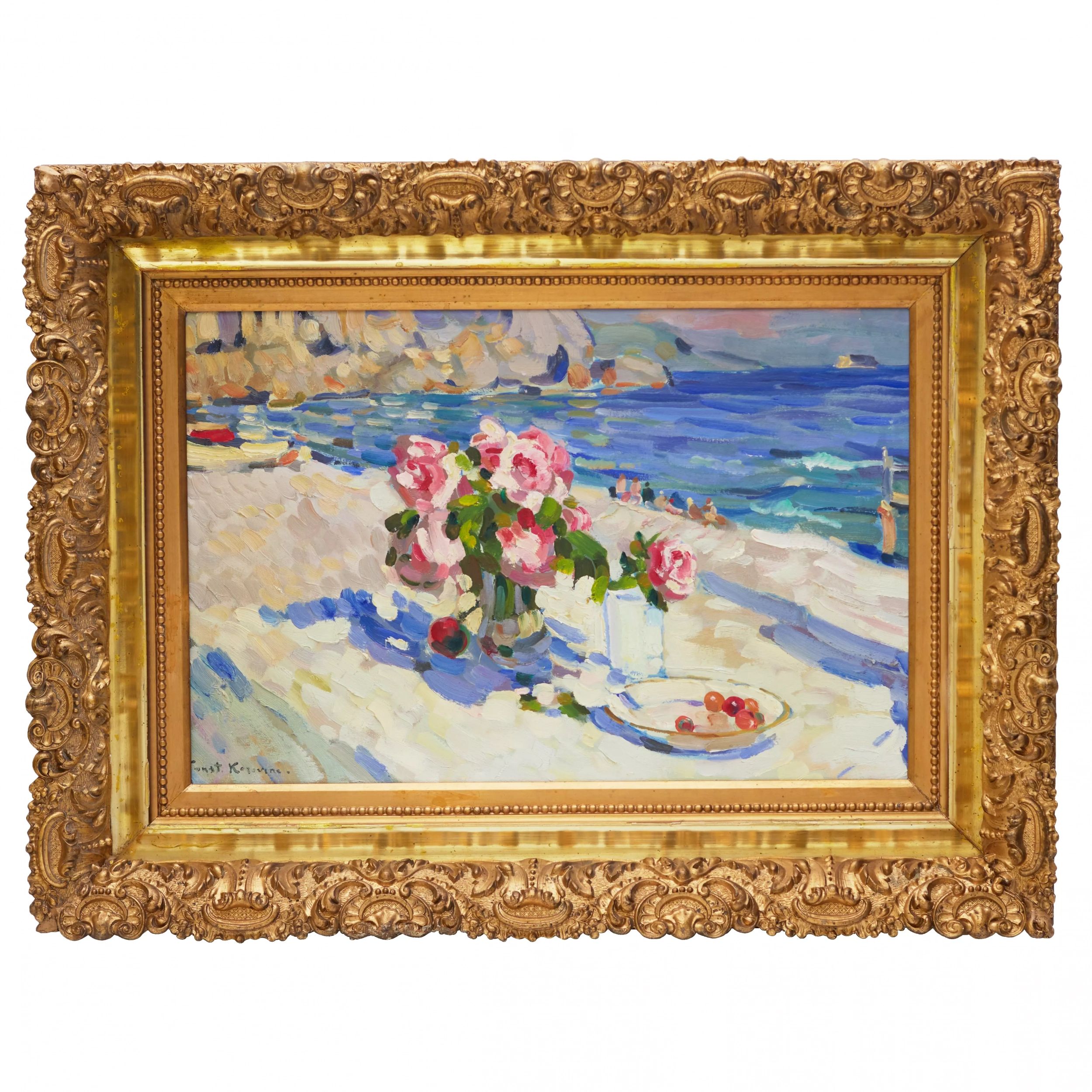

KONSTANTIN KOROVIN (1861–1939). STILL LIFE AGAINST A LANDSCAPE RUSSIA / FRANCE, 1930s
AntiqonART consultant will contact you within one business day after receiving your request.
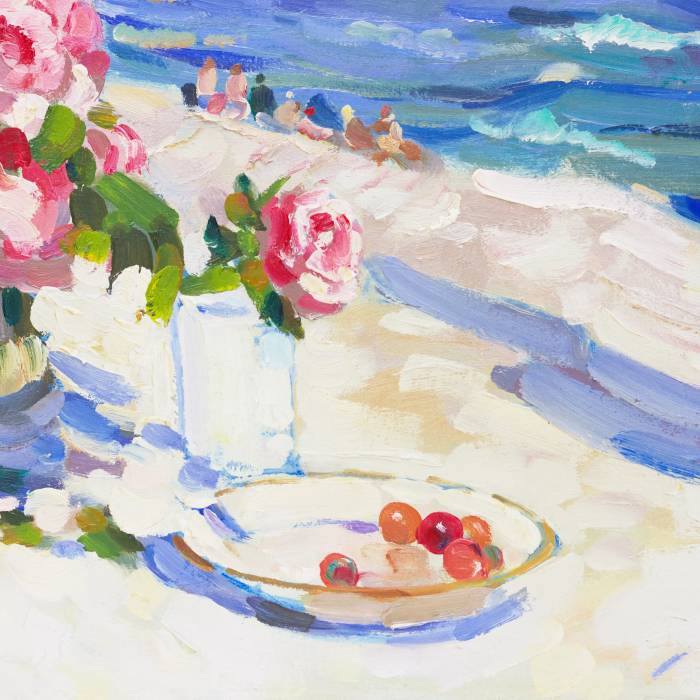
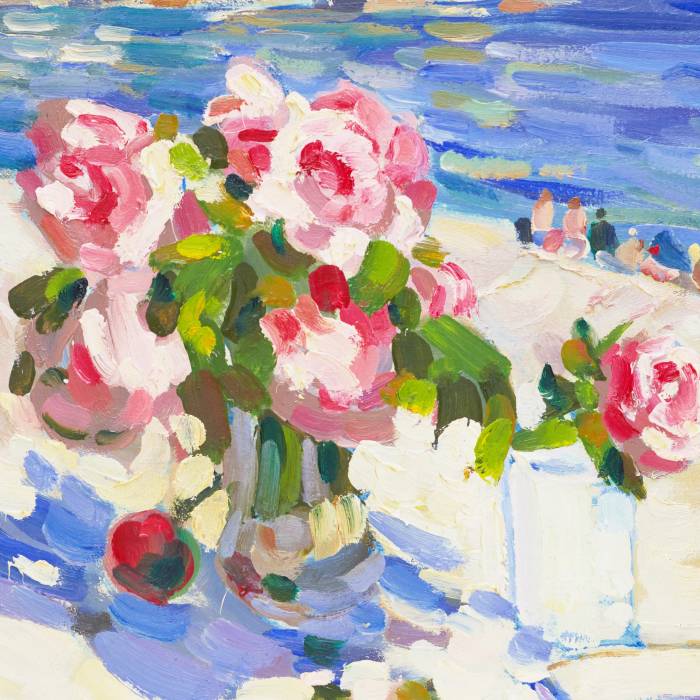
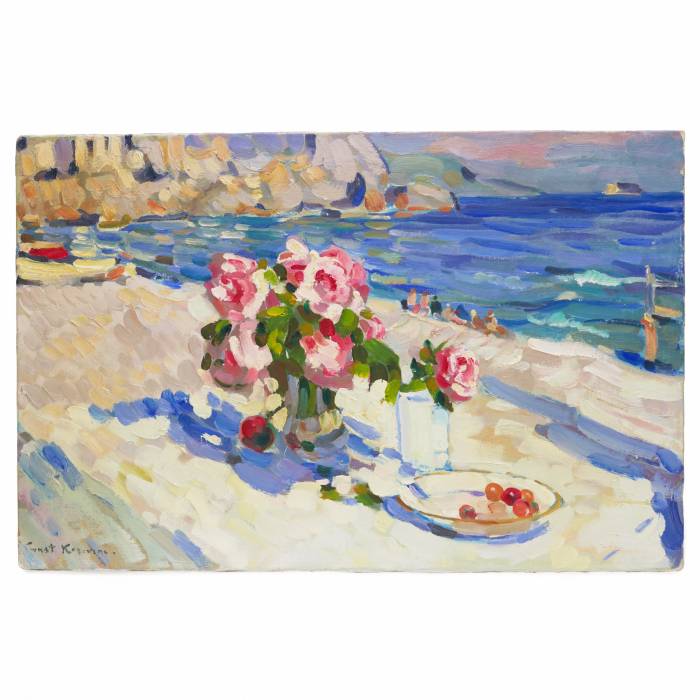
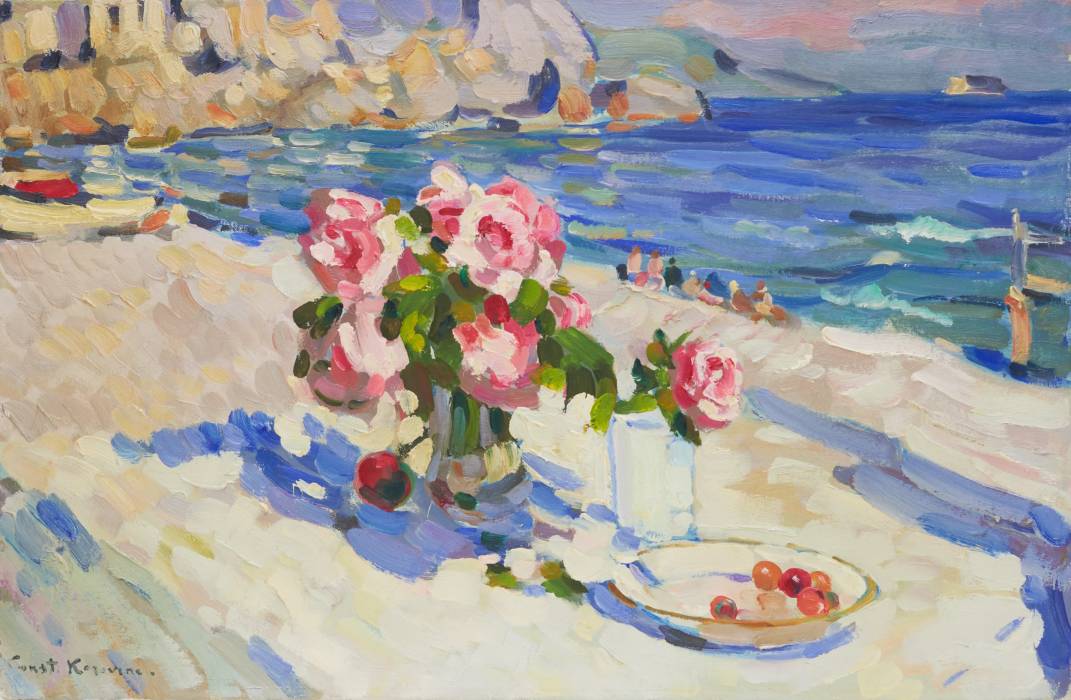
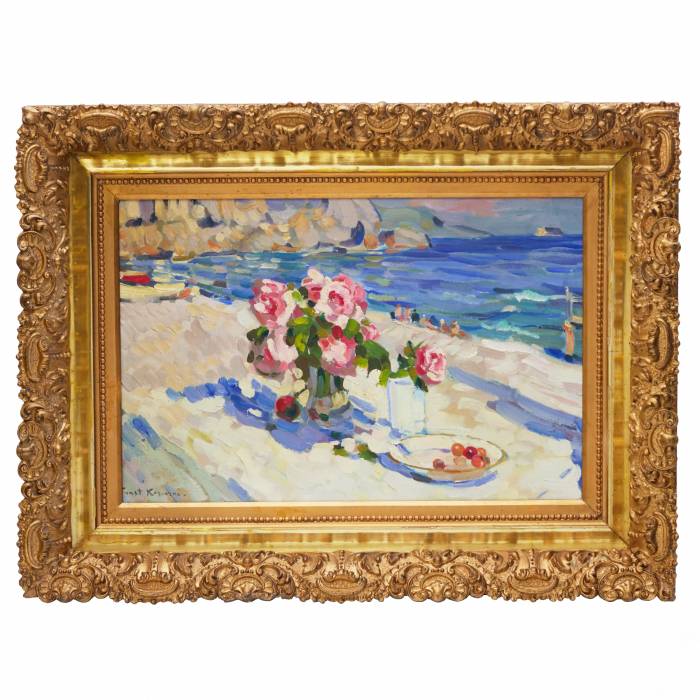
A charming, sunlit composition executed in the 1930s in the spirit of the late Impressionism of the great Russian painter Konstantin Korovin transports the viewer into an atmosphere of southern light and serenity. On a white tablecloth are depicted a bouquet of roses, apples, and a dish of fruit, while behind them the shimmering sea dissolves into transparent air. As in his celebrated Gurzuf Bouquets by the Sea, still life and landscape merge into a single breath, becoming a hymn to midday, warmth, and the joy of life.
Free brushwork, pearly reflections, and the trembling play of light create an atmosphere in which air itself becomes the main protagonist. The artist unites objects and space in a musical chord of light, transforming painting into the poetry of the moment. Everything here is imbued with the artist’s characteristic sensibility, where each brushstroke is filled with the joy of perceiving the world.
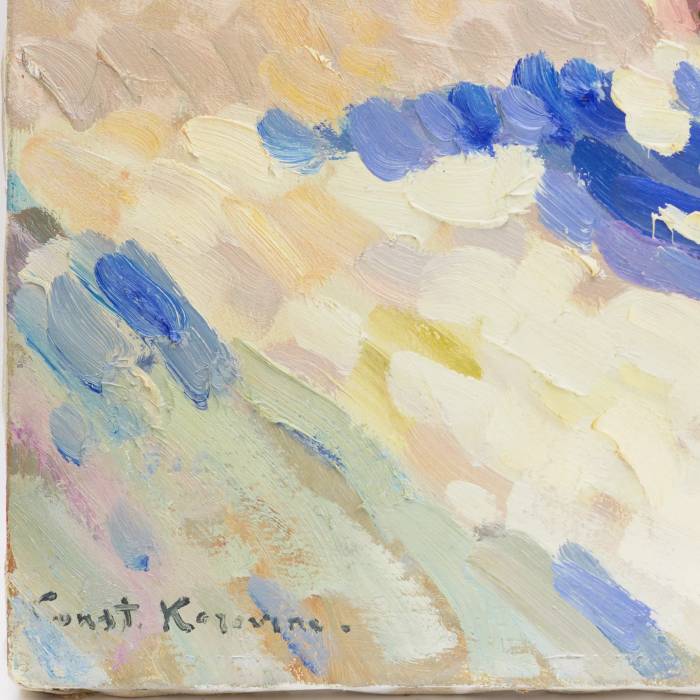
Signature: In the lower left corner in Latin letters: Const. Korovine.
According to historical sources and modern scholarly research, no comparable still lifes by Konstantin Korovin are known from the later period of his life. Technical examination of this work indicates that it was created in the 1930s, a time when the artist was already in advanced age and rarely returned to the motifs of his famous Gurzuf cycle of 1910–1917. It was during those years that Korovin created his celebrated Bouquets by the Sea and Roses with a View of the Black Sea, which became symbols of the poetry of light, peace, and the beauty of the Russian South.
The results of the research suggest that the present work originated within the master’s circle, during a period when his son, the painter Alexei Korovin (1897–1950), under the direct guidance of his father, reproduced the beloved motifs of the Crimean cycle. These compositions enjoyed enduring popularity among collectors and admirers of the artist’s work—émigrés from Russia living in Paris. For them, such images were not only a remembrance of their homeland but also a symbol of hope for the spiritual rebirth of Russia, its return to light, harmony, and inner freedom, embodied in the art of Konstantin Korovin. The compositional solutions, character of brushwork, and painterly texture confirm the work’s connection to the artistic tradition and aesthetic of the Korovin school.
Dimensions: 42 × 71 cm
Framed dimensions: 66 × 86 × 11 cm
Medium: Oil on canvas
Condition: Good. Minor surface dust; no restorations or losses. The canvas is dense and well-stretched.
Expertise: Mākslas un antikvāro priekšmetu eksperti, Riga, 10 June 2025 (Dz. Temerova, L. Liepa). Attributed to Konstantin Korovin (1861–1939)
Provenance: Private European collection
Historical and Biographical Background
Konstantin Alexeevich Korovin (1861–1939) was one of the foremost Russian painters of the late 19th and early 20th centuries, a representative of the Moscow school of Impressionism and a master of plein-air light and theatrical decorativeness. After emigrating to France in 1923, the artist settled near Paris, where he continued to paint intimate landscapes, still lifes, and scenes of the French countryside — works increasingly infused with a nostalgic longing for Russia.
His son, Alexei Korovin (1897–1950), also became a painter and his father’s student, inheriting both his technique and range of motifs — southern landscapes, floral still lifes, and urban street scenes of Paris. Living in France, Alexei participated in exhibitions of the Russian émigré community but never achieved broad recognition, remaining in the shadow of his father’s celebrated name.
Artistic Relationship and Question of Authorship
In the final years of his life, Konstantin Korovin’s painting became especially intimate and lyrical. Archival and technical research indicates that no verified still lifes comparable to the present work are known in the artist’s surviving oeuvre. A technical examination of the canvas and paint layer dates the work to the 1930s, when Korovin, already of advanced age, had largely withdrawn from active painting and only occasionally returned to the motifs of his inspired Gurzuf period (1910–1917).
These years in France became a time of reflection and remembrance. His painting took on a chamber-like, contemplative character, suffused with soft light, nostalgia, and memories of Crimea — of the sun and freedom of the southern coast.
Scholars note that Alexei Korovin consciously followed his father’s aesthetic, creating works that pursued similar aims of light and color. His paintings, particularly the still lifes and southern landscapes of the 1930s, were often perceived by the public as late works by Konstantin Korovin, at a time when the master himself was painting less frequently.
There are documented instances where Alexei’s works were signed with his father’s name — not with the intention to deceive, but for practical reasons: Konstantin’s paintings sold more easily, while Alexei’s had little commercial demand.
This practice is supported both by family recollections — letters, memoirs, and the writings of Vera Korovina, as well as by Konstantin’s own correspondence — and by modern scientific research, including radiography, spectral pigment analysis, and comparative studies revealing differences in brushwork and facture.
Contemporary art historians agree that some of Alexei Korovin’s paintings indeed entered the art market bearing the signature “K. Korovin,” primarily still lifes and landscapes of the 1930s created under his father’s supervision or with his participation.
The present work is presumed to belong to this circle. It unites the painterly traditions of Konstantin Korovin with the emotional warmth of his school, embodying light, harmony, and the spiritual continuity of two generations — father and son.
The painting is in good overall condition.
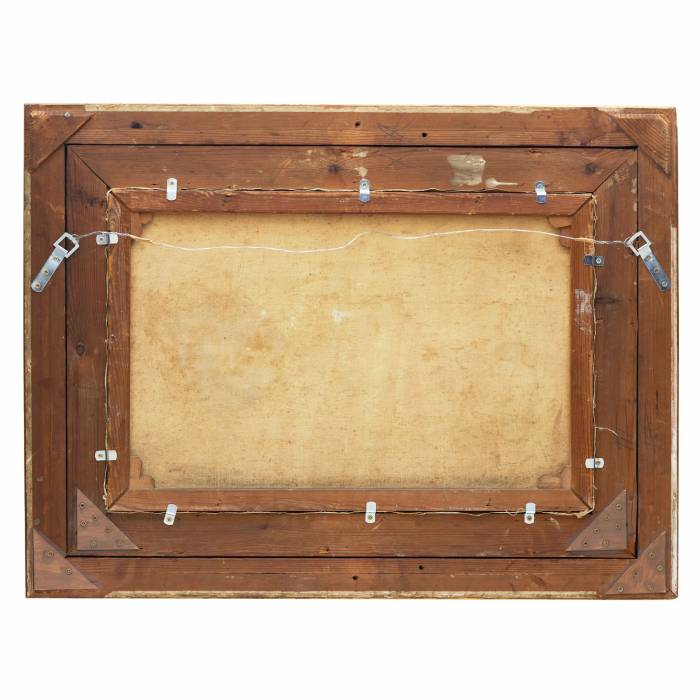
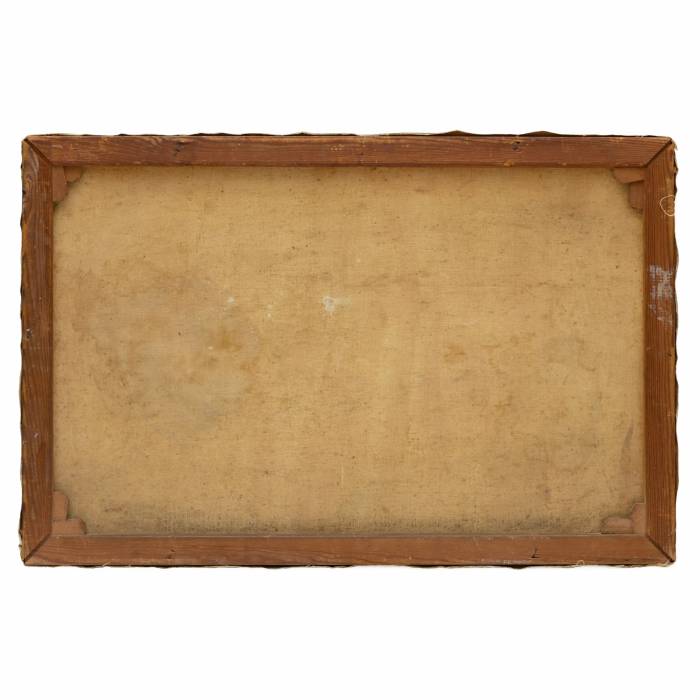
The canvas is fine linen of tight weave, primed on both sides and stretched on its original stretcher. The surface is even, with a light natural patina and minor traces of dust consistent with age. The paint layer is stable, without blistering, losses, or visible signs of restoration.
Under magnification, fine craquelure is present along with a uniform brush texture. The binding medium has fully polymerized; ultraviolet examination reveals a homogeneous paint surface without later additions.
The stretcher and mounting elements are original, dating from the 1930s. The frame is authentic, with a gentle patina and slight traces of age. Overall, the work is well preserved and of museum quality.
The condition report is provided for informational purposes only.
It is not comprehensive and may not reflect all defects, restorations, alterations, or adaptations, as Antiqon does not perform professional conservation-level assessments. The information is based on a qualified, yet subjective, evaluation by our specialists.Before purchasing, we recommend consultation with an independent expert.Please also consult our Terms and conditions and Glossary A-Z, which contain important information on lot characteristics and sale conditions.