
PURVĪTIS VILHELMS KĀRLIS. VILLAGE IN EARLY SPRING LATVIA, 1918
AntiqonART consultant will contact you within one business day after receiving your request.

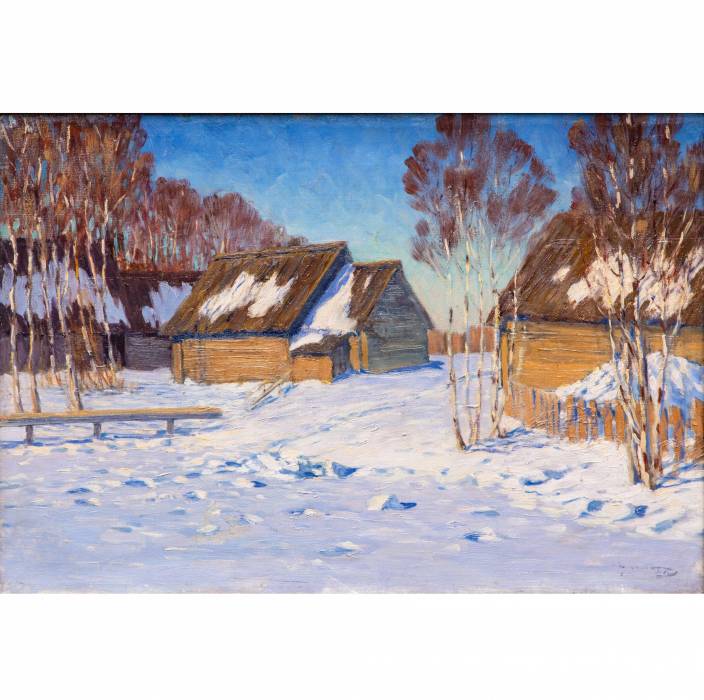
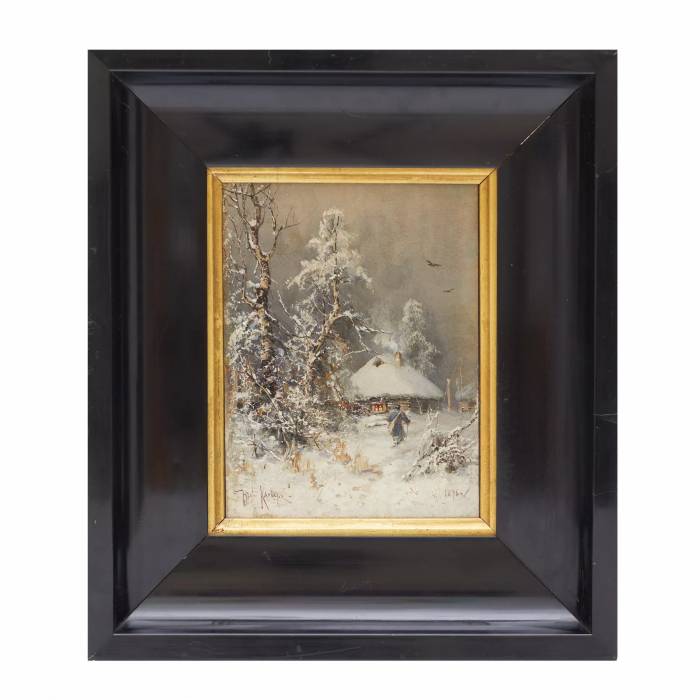
A pictorial work by the outstanding Latvian landscape master Vilhelms Kārlis Purvītis, representing one of the most characteristic motifs of his mature period. The composition depicts a rural courtyard in early spring: lingering snow, wooden buildings with darkened roofs, bare birch trunks, and a transparent, cold sky filled with light. The space is constructed with clarity and balance, defined by a clear horizon line and an open, breathing foreground.
The painting is distinguished by an expressive impasto surface, an energetic brushstroke, and a finely structured color palette. The whiteness of the snow is enriched with cool blue and lilac reflections, while the warm ochre and brown tones of the wooden architecture contrast with the clear turquoise-blue sky. Light plays a central role in the composition, creating a sense of a fragile transitional state between winter and spring. The work exemplifies Purvītis’ characteristic synthesis of realistic observation and decorative generalization of form.
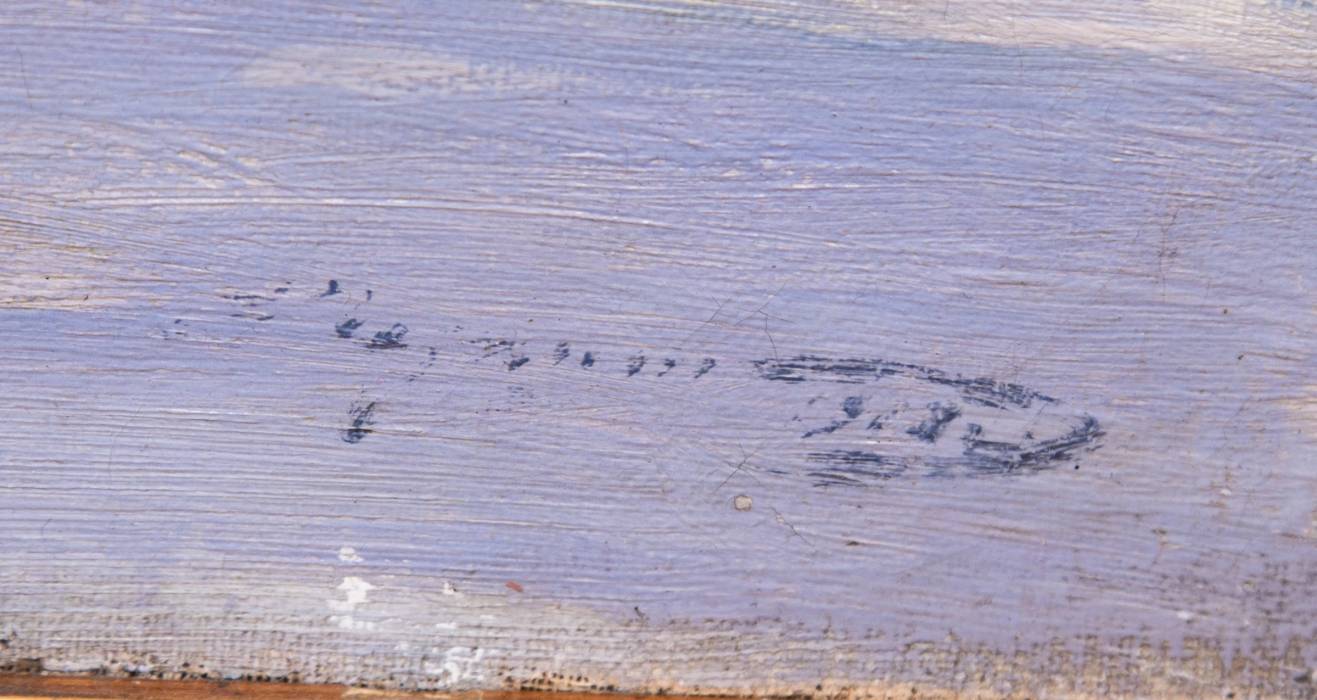
Signature: Signed and dated lower right: “Purvits 1918”, executed in blue paste over the dried paint layer.
Dimensions: 49 × 71 cm.
Material: Oil on canvas.
Condition: Good.
Expertise: Expert report dated 12 October 2021.
Provenance: Private collection.
Vilhelms Kārlis Purvītis (1872–1945) stands as a central figure of the Latvian national school of painting and one of the most significant landscape painters in Northern Europe during the first half of the twentieth century. His studies at the Imperial Academy of Arts in Saint Petersburg under Arkhip Kuindzhi shaped his exceptional sensitivity to light, spatial construction, and the emotional expression of landscape. From his earliest works, Purvītis sought not merely to depict a specific view, but to convey a state of nature, its inner rhythm and atmosphere.
The theme of early spring occupies a special place in the artist’s oeuvre. In the Latvian landscape, this season symbolizes awakening, transition, and a tense anticipation of renewal. In Purvītis’ works, spring is not decorative but philosophical: melting snow, cold light, and bare trees become metaphors for a fragile balance between past and future. Village in Early Spring belongs to the period in which the artist actively explored this motif, repeatedly returning to it in various interpretations, both from direct observation and from memory.
Stylistically, the painting demonstrates a synthesis of late Impressionist influences and the artist’s individual plastic language. The broad, sometimes fragmented brushstroke, the pronounced texture of the paint layer, and the free handling of color align with European artistic tendencies of the early twentieth century, while retaining a distinct national character. The coloristic solution, based on the interplay of cool blues and warm ochres, is characteristic of Purvītis’ authentic works from his Latvian period.
Comprehensive technological examinations, including microscopy, infrared and ultraviolet analysis, radiography, and X-ray fluorescence pigment analysis, confirm the consistency of the materials and technique with the stated date of 1918. The revealed preparatory drawing and the structure of the paint layer fully correspond to reference works by the artist preserved in museum collections. The painting possesses significant artistic and collectible value and represents an important work for both private collections and institutional holdings dedicated to Baltic and early twentieth-century European art.
Overall condition is good. The paint layer is stable, with no active losses. Surface texture is well preserved. Minor signs of natural aging are present, consistent with the age of the work. The canvas shows no deformation; restoration interventions are local and professionally executed.
The condition report is provided for informational purposes only.
It is not comprehensive and may not reflect all defects, restorations, alterations, or adaptations, as Antiqon does not perform professional conservation-level assessments. The information is based on a qualified, yet subjective, evaluation by our specialists.Before purchasing, we recommend consultation with an independent expert.Please also consult our Terms and conditions and Glossary A-Z, which contain important information on lot characteristics and sale conditions.

