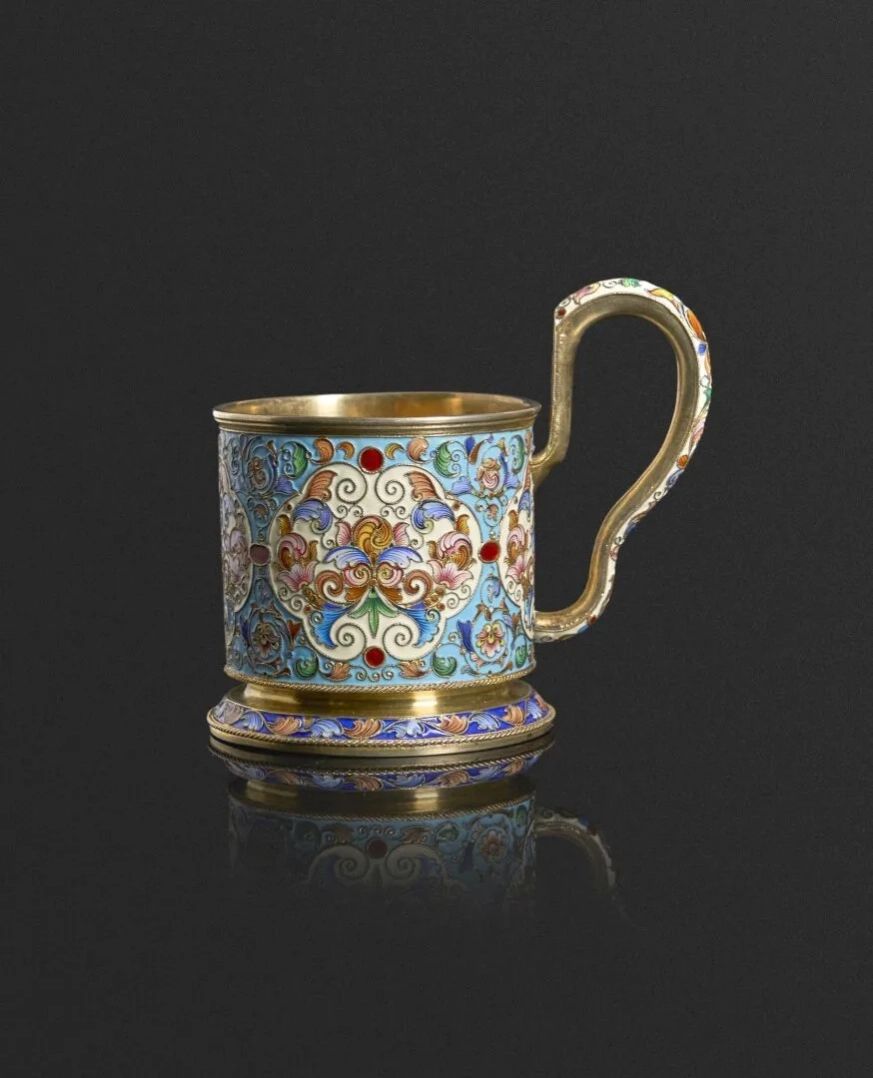



SILVER CLOISONNÉ-ENAMELLED TEA GLASS HOLDER. FYODOR RUCKERT RUSSIA, MOSCOW, TURN OF THE 19TH – 20TH CENTURY
AntiqonART consultant will contact you within one business day after receiving your request.
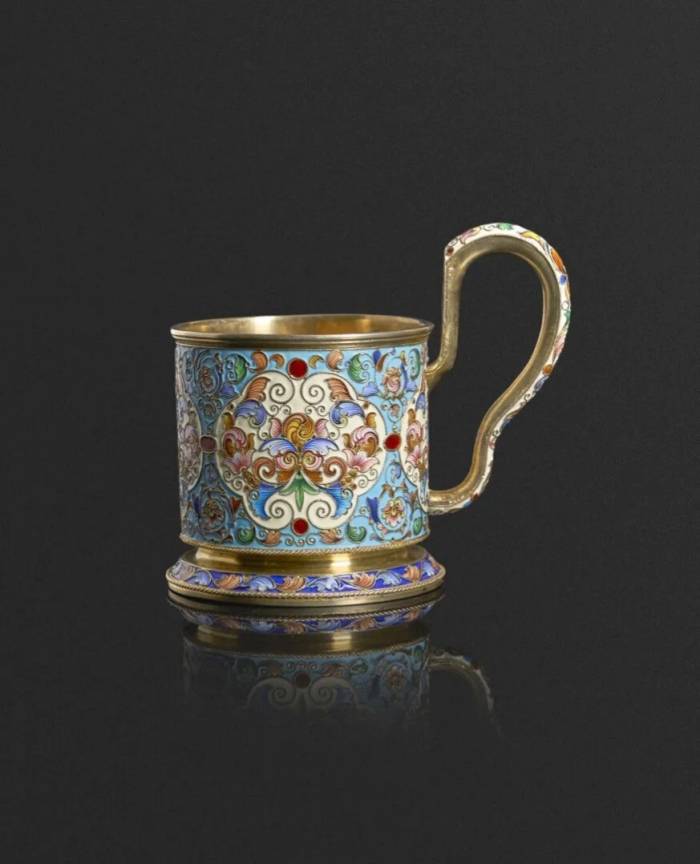
An exquisite silver tea glass holder executed in the cloisonné enamel technique, representing a characteristic and highly accomplished example of the Moscow workshop of Fyodor Ruckert and standing as a benchmark of Russian jewellery art at the turn of the 19th and 20th centuries. The cylindrical body is adorned with a complex polychrome composition of polylobed medallions featuring stylised geometric and foliate motifs on a cream ground, punctuated by translucent red enamel accents. The decoration is further enriched by elegant scrolling flowers and foliage on a sky-blue enamelled background, creating a dense and rhythmically balanced ornamental surface.
The stepped foot is decorated with a band of polychrome cloisonné enamel forming a foliate frieze on a cobalt-blue ground, enhancing the architectural clarity and completeness of the form. The handle, of complex polylobed profile, is fully enamelled in cloisonné and executed en suite with the body. The interior is gilded, in accordance with the highest aesthetic and practical standards of Moscow silver workshops of the period.
Marks: Maker’s mark “FR” in a rectangular cartouche, the mark of the workshop of Fyodor Ruckert; State assay mark of the Moscow Assay District depicting a female head in kokoshnik facing left, within an oval cartouche, with the fineness mark “88” (zolotnik standard), assay mark type used between 1899 and 1908.
Dimensions: Height – 10 cm; Diameter – 7.5 cm.
Weight: 196 g (gross).
Condition: Good. Minor local losses and small areas of enamel damage consistent with age and use. Gilding to the interior with even and natural wear. No deformation.
Provenance: European private collection.
Fyodor Ruckert occupies a distinguished position in the history of Russian jewellery art of the late 19th and early 20th centuries as one of the most prominent representatives of the Moscow school of cloisonné enamel. His workshop became an important centre of artistic production, where ancient Russian ornamental traditions and Byzantine-inspired motifs were reinterpreted within the aesthetic framework of late Historicism and the emerging Art Nouveau. Ruckert’s works are characterised by the richness of their decorative language, the complexity of their compositions and the exceptional quality of their technical execution, securing a special status among Moscow silversmiths of the period.
Of particular significance in Ruckert’s artistic career was his collaboration with the firm of Carl Fabergé. At the turn of the century, Ruckert supplied enamelled objects and decorative components to Fabergé, whose firm relied on his mastery of cloisonné enamel for the creation of high-quality works intended for both the domestic market and for imperial and aristocratic commissions. In certain instances, objects produced by Ruckert’s workshop were stamped with Fabergé marks, reflecting the recognition of his workshop as a trusted and highly skilled partner of one of the leading jewellery houses of the Russian Empire.
At the turn of the 19th and 20th centuries, the tea glass holder evolved from a purely utilitarian object of tea service into an independent work of decorative art, reflecting the taste, social standing and cultural identity of its owner. Moscow enamelled tea glass holders of this period were often regarded as ceremonial objects intended for formal entertaining and representational use. In the works of Fyodor Ruckert, particular attention was paid to chromatic harmony, precision and clarity of the cloisonné wires, and meticulous execution of even the smallest ornamental details.
Today, objects from Fyodor Ruckert’s workshop are represented in museum collections and important private holdings and regularly appear in the catalogues of leading international auctions, where they are regarded as canonical examples of Russian enamel art from the turn of the 19th and 20th centuries. The present tea glass holder is a characteristic example of the master’s mature period, demonstrating a synthesis of decorative richness, technical refinement and clarity of artistic form.
Minor local losses and hairline cracks to the enamel, primarily along the edges of the ornament. Gilding to the interior shows natural wear. Structurally stable, with no evidence of restoration. Overall condition consistent with a high-quality museum-level object.
The condition report is provided for informational purposes only.
It is not comprehensive and may not reflect all defects, restorations, alterations, or adaptations, as Antiqon does not perform professional conservation-level assessments. The information is based on a qualified, yet subjective, evaluation by our specialists.Before purchasing, we recommend consultation with an independent expert.Please also consult our Terms and conditions and Glossary A-Z, which contain important information on lot characteristics and sale conditions.