


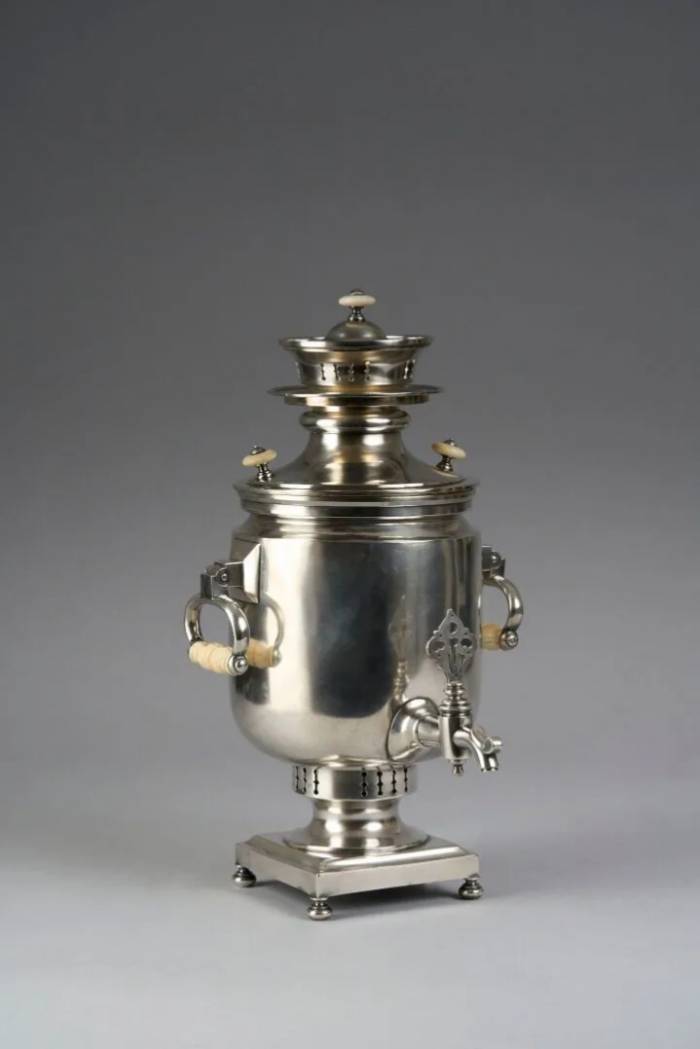
SILVER SAMOVAR. JOHAN OLSONIUS RUSSIA, SAINT PETERSBURG, THIRD QUARTER OF THE 19TH CENTURY
AntiqonART consultant will contact you within one business day after receiving your request.
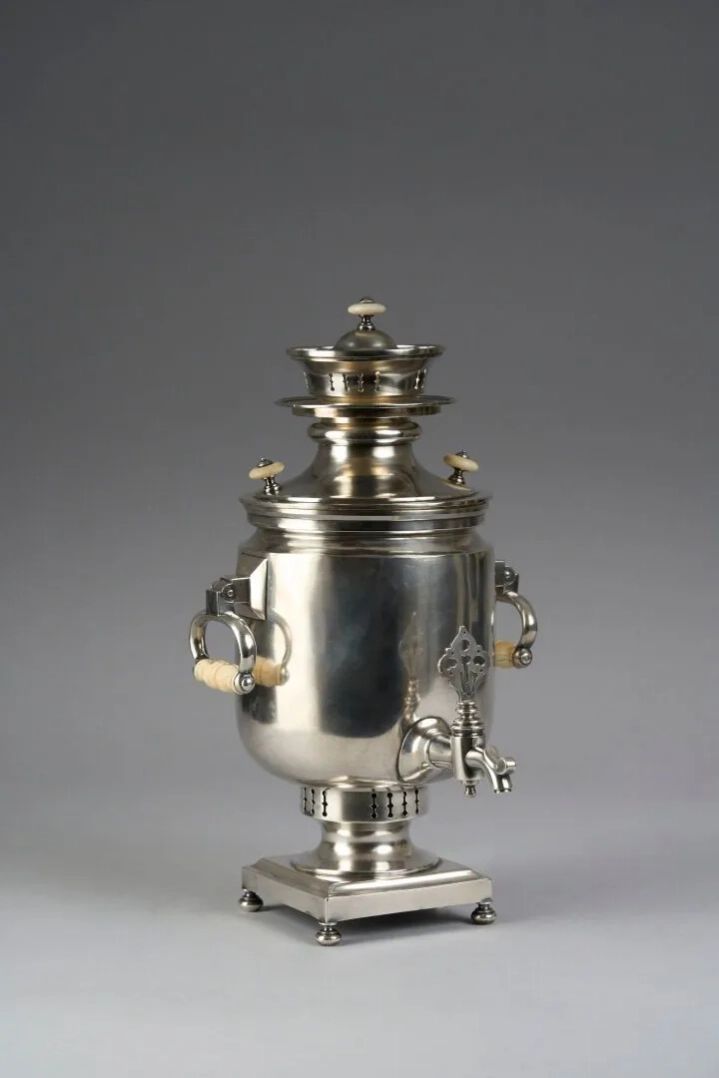
A cylindrical silver samovar executed in the third quarter of the 19th century by Johan Olsonius, one of the key masters of the Grachev Brothers firm, Purveyors to the Russian Imperial Court. The piece displays the defining characteristics of the Saint Petersburg artistic silversmithing school: strict proportions, architectural clarity of silhouette, and a high level of craftsmanship. The body is distinguished by its well-balanced plasticity of form, reflecting the metropolitan taste and academic traditions of the second half of the 19th century. The tap is adorned with an openwork lanceolate plate with finely pierced decoration, enhancing the decorative expressiveness of the object. The side handles are fitted with turned ivory inserts, creating a noble contrast of materials and reinforcing the refined visual composition. The samovar rests on four flattened ball feet, typical of works produced by the Grachev Brothers firm during this period. The interior of the vessel retains traces of original gilding.
Marks: Maker’s mark “J.O.” – Johan Olsonius; Imperial Russian assay mark with fineness “84”; Saint Petersburg city assay mark.
Dimensions: Height: 38.5 cm; Length: 20 cm; Diameter: 23 cm.
Weight: Gross weight: 2322 g.
Condition: Good.
Provenance: Private European collection.
The samovar occupies a central place in the history of 19th-century Russian decorative arts, serving not only as a functional household object but also as a symbol of social status, hospitality, and tea culture. In Saint Petersburg, the capital of the Russian Empire, silver samovars were primarily intended for ceremonial interiors and formal receptions, where they functioned as prestigious objects underscoring the owner’s position.
The Grachev Brothers firm ranked among the most prominent Saint Petersburg silver houses of the second half of the 19th century and held the title of Purveyor to the Russian Imperial Court. The firm’s production was distinguished by high-quality metal, impeccable technical execution, and a restrained yet architecturally refined approach to form. In contrast to the more ornate tendencies of Moscow workshops, the Saint Petersburg school favored academic rigor, clarity of silhouette, and harmonious proportions.
Johan Olsonius, active for the Grachev Brothers between 1842 and 1882, is regarded as one of the firm’s leading masters. His works are characterized by precision of execution, attention to detail, and a high level of artisanal culture. Samovars produced in his workshop successfully combined functionality with artistic refinement and were often commissioned by affluent clients, including members of the upper echelons of society.
The use of ivory for the handles reflects the aesthetic preferences of the period and the desire to combine noble materials. Such samovars were perceived as ceremonial interior objects and were frequently passed down through generations, becoming part of family collections. The present example stands as a representative and expressive testimony to the flourishing of Saint Petersburg silver production and tea culture in the second half of the 19th century.
Silver with an even patina and traces of natural wear consistent with age. Hallmarks are clear and well preserved. The structure is stable. Decorative elements are intact. Overall condition is good.
The condition report is provided for informational purposes only.
It is not comprehensive and may not reflect all defects, restorations, alterations, or adaptations, as Antiqon does not perform professional conservation-level assessments. The information is based on a qualified, yet subjective, evaluation by our specialists.Before purchasing, we recommend consultation with an independent expert.Please also consult our Terms and conditions and Glossary A-Z, which contain important information on lot characteristics and sale conditions.