


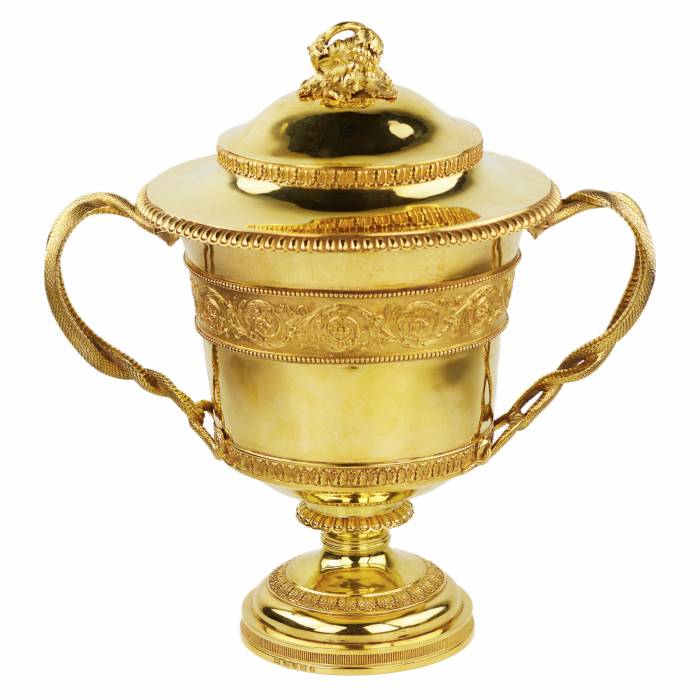
COVERED NEOCLASSICAL CUP. ROBERT GARRARD II & EDWARD BURROWS. ENGLAND, FIRST THIRD OF THE 19TH CENTURY
AntiqonART consultant will contact you within one business day after receiving your request.
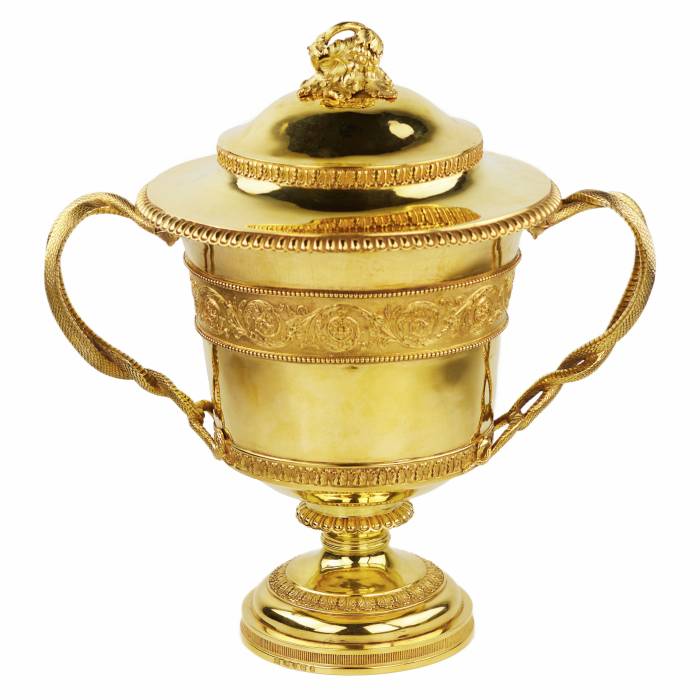
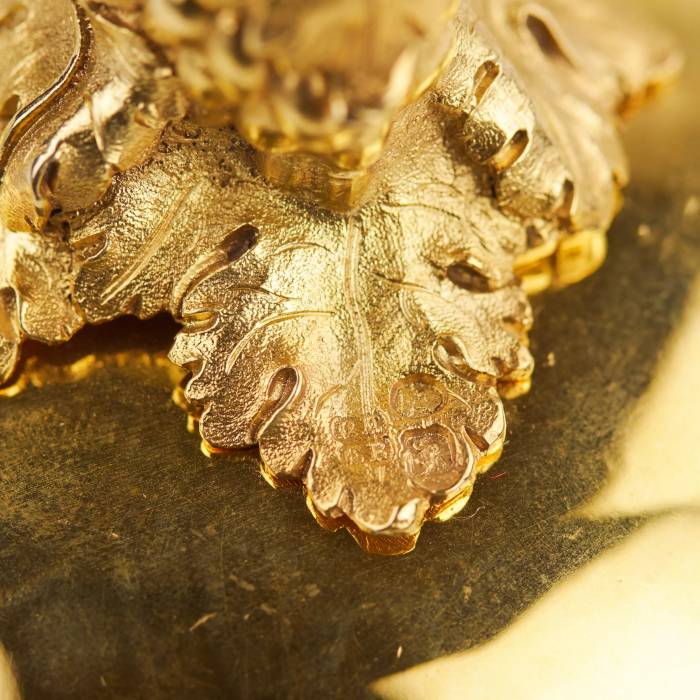
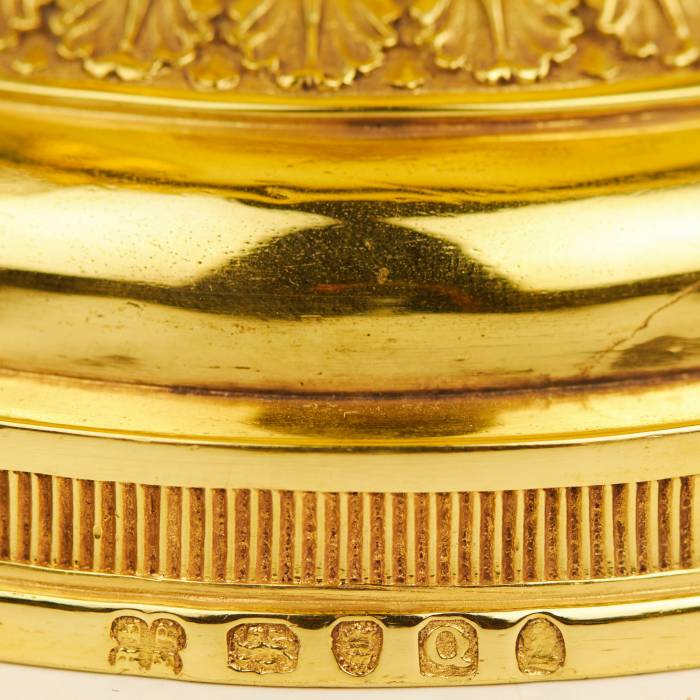
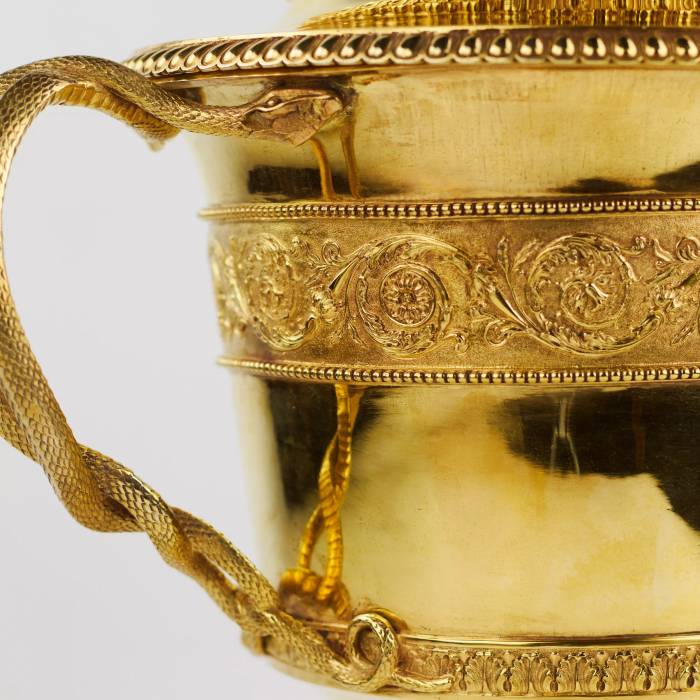
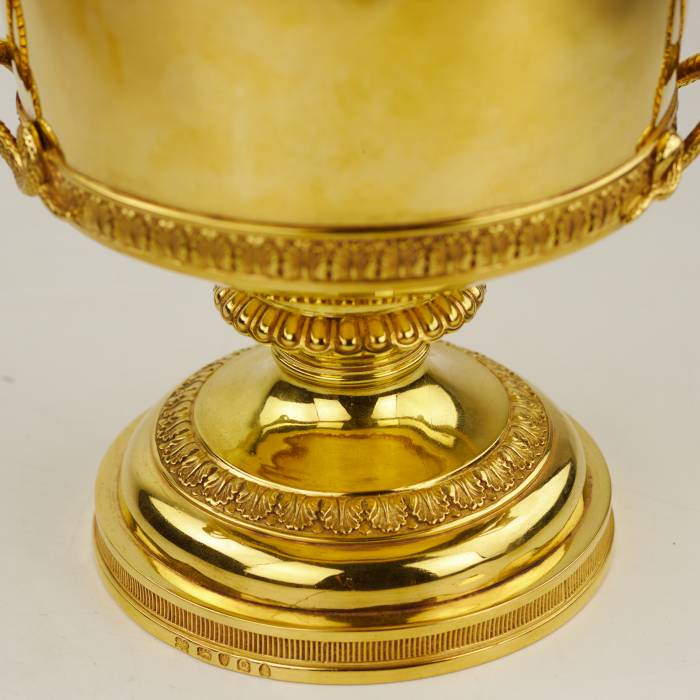
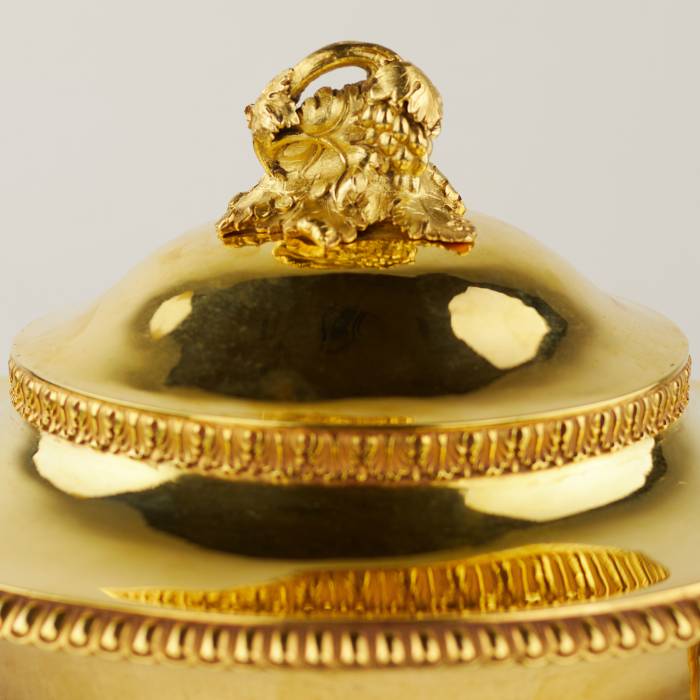
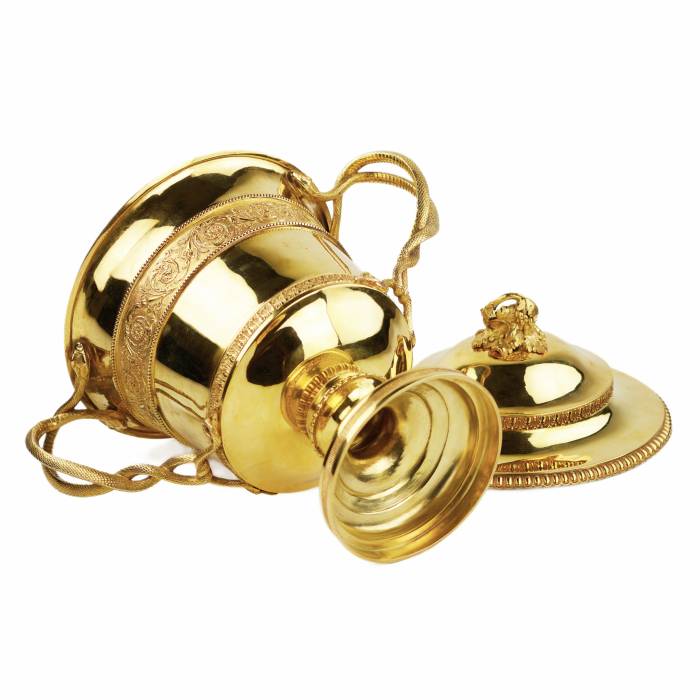
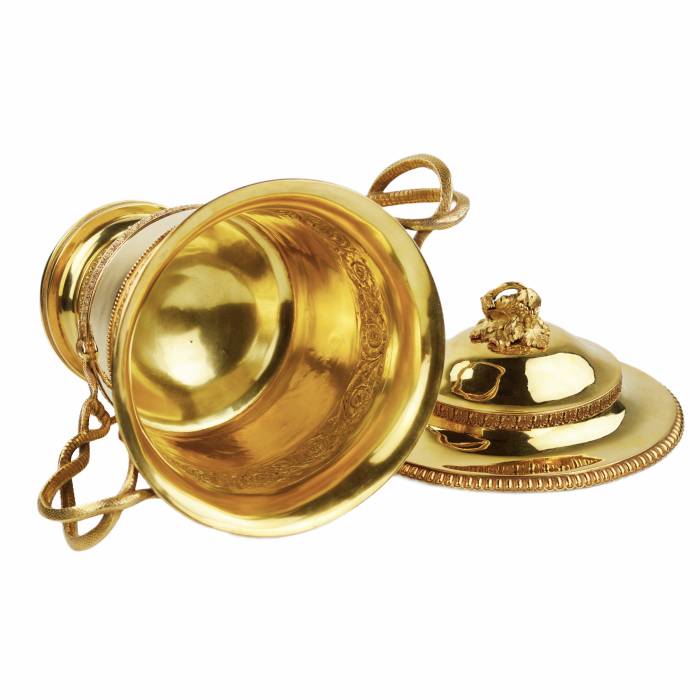
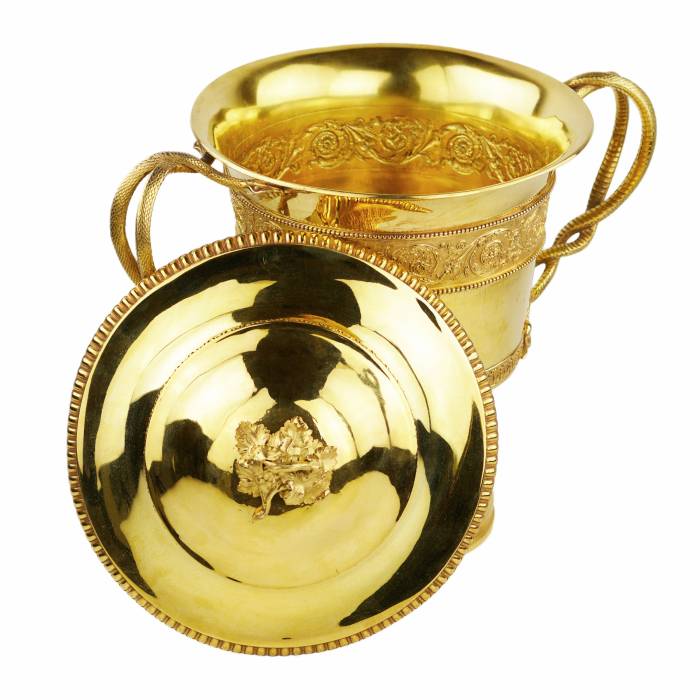
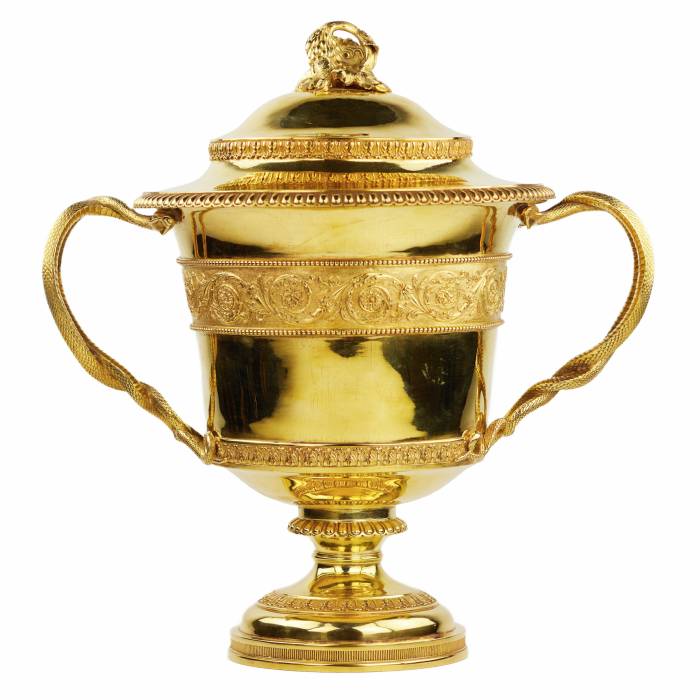
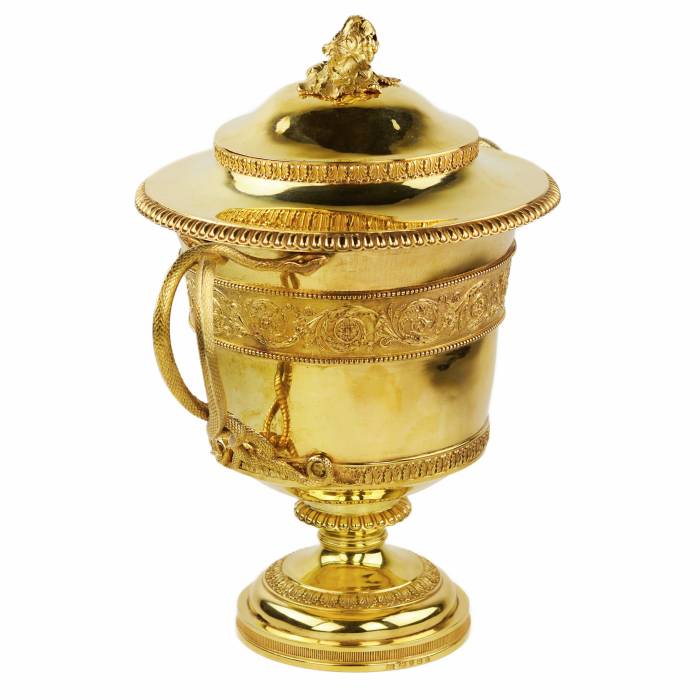
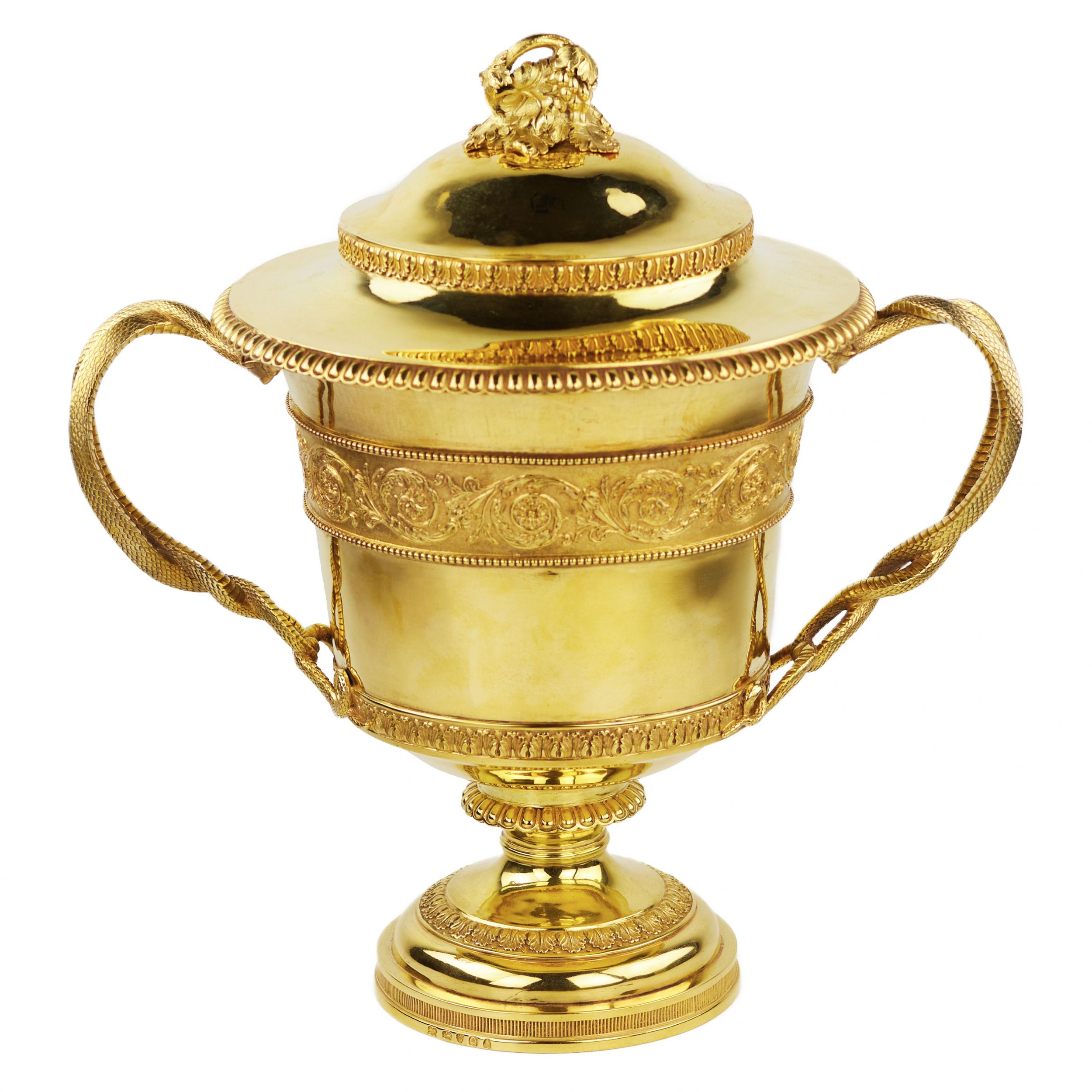
An impressive two-handled lidded cup crafted in parcel-gilt silver (vermeil) in the neoclassical style. The Medici-shaped body is richly adorned with a frieze of rinceaux, palmettes, and acanthus leaves, complemented by a beaded border and finely engraved motifs. The serpentine handles dramatically encircle the body, and the lid is crowned with a sculptural leafy finial. Each detail reflects the refined craftsmanship of the Georgian period. The piece stands on a fluted and profiled pedestal base with acanthus ornamentation. The hallmarks confirm its London origin, sterling standard, and authorship by the renowned workshop of Robert Garrard II in partnership with Edward Burrows.
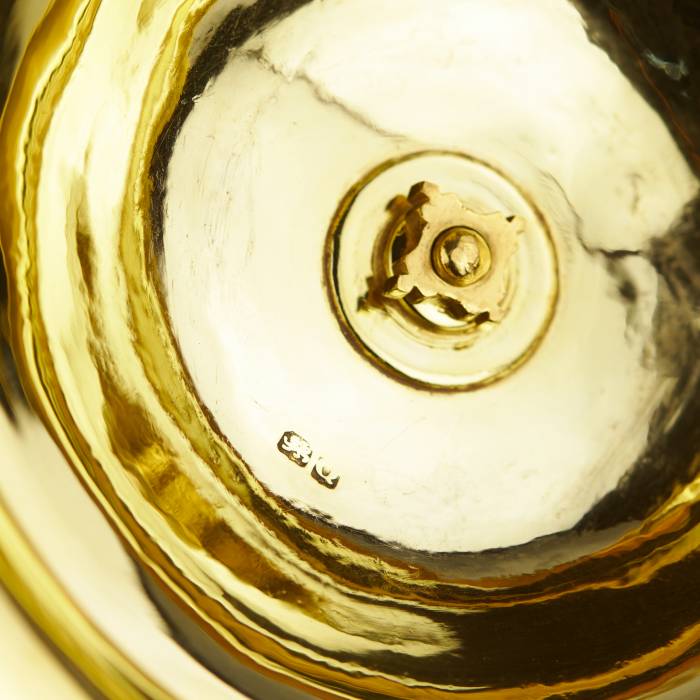
Marks: A quatrefoil cartouche bearing the initials RE / EB — the registered mark of Robert Garrard II & Edward Burrows, used during the 1820s. This mark represents the early phase of the illustrious Garrard house, later appointed as official Crown Jeweller. Additional marks: the leopard’s head — the hallmark of the city of London, in use since the 13th century; the date letter “O” (in an oval) — corresponding to the year 1829; lion passant — the standard mark for sterling silver (925), mandatory in England since the 13th century; and the monarch’s profile — the duty mark indicating silver tax paid during the reign of George IV or William IV.
Dimensions: Height: 35 cm. Width (handle to handle): 33,5 cm.
Weight: 2.520 kg
Condition: Excellent condition, with deep gilding, crisp marks, and no restorations. Museum quality preservation.
Provenance: From a private collection, Monaco.
The first third of the 19th century in British applied arts was marked by the flourishing of neoclassicism — a style inspired by the aesthetics of antiquity, emphasizing symmetry, noble lines, and architectural harmony. During the reign of George IV, there was a pronounced fascination with Greco-Roman forms, including Medici cups, which became icons of aristocratic taste and cultural refinement.
Within this context, the workshop of Robert Garrard II, who took over the family firm in 1818, played a defining role. His collaboration with Edward Burrows led to the creation of the dual hallmark RE / EB, recorded by the London Assay Office in the 1820s. This era marked the foundational phase of the Garrard legacy. By the 1830s, Garrard was among the leading London silversmiths, and in 1843, Queen Victoria officially appointed the firm as Crown Jeweller, responsible for maintaining, creating, and restoring the regalia of the British monarchy.
In the decades that followed, Garrard produced some of the most important ceremonial objects in British history, including the restoration of St. Edward’s Crown, the coronation regalia for Edward VII, and the Imperial State Crown set with the famed Cullinan I diamond. Yet, it is the pre-1830 works — such as this cup — that are the rarest and most sought-after among collectors, as they embody the formative design language of Garrard in the age of classical revival.
This cup exemplifies that early style: a monumental Medici form, serpent handles evoking wisdom and eternity, and ornamentation steeped in classical symbolism. Such pieces were not only centerpieces of aristocratic banquets but were often presented as diplomatic gifts, trophies, or nuptial offerings.
Pieces bearing the Garrard & Burrows hallmark from this era are exceedingly rare on the market and are primarily found in prestigious institutions, including the Victoria and Albert Museum, The Royal Collection Trust, and the British Museum. Their value lies not only in technical mastery but also in their place at the origin of one of Britain’s most celebrated and enduring royal jewellers.
Outstanding condition. Deep gilding, clearly struck marks, and pristine surfaces. No restorations. A museum-grade example of early 19th-century British silver.
The condition report is provided for informational purposes only.
It is not comprehensive and may not reflect all defects, restorations, alterations, or adaptations, as Antiqon does not perform professional conservation-level assessments. The information is based on a qualified, yet subjective, evaluation by our specialists.Before purchasing, we recommend consultation with an independent expert.Please also consult our Terms and conditions and Glossary A-Z, which contain important information on lot characteristics and sale conditions.