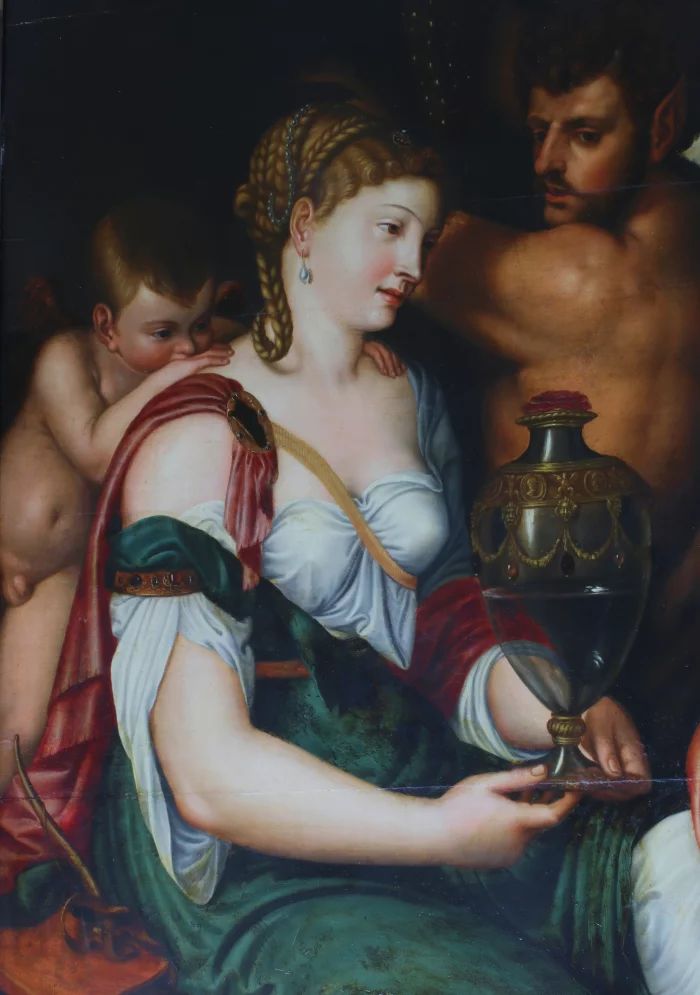
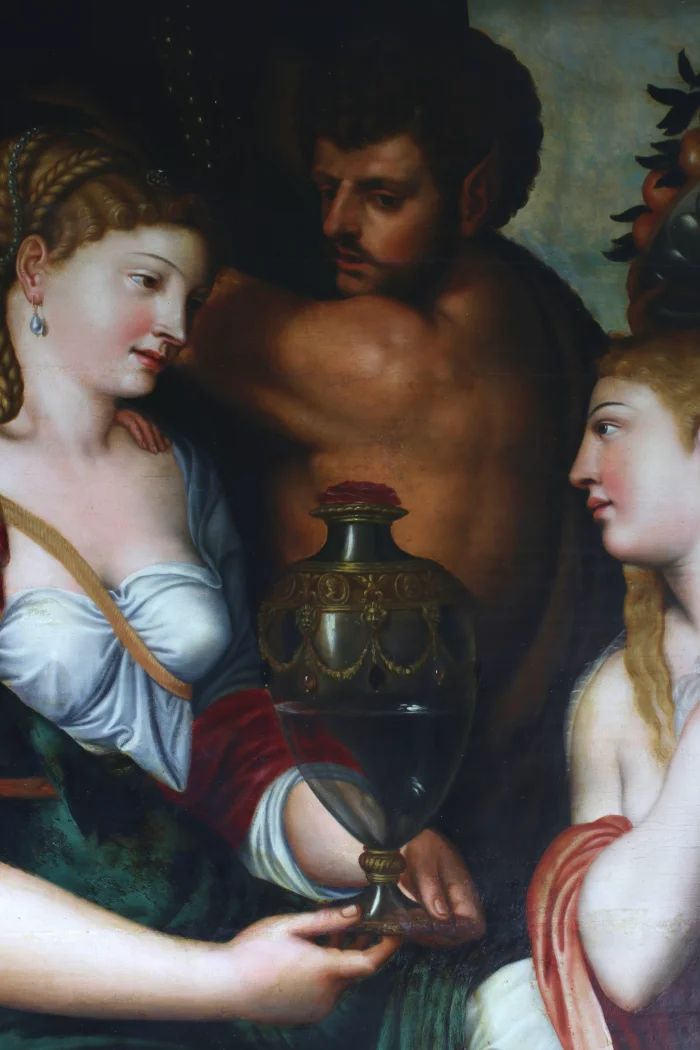
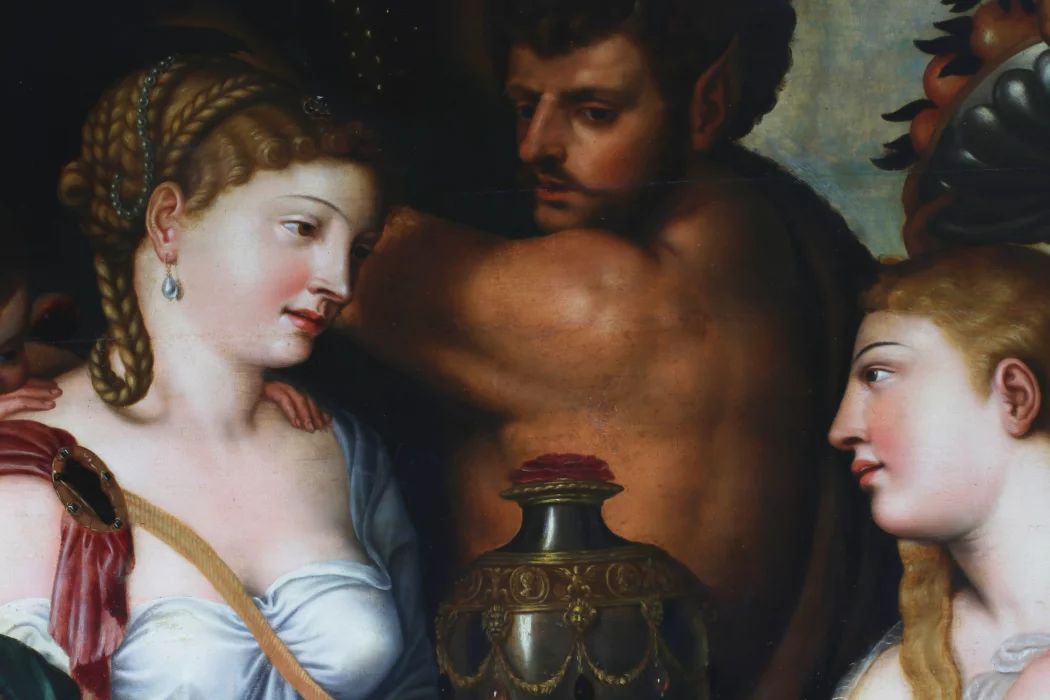
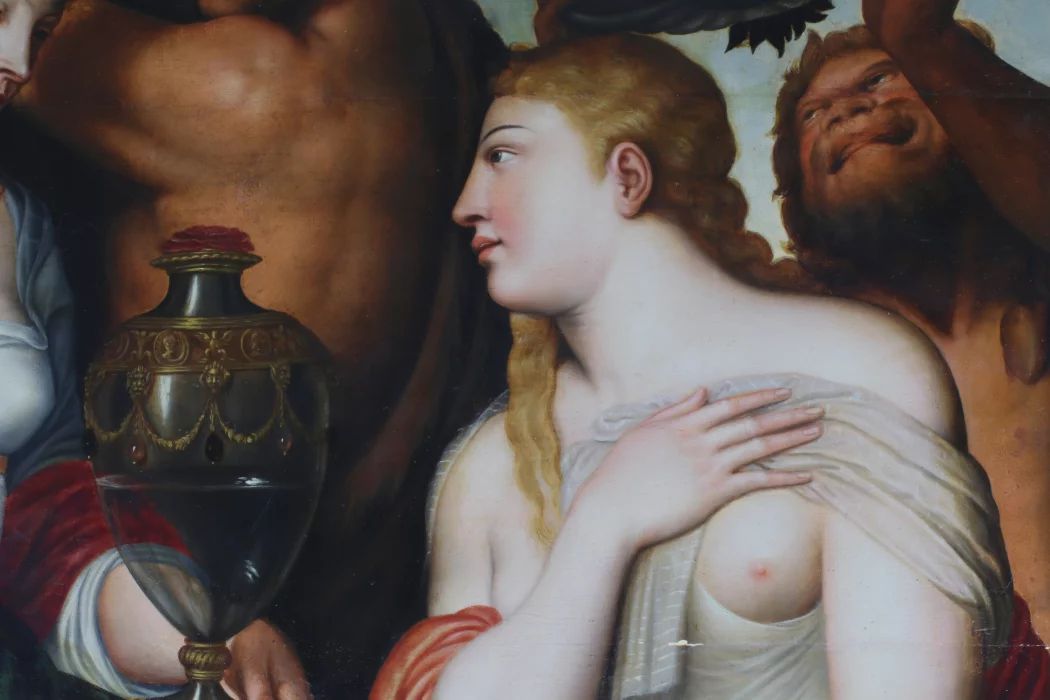
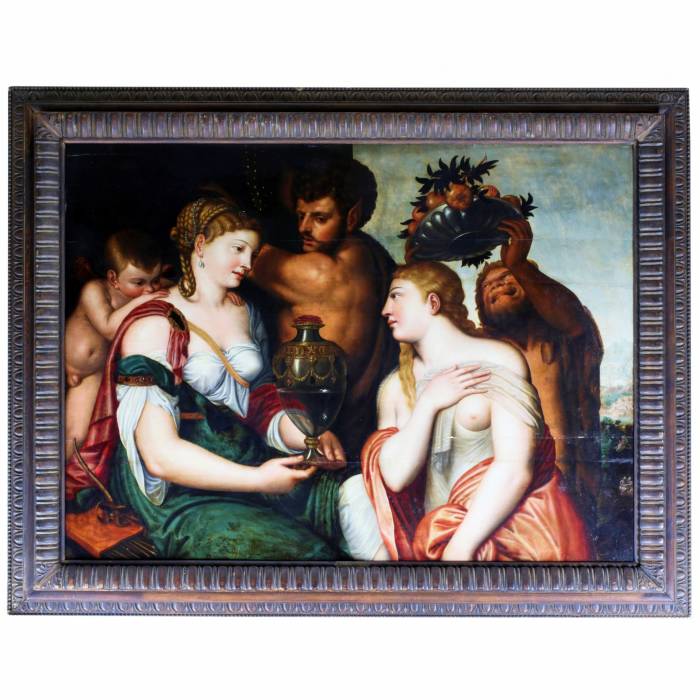
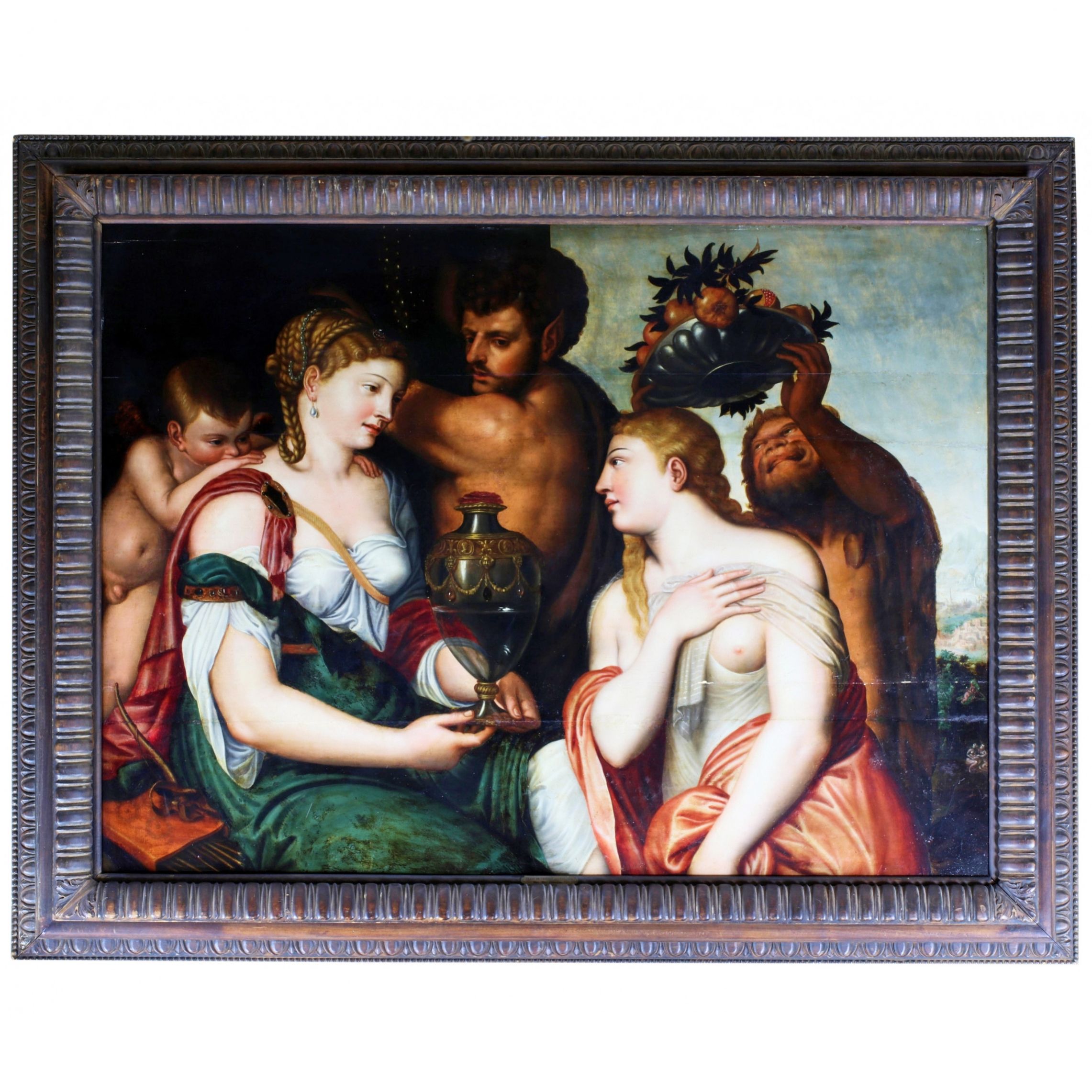
A monumental Flemish oil on panel, The Cup of Ceres, is an outstanding example of the synthesis between Italian Renaissance and Northern Mannerism. Based on Terence’s classical maxim Sine Cerere et Libero friget Venus (“Without Ceres and Bacchus, Venus freezes”), the composition is arranged as a triangular grouping of figures. At its centre stands a transparent vase crowned with a rose, symbolising the spirit of love and life. To the left, a woman in antique drapery accompanied by Cupid; to the right, the nude Venus with her hand upon her chest. Behind them rises a faun, and in the background a bearded servant carries a basket of fruit.
According to Dr Ernst Wengenmayer (Munich, 7 December 1962), this work is an autonomous version of a composition similar to the painting in the Alte Pinakothek (cat. no. 484), acquired in 1792 by Elector Carl Theodor and attributed to the workshop of Titian. The expert notes that this version was painted by Frans Floris shortly after his return from Italy (post-1540) and features several authorial differences: a mountainous background with figurative Bacchic scenes, a rose-topped urn, and the bearded servant bearing fruit.
Dimensions: Height: 111 cm, Width: 149 cm
Material: Oil on panel
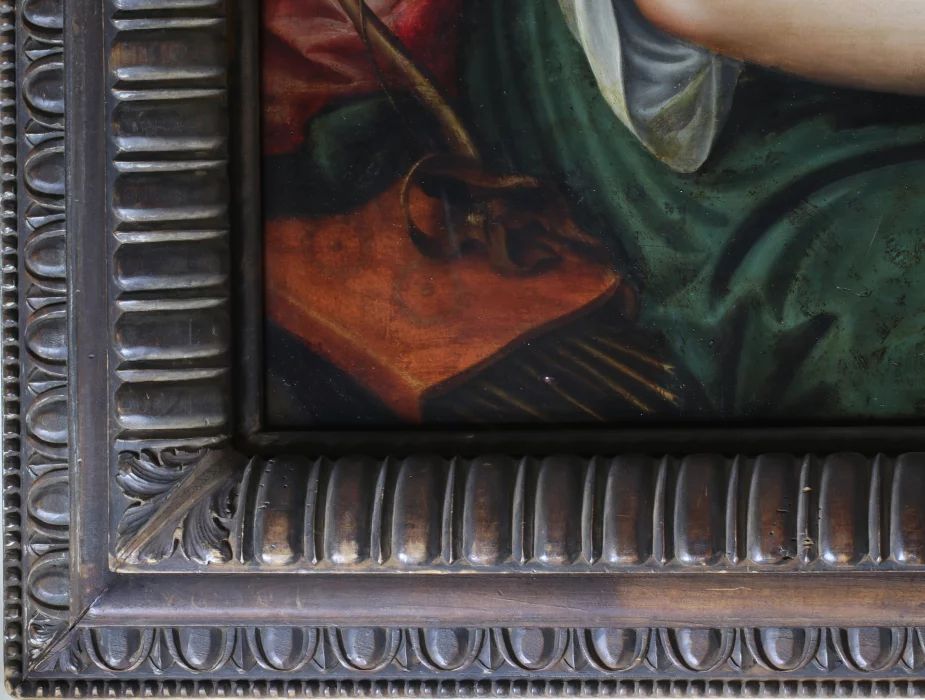
Condition: Early signs of restoration, minor paint losses, early structural reinforcement of the panel (cradling). Overall, very good condition for its age. Presented in an old carved frame.
Provenance: Private European collection. Acquired at Schloss Alden, Germany.
Expertise: Dr Ernst Wengenmayer, Munich, 7 December 1962, attribution to Frans Floris de Vriendt.
Frans Floris de Vriendt (c. 1517–1570) was a central figure in mid-16th-century Flemish painting, a pioneer of Northern Mannerism. Trained under Lambert Lombard and having travelled to Italy, Floris absorbed the lessons of Michelangelo, Raphael, and Titian, blending the harmony and plasticity of the Italian Renaissance with Netherlandish traditions. Upon his return to Antwerp around 1540, he produced works adapting Venetian painting to Northern tastes.
The theme “Sine Cerere et Libero friget Venus” was popular in Renaissance humanist culture, expressing the interdependence of love, fertility, and life’s pleasures. Ceres (goddess of agriculture) and Liber (Roman Bacchus) symbolise the material and spiritual nourishment that sustains love, embodied by Venus.
As noted by Dr Wengenmayer in his 1962 expertise, this painting is an original reinterpretation of a composition once attributed to Titian’s workshop. Unlike the Italian model, Floris includes distinctly Northern elements: a precisely rendered mountainous landscape, elaborate drapery and accessories, sculptural modelling of figures, and emphasised symbolism of the central vessel. Such works adorned the residences of the elite, serving as both aesthetic treasures and intellectual emblems of status.
Panel in good condition with early cradling, stable paint layer, minor localised paint losses. Early restorations do not compromise the integrity of the work. Housed in an old carved frame.
The condition report is provided for informational purposes only.
It is not comprehensive and may not reflect all defects, restorations, alterations, or adaptations, as Antiqon does not perform professional conservation-level assessments. The information is based on a qualified, yet subjective, evaluation by our specialists.Before purchasing, we recommend consultation with an independent expert.Please also consult our Terms and conditions and Glossary A-Z, which contain important information on lot characteristics and sale conditions.